Get Full Government Meeting Transcripts, Videos, & Alerts Forever!
Get email alerts on the Clean Energy Finance topic
No spam. Unsubscribe anytime.
Committee hears proposal to create revolving clean energy loan fund; nuclear eligibility draws opposition
Summary
Senate Bill 52,08 would authorize the Department of Commerce to offer loans for clean-energy projects from a new Clean Energy Fund account, using Climate Commitment Account funds subject to appropriation; proponents framed it as a revolving loan vehicle modeled on public works financing, while opponents urged removing advanced nuclear and small
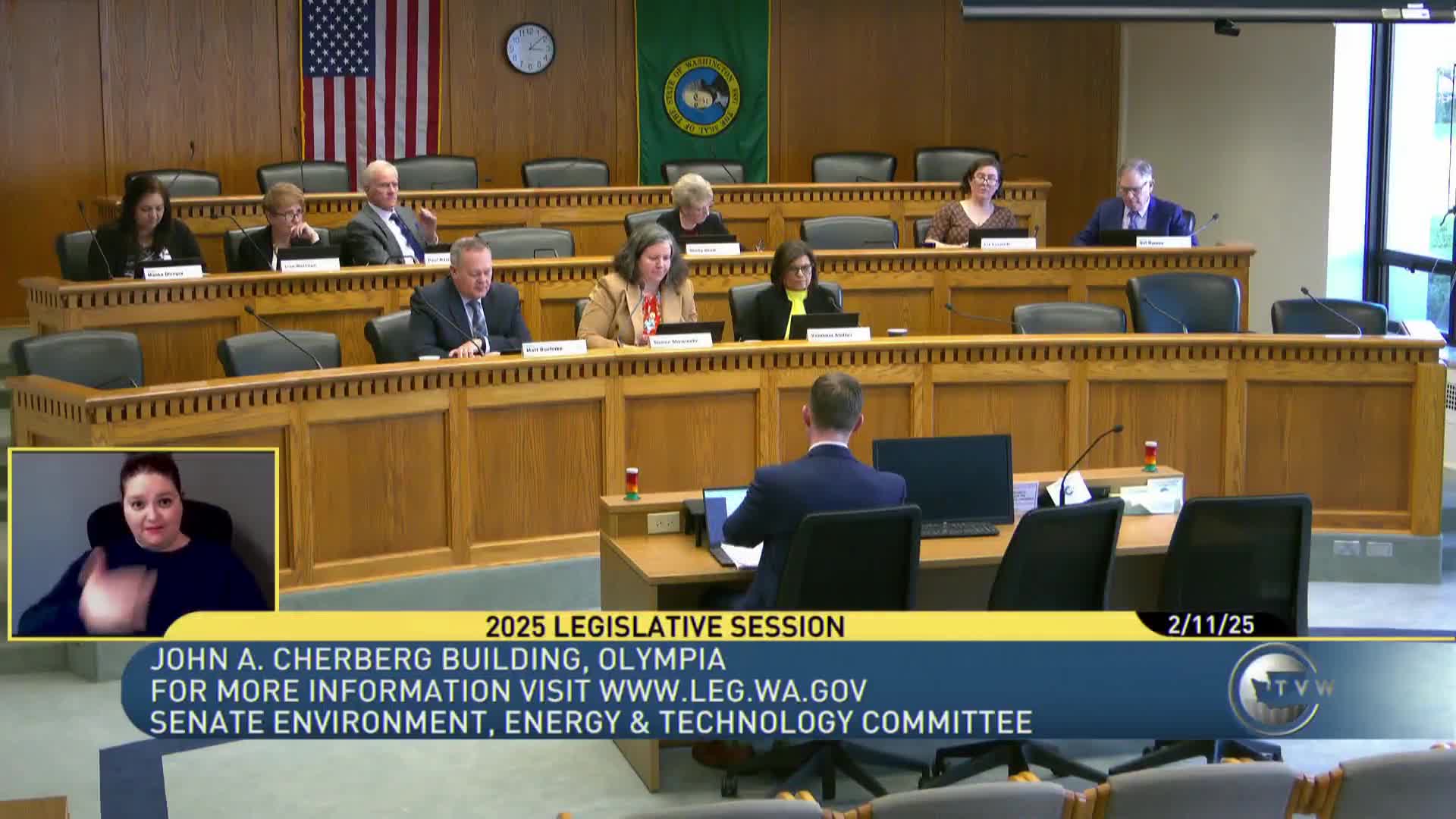
The Senate Environment, Energy & Technology Committee heard Senate Bill 52,08, a proposed substitute to authorize the Department of Commerce — subject to appropriation — to offer loans to aid specified clean-energy projects and to create a Clean Energy Fund account. Staff described the account as intended to make loans for projects including zero-emission vehicle acquisition and charging infrastructure, site evaluations for generation or transmission, installation of solar, wind, geothermal or hydrogen equipment, and—controversially—development of advanced nuclear reactor technology.
Committee staff told members the Clean Energy Fund (CEF) has existed in prior capital budgets and that most recently $60,000,000 was appropriated for CEF competitive grants in the 2325 capital budget. The proposed substitute would create a revolving-loan account and allow Commerce to offer reduced or capped interest rates for public entities and require private-entity loans to be priced at no less than the U.S. prime rate plus 2 percent. The bill would impose due-diligence, disclosure and ethics checks on recipients and permit Commerce to cancel loans and pursue remedies if requirements are violated. Staff described a partial fiscal note showing non-zero but indeterminate impacts because appropriation amounts are uncertain.
Sponsor testimony described the proposal as modeled on the state Public Works Trust Fund to create a revolving vehicle that stretches public dollars and expedites projects to meet the state’s Climate Commitment Account objectives. Senator McEwen said, “think of this similar to how we have the Public Works Trust Fund,” and framed the loan vehicle as a way to move projects — public and private — to market more quickly.
Witnesses were sharply divided on eligibility language. Supporters, including Clean and Prosperous Washington, urged innovative finance tools to crowd in private capital and listed potential loan products such as credit enhancements and interest-rate buy-downs. Opponents, including Sierra Club and local environmental and community groups, urged removing advanced nuclear and small modular reactors (SMRs) from the list of eligible technologies. Speakers argued SMRs are unproven, likely more expensive than renewables plus storage, and would divert scarce public funds from faster, lower-cost clean-energy options; King County and Hanford-specific concerns were raised by community groups.
Other concerns included constitutional limits on lending public credit and the appropriate interest-rate floor for private loans; Senator Wellman questioned whether prime-plus-2 percent would be attractive to private borrowers. Staff and sponsor said budget-writers would decide appropriations and that the prime-plus-2 provision was intended to avoid a forbidden gift of public funds. No vote occurred; the committee received substantial written comment (staff recorded 85 signers who did not testify, 53 pro and 32 con) and testimony closed with requests to amend or narrow eligibility language before advancing the proposal.