Get Full Government Meeting Transcripts, Videos, & Alerts Forever!
Get email alerts on the Lead In Cookware topic
No spam. Unsubscribe anytime.
Committee weighs fixes to lead-in-cookware law amid testing, enforcement disputes
Summary
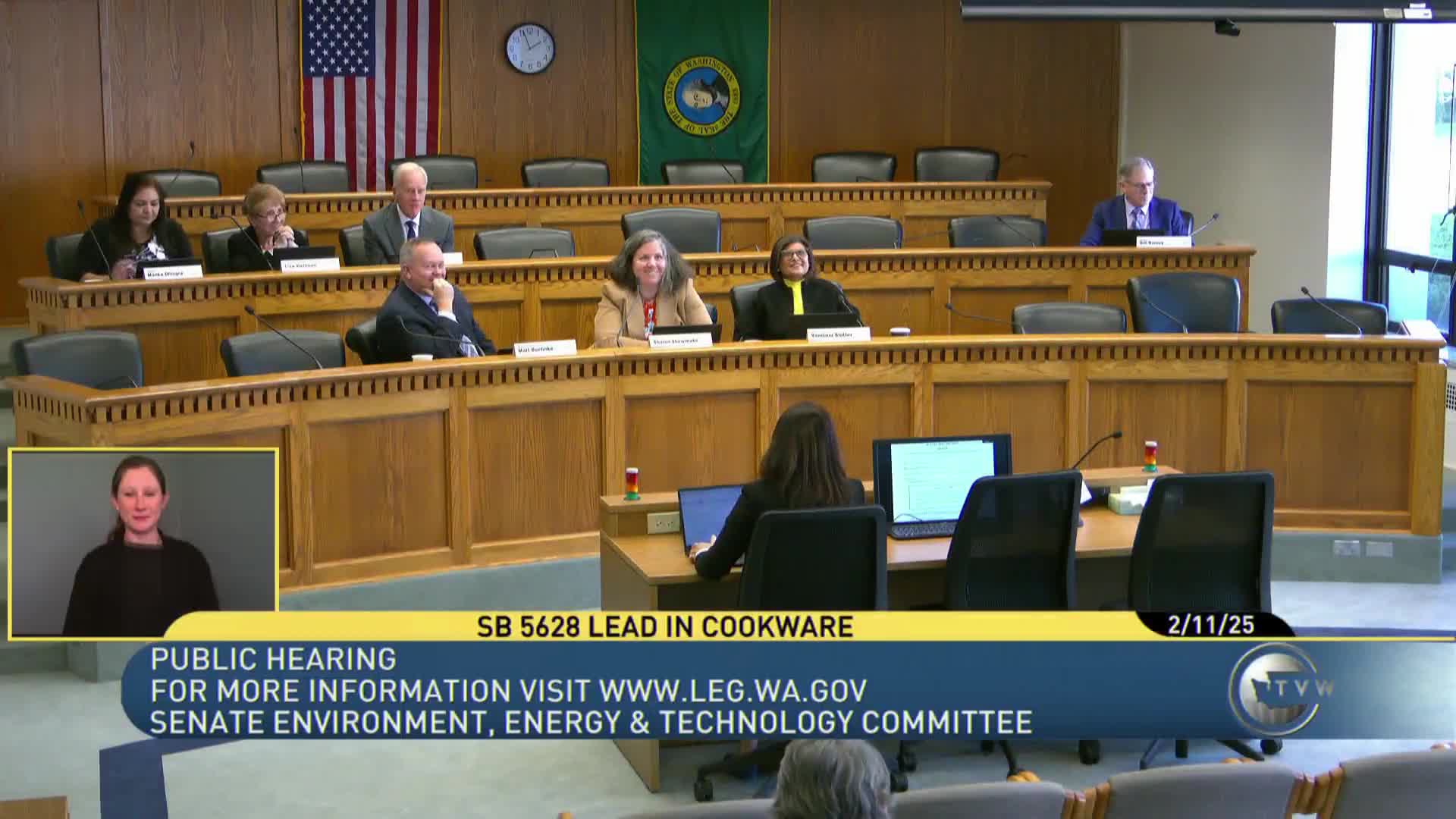
The Senate Environment, Energy & Technology Committee heard testimony on Senate Bill 5,628, which would refine Washington’s law restricting lead in cookware and cookware components by clarifying covered parts and exemptions.
The Senate Environment, Energy & Technology Committee heard testimony on Senate Bill 5,628, a proposed substitute that would refine last year’s restrictions on lead in cookware and cookware components. Alicia Kinney Clausen, committee staff, briefed members on the bill’s key changes: a 5 parts-per-million (ppm) limit for lead and lead compounds remains, but the bill narrows covered components to include utensils, griddles and other cooktop surfaces that contact food, excludes inaccessible components and large appliances, and provides manufacturers protections from liability for unknowingly selling restricted products.
Stakeholders urged further changes. Kevin Messner and Charlie Brown from industry groups said the statute’s current content-based 5 ppm standard could unintentionally ban widely used metal cookware because total content does not necessarily predict how much lead enters food during cooking. Brown told the committee that “lead truly is ubiquitous in the environment” and said many aluminum products test above trace levels; Kevin Messner said testing should focus on how much lead “leaches into the food that you eat” and recommended migration (leachate) testing that simulates food contact.
Health and county officials said content limits were necessary and warned that the substitute would weaken public protections. Monica Ayres of King County Hazardous Waste testified that local public-health investigators found elevated blood lead in recently resettled Afghan children and identified traditional aluminum pressure-cooker cookware as a source; her unit’s tests found cookware with “alarmingly high levels of lead that could leach into food.” Reza Pedram of the Afghan Health Initiative described a cookware-exchange program that removed contaminated pans from more than 100 families.
Department of Ecology told the committee it supports clarifying language in a proposed substitute to avoid regulatory overreach that could include refrigerators and inaccessible interior components; Ecology said the substitute could avoid the need for rulemaking. Staff noted a fiscal impact to Ecology of about $360,000 tied to Model Toxics Control Act implementation.
Industry and standards groups urged use of leachability tests and harmonization with NSF and FDA approaches. Several witnesses described two common laboratory approaches: X-ray fluorescence (XRF) content screening that gives spot measurements of lead content and a migration/leachate test using acetic or citric acid at cooking temperatures to measure lead that actually transfers to food; proponents of migration testing said it measures exposure in parts per billion and aligns with food-safety standards used for restaurants and schools.
Committee members asked whether other states regulate similarly; witnesses said Minnesota has a 90 ppm law and that Washington’s 5 ppm standard is among the strictest. Several witnesses asked the Legislature to continue the conversation and consider a substitute that narrows covered items and establishes clear testing and enforcement protocols. No final action or vote was taken; Ecology and several stakeholders said they were working on substitute language and requested further committee engagement.