Get Full Government Meeting Transcripts, Videos, & Alerts Forever!
Get email alerts on the Administrative Separation Education Boards topic
No spam. Unsubscribe anytime.
Committee reviews bill to let small education boards arrange independent administrative services separate from OSPI
Summary
House Bill 16 62 would remove statutory provisions requiring several small education boards and commissions to reside administratively within OSPI and require them to procure independent administrative services; agency directors testified about hiring, contracting and financial transparency issues.
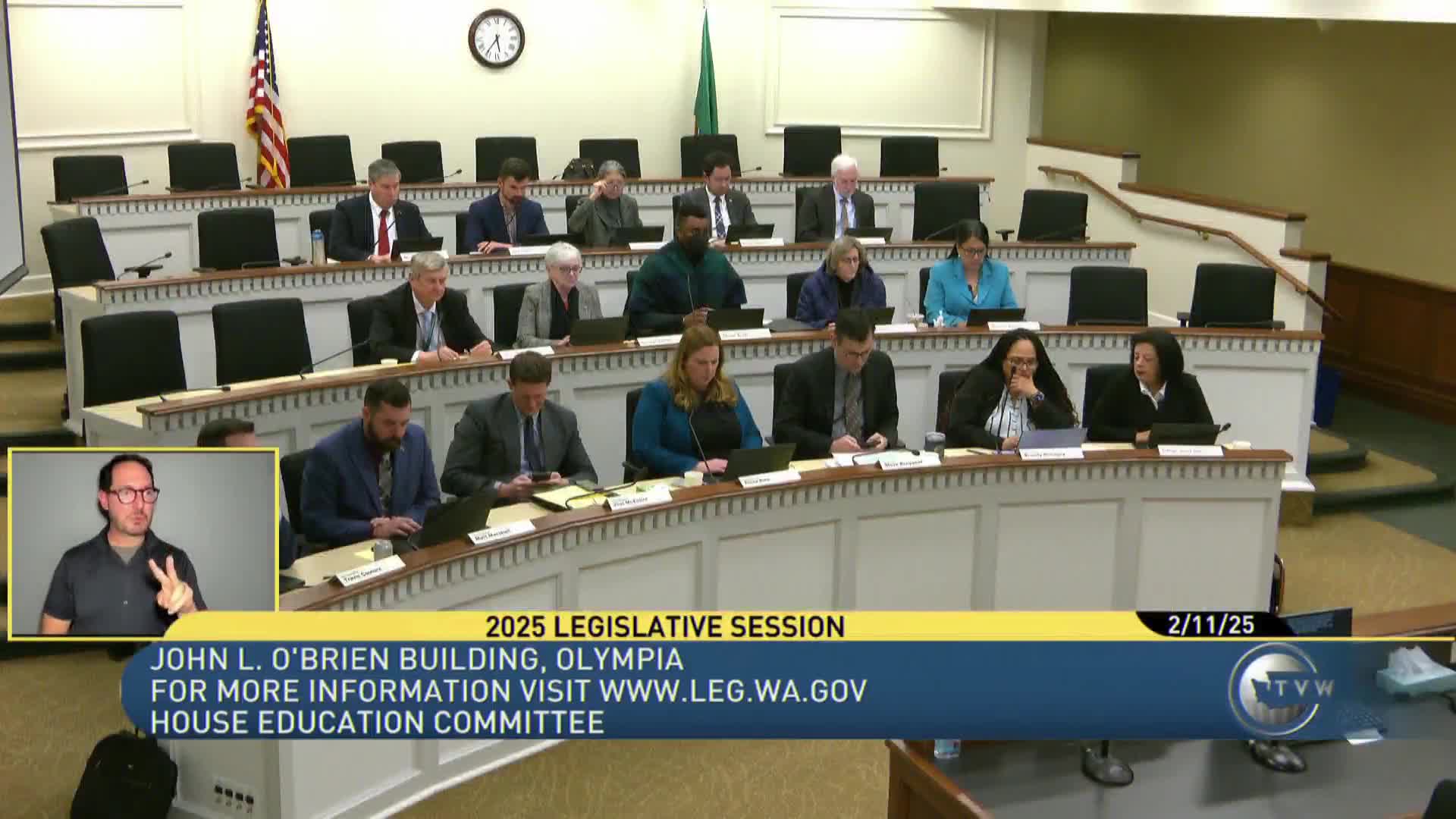
Nonpartisan staff briefed the House Education Committee on House Bill 16 62, legislation that would require the State Board of Education, the Professional Educator Standards Board (PESB), the Financial Education Public Private Partnership (FEP), and the Washington State Charter School Commission to make independent provision for their administrative services instead of being administratively housed within the Office of Superintendent of Public Instruction (OSPI).
Ethan Moreno, nonpartisan staff to the committee, told members that although each entity is governed by separate statutes, they currently rely on OSPI for human resources, payroll, technology, facilities, purchasing and budget support. The bill would remove provisions that require those entities to reside within OSPI for administrative purposes effective July 1 and direct the Office of Financial Management to coordinate transition supports such as establishing accounts and agreements for state administrative services. OSPI would continue providing administrative services through the close of the 2025–26 fiscal year to allow transitions to proceed, Moreno said.
The bill also requires that records, contracts and files held by OSPI on behalf of the listed entities be transferred to the applicable entity by July 1, 2026; employees assigned to those entities at OSPI would be transferred to the applicable entity, subject to appropriate review; and existing contracts executed by OSPI on behalf of an entity would remain in force and be performed by the applicable entity.
Agency leaders and witnesses described operational costs and delays they said stem from being administratively housed inside a much larger agency. Randy Spalding, executive director of the State Board of Education, said small agencies need flexibility in travel, procurement and hiring and that separation could allow them to use small‑agency services and streamline processes. Dr. Erica Hernandez Scott, executive director of the Professional Educator Standards Board, told the committee that administrative approvals at OSPI had delayed a paraeducator learning platform launch and that more than 3,000 paraeducator candidates paid over $280,000 in alternative assessment fees while that launch was postponed.
Tracy Godat, executive director of the Financial Education Public Private Partnership, told the committee boards and commissions pay an indirect fee to OSPI—she estimated about 13%—but that agencies had limited visibility into how funds were allocated and sometimes faced transitions to more expensive platforms without agency input. Marcus Harden, executive director of the Washington State Charter School Commission, said hiring delays and multiple layers of approval place small agencies at a competitive disadvantage when recruiting and retaining staff.
Supportive public testimony included John Axtell, a student advocate, who endorsed independent administration and described the change as an efficiency and accountability improvement. Several agency leaders said they were not taking a policy position on the bill but detailed operational challenges the bill is intended to address.
Committee members asked clarifying questions about whether the bill would change the agencies’ statutory missions (it would not) and about transition costs and timelines. Staff said a fiscal note had been requested but not yet received. The committee closed the public hearing on the bill and adjourned the evening’s session.