Get Full Government Meeting Transcripts, Videos, & Alerts Forever!
Get email alerts on the Criminal Justice Sentencing topic
No spam. Unsubscribe anytime.
Committee hears bill to let courts consider survivors' abuse histories at sentencing
Summary
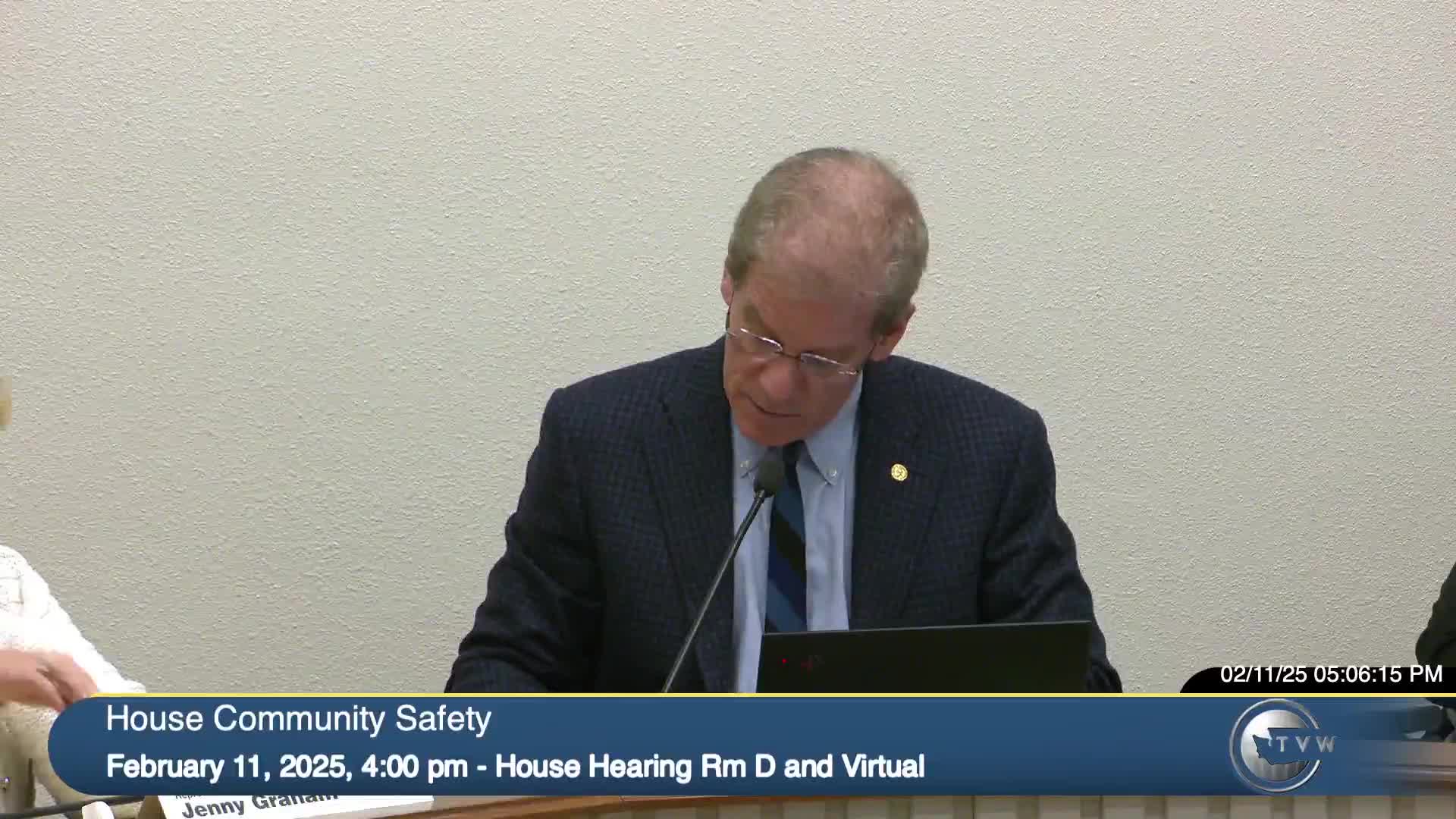
House Bill 1591, the Survivors Justice Act, received testimony proposing that courts be allowed to consider a defendant's history of domestic violence, sexual assault or human trafficking when determining sentence or eligibility for resentencing if that abuse was a significant factor in the offending.
House Bill 1591, the Survivors Justice Act, received testimony proposing that courts be allowed to consider a defendant's history of domestic violence, sexual assault or human trafficking when determining sentence or eligibility for resentencing if that abuse was a significant factor in the offending.
The bill’s supporters said the change would allow courts to recognize how trauma and coercion shape behavior and to provide targeted sentencing alternatives. Prosecutors’ groups and law-enforcement representatives urged narrower language and limits to prevent misuse and to preserve victims’ voices.
David Martin, who supervises the domestic violence unit in the King County Prosecutor’s Office, testified in support and described the problem this way: "I've seen first hand how trauma shapes decisions, limits options, and traps people in cycles of abuse." Martin said his office’s Survivors First diversion program, run in partnership with the YWCA, has identified and diverted people whose offending was linked to ongoing victimization. "In the Survivors First program ... we diverted, I wanna say, 240 cases last year," Martin said, adding that the state’s caseload forecast showed only one downward exceptional sentence in 2024 for crimes committed under duress, coercion or compulsion.
Martin and several advocacy groups told the committee the bill is intentionally narrow: survivors would carry the burden to show abuse was a significant factor, and courts would retain discretion to deny relief. "This bill simply extends that recognition to survivors of abuse," Martin said. "Courts retain full discretion to deny relief when it isn't warranted."
Advocates said the proposed law would align sentencing with decades of Washington law that recognizes victim trauma. Leigh Hoffheimer of the Washington State Coalition Against Domestic Violence told the committee the bill "provides critical relief for survivors" and argued judicial discretion, coupled with diversion and community-based services, reduces recidivism.
Supporters with legal aid and survivor-advocacy groups echoed that position. Elizabeth Hendren of the Violence Law Center said intimate partner violence and trafficking have been well documented as drivers of incarceration for women and girls, and called the bill a "needed remedy." Cindy Arons Ellsbury, a resentencing resource attorney with the Washington Defender Association, urged refining the bill to remove an unexplained eight-year sentence threshold and to broaden acceptable evidence—she recommended adding assessments or evaluations by licensed trauma-informed clinicians for people without police reports or formal records.
Speakers for prosecutors and law enforcement raised practical and legal concerns. Russell Brown, executive director of the Washington Association of Prosecuting Attorneys, said the bill’s resentencing provisions would join several other bills seeking resentencing and that the system currently lacks capacity: "We do not have enough prosecutors. We do not have enough defense attorneys. There is not the capacity to do this." Brown also pointed to existing mitigating-factor provisions in state law (citing RCW 9.94A.535 subsections) and said the bill’s current language is broader than those provisions, lacks structured limits on reuse, and omits a required role for victims in the process.
James McMahon, policy director for the Association of Sheriffs and Police Chiefs, said he supports considering victimization at sentencing "appropriately," but asked the committee to clarify limits — for example, excluding premeditated crimes against children or other categories he described as "nonstarters." McMahon said some of his membership supported mandatory controls like clearer limits, while others worried the bill as drafted swept too broadly.
Witnesses who support the bill acknowledged those concerns and asked the committee for technical fixes: narrower enumerated exclusions, clearer evidentiary standards for resentencing, and treatment or release conditions modeled on other sentencing alternatives. Cindy Arons Ellsbury recommended replacing certain risk or chemical-dependency assessments with trauma-informed clinical evaluations tailored to determine support needs and reduce future risk.
Committee chair Representative Goodman closed public testimony by noting the bill will require drafting changes and follow-up work. The committee recorded no vote during the hearing; members said they would return for executive action to refine the language.
The hearing combined policy, procedural and evidentiary questions: supporters framed the bill as a targeted recognition of trauma and a judicial tool, while law-enforcement and prosecution representatives asked for more precise limits and procedural safeguards to protect victims and preserve prosecutorial and sentencing balance.
No formal action or vote on HB 1591 was recorded during the hearing; committee members said they plan to continue refining the bill ahead of executive action.