Get Full Government Meeting Transcripts, Videos, & Alerts Forever!
Get email alerts on the Early Literacy Structured Literacy topic
No spam. Unsubscribe anytime.
House committee hears bill to require structured literacy, tighten third‑grade promotion rules
Summary
House Bill 1832 would require school districts to implement structured literacy for kindergarten through fourth grade, set training and certification timelines for educators, and tighten third‑grade promotion criteria; testimony at a House Education Committee hearing split on retention, incentive pay and implementation details.
A House Education Committee hearing reviewed House Bill 1832, a proposal to require school districts to implement a statewide structured literacy program for kindergarten through fourth grade and to change third‑grade promotion rules.
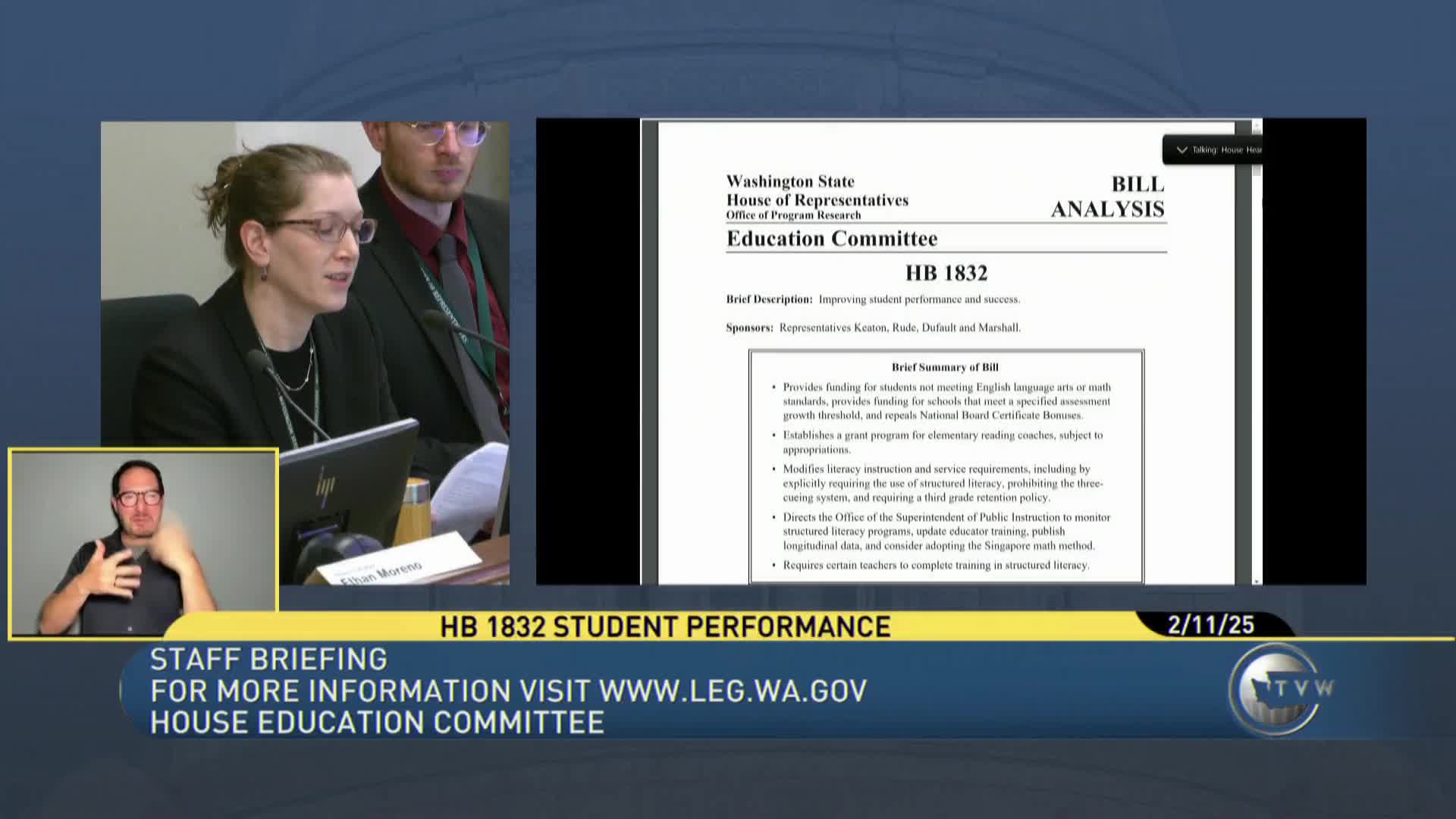
Committee staff described the bill’s core requirements: districts, charter schools and education compact schools must implement a structured literacy program using evidence‑based instructional practices by the start of the 2027–28 school year; annual screening assessments must identify at‑risk readers; and family engagement strategies are required. The Office of Superintendent of Public Instruction (OSPI) and the State Board of Education are directed to monitor implementation, the Professional Educator Standards Board (PESB) must adopt revised teacher standards, and teacher preparation programs must incorporate the new standards by the 2027–28 academic year.
The bill also requires OSPI, within available resources and in consultation with experts, to develop and post an educator training program and refresher course on implementing structured literacy. Staff said annual counts of individuals completing the training must be reported to the Legislature, and beginning September 2027 interventions for students below grade‑level must be provided by educators who have completed the structured literacy training. Mentors of some beginning educators and pre‑service teachers must also complete the program. To renew certificates after Sept. 1, 2028, teachers with endorsements or assignments related to reading or writing literacy must have completed the training.
On promotion policy, staff summarized that starting Sept. 1, 2027, third‑grade students must meet one of three criteria to be promoted to fourth grade: meet grade‑level standards on the state English language arts assessment, pass an alternative assessment, or demonstrate sufficient third‑grade reading skills through a portfolio of student work. Staff said districts must implement an intensive reading improvement strategy for retained students and that those interventions must be delivered by educators trained in structured literacy. The bill also directs OSPI to compare state math standards to the Singapore Mathematics model and report to the Legislature by December 2025 with a recommendation on adopting that approach. A fiscal note has been requested, staff said.
Representative Michael Keaton (Assistant Ranking Member), the bill’s prime sponsor, framed the proposal as an effort to reverse recent declines in early reading outcomes and described local results after two years of structured literacy work in his district. “We’ve already seen a big decrease in remedial support requirements,” Keaton said, adding that he wants to incentivize professional development and classroom impact for educators.
Supporters who testified included Dr. Vicki Murray, director of the Center for Education at the Washington Policy Center, who called the bill an “important step” toward academic rigor and cited Mississippi’s policy changes in 2011 as an example of measurable gains after similar reforms. Rhonda Litzenberger, a 17‑year school board director, supported professional development and said incentives can aid retention of effective teachers. Several other parents, teachers and private citizens testified in support and urged stronger emphasis on knowledge‑rich instruction and on aligning assessment with taught content.
Officials who registered concerns included Jenny Plaja of the Office of Superintendent of Public Instruction, who said OSPI shared the bill’s goals but raised questions about some strategies, the timeline and using National Board certification bonus funds as the bill’s financing mechanism. Plaja warned that redirecting those bonuses could affect retention of experienced educators in high‑poverty schools. Naswe Nishida of the Washington Education Association said the union broadly agreed on the intent of improving literacy but urged caution on grade retention, citing research that retention can increase long‑term disparities and that alternatives such as early learning and targeted interventions may be preferable.
Committee members questioned the bill’s proposed incentive structure. One lawmaker asked why the bill would allocate smaller per‑pupil amounts for students not meeting standards and larger bonuses for meeting standards; Keaton said the intent was to incentivize teacher professional development and reward measurable improvement, and to ensure funds reach classrooms rather than administrative overhead.
Public commenters and experts flagged several implementation questions that the committee did not resolve at the hearing: how the training will be resourced across districts, how districts serving higher‑need student populations will be supported, how alternative assessments and portfolios will be defined, and whether redirecting National Board bonuses is appropriate. The Office of Superintendent of Public Instruction, the Professional Educator Standards Board and other education stakeholders were identified by staff as agencies responsible for implementation steps in statute.
The committee closed the public hearing after staff and witnesses completed testimony; staff recorded sign‑in counts for the record.