Get Full Government Meeting Transcripts, Videos, & Alerts Forever!
Get email alerts on the Grid Transmission Reconductoring topic
No spam. Unsubscribe anytime.
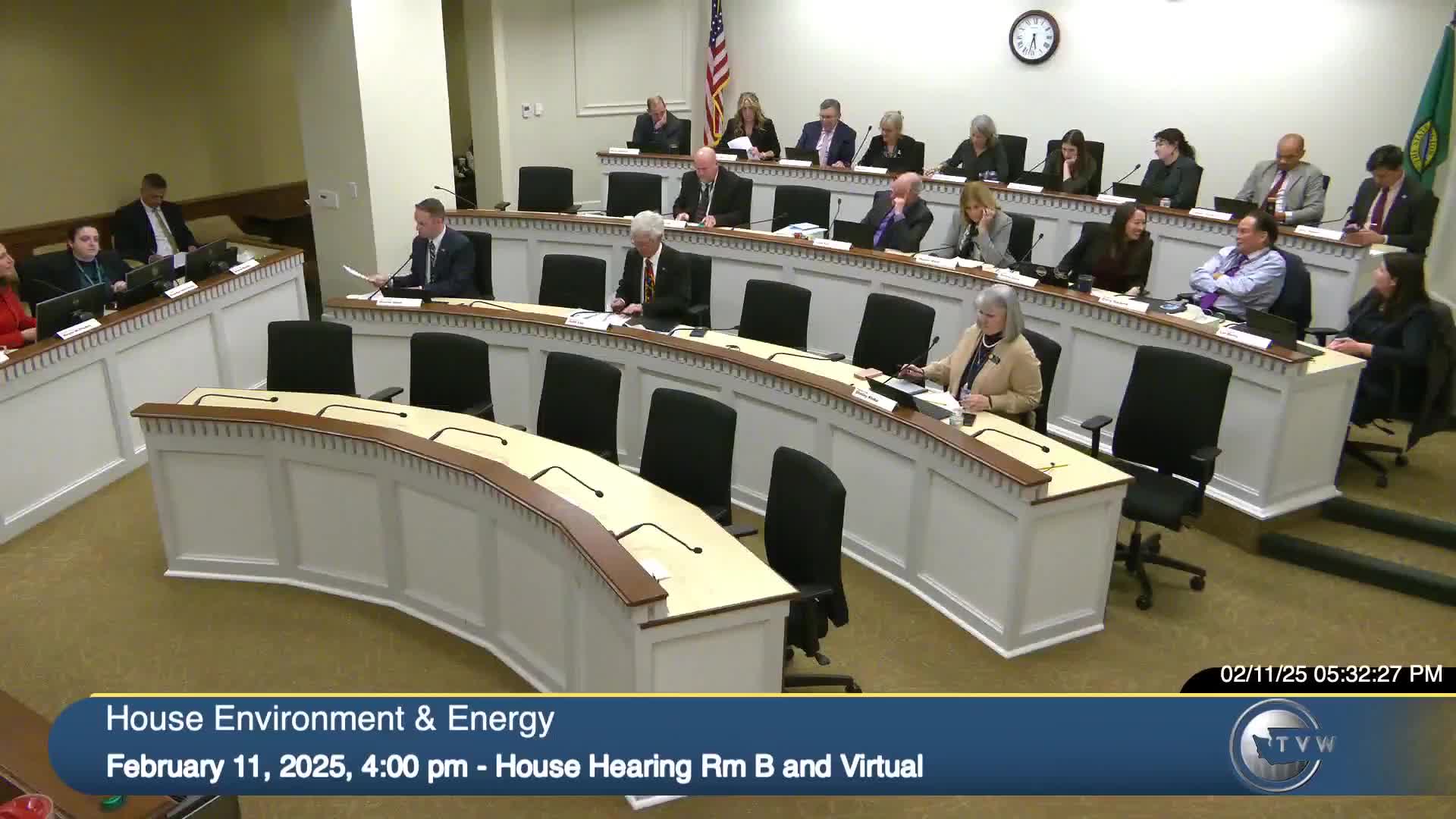
Committee holds hearing on HB 1819 to encourage reconductoring and speed permitting for transmission upgrades
Summary
House Bill 1819, proposing reconductoring of existing transmission lines with advanced conductors and a narrow SEPA exemption, received a public hearing and broad stakeholder comment before the House Environment & Energy Committee.
House Bill 1819, introduced to address transmission congestion and increase capacity on existing corridors, received a public hearing before the House Environment & Energy Committee.
Representative Ed Barnard, the bill sponsor, told the committee the measure would (1) require utilities to assess where advanced conductors could increase capacity, (2) create a narrow SEPA categorical exemption for reconductoring projects within existing rights-of-way, and (3) authorize an up-to-2% additional rate of return for utilities that invest in reconductoring new projects. "We need more power on our grid," Representative Barnard said. "This bill does three things to help get more power down existing transmission lines."
Megan McFadden, committee staff, summarized the bill's key provisions, including a UTC reporting requirement before 02/1930 on the use of incentives and an exemption for reconductoring within existing disturbed rights-of-way.
Testimony included utilities, trades and environmental groups. Nicholas Garcia of the Washington Public Utility District Association said reconductoring can help address overuse of existing transmission and supported the bill. Jason Hudson of IBEW Local 77 urged stronger specificity in the required transmission assessment and a clear definition of "reconductoring with advanced conductors," and supported including height in the categorical exemption. Maggie Douglas (Public Service Company/PSC) likewise supported the categorical exemption and suggested aligning with federal exemptions adopted in April 2024. Climate and clean-energy groups supported the bill's intent but asked for tribal consultation language and refinements to protect cultural and sensitive resources.
Opponents and commenters raised concerns about section 2's permissive 2% rate of return. Peter Godlowski (Association of Washington Business) and the Alliance of Western Energy Consumers urged removing or refining the incentive language, arguing it could shift costs to ratepayers; the Alliance provided committee members with an analysis estimating substantial rate impacts if investor-owned utilities undertook reconductoring at scale under a 2% add-on. Sponsor Barnard said she is open to stakeholder input, including possible alternatives such as construction-work-in-progress cost recovery.
Committee members asked technical questions about how changes in land use, archaeological finds or water-covered areas would interact with the proposed categorical exemption. Representative Klobach (committee member) raised concerns about changed conditions since original corridor approvals; the sponsor said the exemption is targeted to previously disturbed land and that she is willing to work with agencies to refine language.
No final committee vote occurred for HB 1819 during the hearing; the hearing record closed after testimony concluded.