Get Full Government Meeting Transcripts, Videos, & Alerts Forever!
Get email alerts on the State Legislation topic
No spam. Unsubscribe anytime.
City’s intergovernmental relations team briefs council on key state bills, two-week cutoff
Summary
Seattle’s Office of Intergovernmental Relations updated the City Council on the 2025 Washington legislative session, highlighting bills the city is tracking on housing, public safety, transportation, childcare and data-center impacts as the Feb. 21 policy committee cutoff approaches.
Seattle’s Office of Intergovernmental Relations (OIR) briefed the City Council on Feb. 10 on the status of the 2025 Washington legislative session and the city’s priorities, warning that the policy committee cutoff is two weeks away.
“We are now in week 5 of the 2025 legislative session, with only two more weeks until the February 21 policy committee cutoff,” said Mina Hashemi, director of the Office of Intergovernmental Relations, as she opened the briefing.
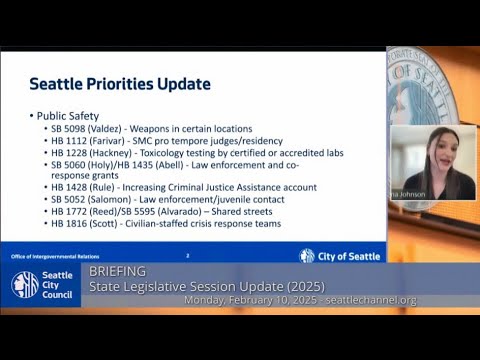
The update listed bills the city is tracking and where the city has “signed in” either in support or for informational purposes. Hashemi and OIR staff told the council the team has been registering positions, testifying and coordinating with sponsors on measures that could affect city services and residents.
Why it matters: the cutoff narrows the window for policy committee action on bills that could affect downtown and neighborhood development, housing conversions, public safety tools and state-level funding that flows to local programs.
Key items highlighted by OIR included:
- Executive Order 25-05: Gov. Jay Inslee’s executive order directing the Washington State Department of Revenue to convene a data center work group to evaluate the economic, tax, energy and environmental impacts of data centers. OIR said the group will recommend policies to address energy use and broader economic effects.
- Housing and adaptive reuse: Council Bill 120,937 (in committee) would create a sales-and-use tax deferral to incentivize converting underused commercial property to housing. OIR said the city continues to track that measure as part of its housing agenda.
- Civilian crisis response teams: OIR added House Bill 1816 to its public-safety tracker; that bill would permit civilian-staffed crisis response teams for cities of Seattle’s size. OIR said the city has planned testimony and will monitor the bill’s hearing schedule.
- Transportation and small-business displacement: House Bill 1733 would increase reimbursement caps for moving and relocation expenses for businesses impacted by major agency projects (the OIR briefing described it in the context of Sound Transit expansion and said the city supported the change).
- WSDOT surplus land leasing: House Bill 1774 would allow leasing of certain washed-out or surplus highway land to cities or nonprofits at below-market rates for public benefit; OIR said this could help activate underused state-owned parcels.
- Child care workforce: Senate Bill 5279 and House Bill 1648 were added to the tracker; OIR said those measures aim to expand qualifications for child-care providers to increase statewide capacity.
- Bottle-return proposal: House Bill 1607 (described by OIR) would create a statewide beverage container return system that returns a 10-cent refund to consumers who return eligible containers; staff said they would follow implementation details (drop-off locations, operators) as the bill advances.
OIR also reviewed a larger set of bills the city has signed in on, including measures touching historic landmark designation, public defense funding, grant continuations for law-enforcement-connected programs, rent-stabilization discussion bills, parking minimum rule changes and proposals addressing transitional or supportive housing permitting.
Council questions and staff responses
Councilmember Rink asked about potential “progressive revenue” proposals at the state level. Hashemi replied that few bills on that topic have been introduced so far but that a state revenue forecast expected later in February typically prompts further discussion; “as of now, I think folks are telling us that all options are on the table,” she said.
Councilmember Rivera asked OIR to coordinate more regular briefings on federal funding activity; OIR agreed to host weekly calls for council legislative assistants to keep council offices updated on rapid federal developments.
Several councilmembers asked for follow-up briefings with OIR staff on specific bills. OIR said it would provide additional detail on the bottle-return proposal’s logistics, on House Bill 1816’s hearing schedule and on other items as the session progresses.
Context and next steps
OIR said many tracked bills remain in early stages; some have passed committee and been sent to rules or the other chamber. With the Feb. 21 policy committee cutoff approaching, the office urged councilmembers to contact the OIR team for constituency-specific briefing and testified that the office will continue signing in on behalf of the city as bills move.
The presentation included OIR staff Sameer Ginejo and Anna Johnson; the city’s positions described during the briefing reflect OIR’s tracking and recorded sign-in activity, and will be updated as bills advance through the legislature.
Ending
OIR offered to return with deeper briefings on specific bills and to coordinate recurring federal-update calls for council offices. The council did not take a formal vote on any bills during the briefing; the presentation was informational and intended to prepare councilmembers for the Feb. 21 policy committee cutoff.