Get Full Government Meeting Transcripts, Videos, & Alerts Forever!
Get email alerts on the Student Board Selection topic
No spam. Unsubscribe anytime.
AP Government students propose blind application, rubric for student board representative; board refers process to policy committee
Summary
A team of Lynnbrook UFSD AP Government students presented a blind, rubric-based application and interview plan for a student representative to the Board of Education. Board members agreed the framework should guide the policy committee, which will draft the formal policy and take it through the required readings.
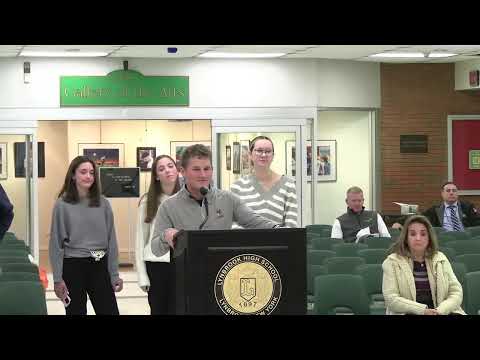
A group of AP Government students presented a proposed selection process for a student member of the Lynnbrook Union Free School District Board of Education at the Jan. 8 meeting, and board members agreed to refer the proposal to the policy committee for formal development.
The student team described a blind application process: students would pick up an application from a designated staff member, fill in the application questions (which intentionally omit identifying details), and leave a separate cover sheet with name and guidance counselor. A designated staff member would assign application numbers and keep identifying information separate so that AP Government students could review and score the anonymous responses using a rubric. Candidates who advance would be invited to an interview panel including district staff and board representatives.
The students said the application packet includes a roles-and-responsibilities page and that interview questions will be used to follow up on written responses. They said they had deliberately removed identifiers that could reveal a candidate's extracurricular leadership roles to reduce bias. They also described plans for assigning application numbers and for the AP Government classes to score the anonymized written responses using a rubric.
Board members praised the students' work. A board member noted the process appeared rigorous and appropriate but said the matter must proceed through the district's policy process: any formal requirement for a student board member would need to go to the policy committee and then be posted for first and second readings before adoption. Several board members suggested the students include uniform interview questions and consider word-count guidance for written answers so reviewers receive comparable responses.
Board members present at the discussion said the conversation would guide the policy committee's drafting; two of the three policy committee members were present and would carry feedback into the committee's work. The board did not adopt a policy at the meeting; it directed that the proposal be taken to the policy committee for drafting and later return to the full board for the required readings and votes.
The students and staff who helped design the process included AP Government students, Mr. Finder (staff), Mr. Sarosi, Mr. Benedetto and Mrs. Lancaster. A board member thanked the students and the district staff for their work on the application and rubric.