Get Full Government Meeting Transcripts, Videos, & Alerts Forever!
Get email alerts on the Military Infrastructure topic
No spam. Unsubscribe anytime.
Minnesota National Guard asks legislature for $3 million in design funds for Duluth fighter hangar
Summary
The Minnesota National Guard told the Senate Capital Investment Committee it is seeking $3 million in state design funding to ready a new universal fighter hangar at Duluth — a state gesture officials say would improve competitiveness for an estimated $28 million in federal construction money.
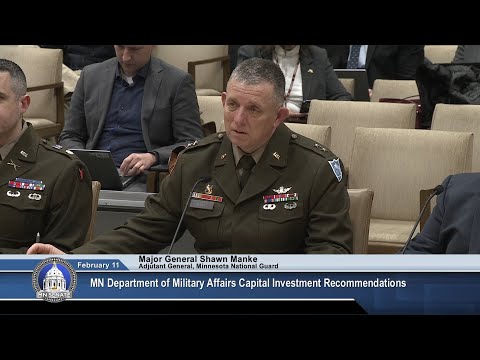
Major General Sean Manky, Adjutant General of the Minnesota National Guard, told the Senate Capital Investment Committee on Feb. 11 that the Guard is requesting $3 million in state design money to plan a new hangar for the 148th Fighter Wing at Duluth International Airport. The design funding, Manky said, would allow the state to better compete for roughly $28 million in federal construction funding for a three‑bay, universal shelter capable of housing F‑15EX, F‑35 or future fighter models.
The request matters because the current hangar on the flight line was built nearly 70 years ago and moved in the 1980s from the former Duluth Air Force Base. "This hangar was not purpose built for the aircraft that it houses today or for future aircraft," Manky said, describing leaking, dated facilities and safety concerns. He said design would take about 12–15 months with construction expected to follow in 18–24 months.
Don Kerr, Executive Director of the Minnesota Department of Military Affairs, clarified a question from the committee about property ownership: the specific parcel where the hangar would sit is state‑owned, Kerr said, after earlier committee members expressed concern about bonding on federal land. "The actual plot of land that we're planning to put the hangars on does belong to the state of Minnesota," he said.
Committee members pressed how the state investment would interact with federal funding. Senator Pratt asked whether the full $28 million construction request would typically be awarded by the federal government; Manky responded that the Guard would apply for the full amount and that because the facility sits on a federal installation the project is eligible. Pratt also asked how the requested $3 million demonstrates state good faith; Manky said the design commitment would strengthen competitiveness for federal dollars.
Manky highlighted the wider economic and public‑safety role of the 148th Fighter Wing in Duluth, noting the wing's firefighting capability for Duluth International Airport and the presence of other response units such as an explosive ordnance disposal team and a fatality search and rescue team that have supported state active‑duty responses.
No formal vote or committee action was recorded in the hearing. The presentation closed after committee questions and the chair thanked the witnesses for their testimony.