Get Full Government Meeting Transcripts, Videos, & Alerts Forever!
Get email alerts on the Energy Utility topic
No spam. Unsubscribe anytime.
City hears update on electric aggregation rates as market pressures could raise prices in June
Summary
Aspen Energy representatives briefed council on the city’s electric aggregation program and RFP results, warning market-driven wholesale price increases could push standard offer rates above the aggregation price starting June 2025 and complicate resident communications.
Council members and Aspen Energy representatives discussed Bexley’s electric aggregation program during a second-reading agenda item on Feb. 11, with vendors warning that wholesale capacity pressures and new data center demand could raise regional prices beginning June 2025.
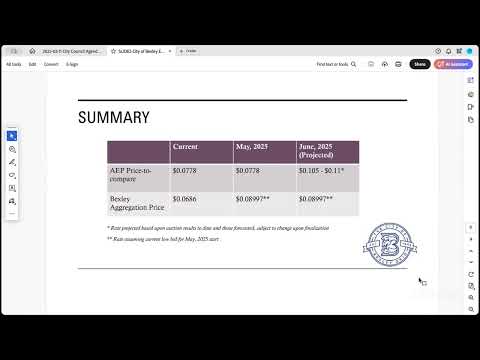
John and Jay of Aspen Energy reviewed the current program and RFP results and explained that the aggregation program’s current generation rate is 6.86 cents per kilowatt-hour under a 20-month contract that began in September 2023 and runs through May 2025. Aspen representatives said the program has saved the community about $1.2 million to date and has remained below the AEP standard-choice price during the contract term.
Why it matters: auction and capacity changes on the PJM grid are expected to push the AEP standard-choice offer substantially higher for the June 2025–May 2026 period, Aspen representatives said. That, in turn, makes timing for a new aggregation contract more complicated: a short gap between the end of the current contract and the start of a new supplier could leave residents temporarily paying a higher standard offer rate before a new aggregation rate takes effect.
Aspen walked council through RFP responses for a May or June 2025 start. The lowest proposal for a May start showed an initial 13-month price around 9.01 cents; a June start produced higher near-term prices, though one supplier offered a 24-month option below 9 cents. Aspen warned that AEP’s auction (which sets the standard-choice offer) takes place annually and that capacity-driven increases could make the comparison rate appear lower than a newly contracted aggregation rate for a short interval.
A council member summarized the communications challenge: residents will compare the city’s contracted rate to the posted AEP price-to-compare and could see the city price as higher for a month even if the aggregation contract saves money over the longer term. “We’re going to be saying, we got this great deal. It’s 8.997¢,” the council speaker said, “and they’ll be like, wait a second — why have you signed us up for more expensive electricity than what I can go get at a face rate with AEP?” The speaker (Council President) urged careful timing and clear disclosure to residents.
Aspen said the market has been affected by large new data-center investments and increased capacity demand in the PJM regional grid; representatives cited recent announcements of major data-center investment in the region. Aspen projected the AEP standard-choice rate could move from about 7.78 cents now to an estimated 10.5–11 cents beginning in June 2025, but the company noted the official AEP price is not finalized until mid-May.
Council and Aspen also discussed RFP details, supplier offerings and possible start dates. Council Member McPeek asked for a simple household example to understand the impact; Aspen responded that overall generation, transmission and other components affect final bills and cautioned that a single example does not capture all bill components.
The agenda item was listed as the second reading of Ordinance 05-25 to approve the supplier for the city’s electric aggregation program; no final council vote on the ordinance was recorded during the Feb. 11 meeting.
Council members asked Aspen to return for further discussion and focused on the need for clear resident communications if the council moves forward with a new aggregation term that could briefly overlap or exceed the AEP price-to-compare.