Get Full Government Meeting Transcripts, Videos, & Alerts Forever!
Get email alerts on the Wildfire Resilience topic
No spam. Unsubscribe anytime.
Board adopts Nevada County 2025 Community Wildfire Protection Plan; calls for implementation and stakeholder collaboration
Summary
After a multi-year, countywide collaborative process, Nevada County adopted the 2025 Community Wildfire Protection Plan (CWPP). The plan maps hazard and risk, identifies project-priority areas for multi-benefit treatments, and establishes a stakeholder collaborative to advance implementation.
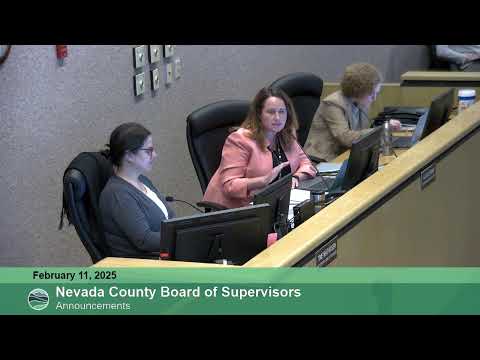
Nevada County’s Board of Supervisors on Feb. 11 adopted the countywide 2025 Community Wildfire Protection Plan (CWPP), a strategic, collaboratively developed document intended to guide wildfire risk-reduction projects and coordination across jurisdictional and community boundaries.
The plan and process: Interim Emergency Services Director Alex Cubel Toole and Nevada County wildfire coordinator Alessandra Zambrano presented the CWPP as the product of nearly three years of stakeholder work that included technical advisory committees, multiple agency partners, and extensive community outreach. The county divided the landscape into forecast zones to reflect distinct fire environments and incorporated 32 wildfire risk assessments countywide.
Community input and scope: Staff reported more than 94 outreach events and over 2,200 resident survey responses, plus nine community risk-reduction workshops. The plan maps high‑value resources and assets (HVRAs) — including community lifelines, public health vulnerabilities, natural resources and economic nodes — and overlays those with fire behavior hazard to identify where multi-benefit projects could most reduce risk.
Project priority areas and an example project: The CWPP identifies “project priority areas” where treatments could simultaneously protect lifelines, public health and natural resources. As an example of implementation, staff outlined the UBET resilience project (a mining-district watershed and infrastructure area) that aligns with a Community Wildfire Defense Grant application the board authorized staff to submit earlier in the meeting. Staff said the project addresses hazard, community lifelines (transportation and water infrastructure), community health (soil erosion/smoke risk), and natural-resource values.
Implementation governance and next steps: Staff described a revamped quarterly Wildfire Stakeholder Collaborative (about 75 members) that will serve as the implementation vehicle and host four subcommittees — permitting & environmental compliance, monitoring & metrics, data management, and collaborative funding. Staff will complete a county land management plan (a how-to for on-the-ground treatments) by June and launch a geospatial project-tracking application.
Why it matters: The CWPP is a precondition for several state and federal competitive grants and provides a common prioritization framework so partners can align funding and project design for maximum benefit.
Vote and closing: The board unanimously adopted the CWPP and authorized the chair to sign the 2025 plan. Officials emphasized the plan is intended to be active — guiding projects, securing funding, and supporting community outreach and adaptive management.