Get Full Government Meeting Transcripts, Videos, & Alerts Forever!
Get email alerts on the Tax Deed Ordinance topic
No spam. Unsubscribe anytime.
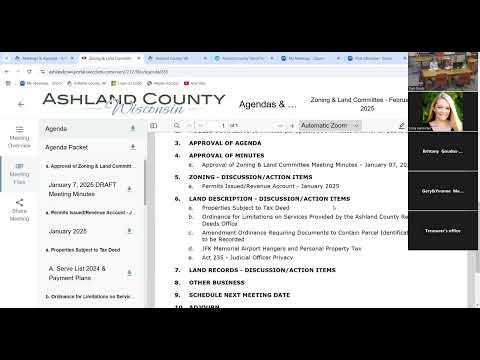
Ashland County zoning committee reviews tax-deed ordinance, timeline for county board action
Summary
The Ashland County Zoning Committee discussed draft tax-deed ordinance language, timing for county board review and the process for listing tax-deeded properties, including references to a state statutory change tied to the Tyler v. Hennepin County case.
The Ashland County Zoning Committee discussed a draft tax-deed ordinance and the timeline for forwarding the ordinance to the full county board, with members saying the board could act on the ordinance at its March 28 meeting and property listings could move forward in April if timing holds.
Committee members said the ordinance change is needed to bring local processes into compliance with a state legislative change made in response to Tyler v. Hennepin County. “The order to and the reason why we have the order is to comply with the new state statute that the legislature passed in response to the Tyler v Lawrence Tyler v Hennepin County decision,” a committee member said during the meeting.
Why it matters: committee members emphasized that finalizing the ordinance will allow the county to proceed with tax-deed listings and sales that have been delayed. Members also said the county must balance outreach and payment-plan options with the statutory foreclosure timeline.
Key details: committee members agreed to bring the draft ordinance back for discussion in mid-March so the county board could consider it on March 28. If the county board approves the ordinance at that meeting, the zoning committee would prepare a list of properties for possible listing in April. Committee members clarified that the treasurer (or the treasurer’s appointee) is statutorily empowered to acquire tax-deeded property, while this committee would retain oversight and final approval of tax-deed actions.
Discussion and concerns: participants stressed the county’s long-standing practice of working with property owners through payment plans up to the foreclosure date and said the county’s objective is to collect delinquent taxes rather than take property. One committee member noted the financial consequences of delayed action: “We have to make all the school district and the cities and towns and villages whole on their taxes. So we're actually out money until the taxes are fully paid or the property is sold.”
Process questions included how foreclosure notices interact with estates, the accrual of interest and costs, and whether administrative costs can be added to tax-deeded amounts. Committee members also noted that some unpaid municipal utility assessments and special assessments (for example, road special assessments) can be placed on property tax bills and, if unpaid, would require the county to make the municipality whole.
Next steps: committee members asked staff to prepare language changes and a property list for mid‑March so the ordinance could move to the county board on March 28. The committee discussed postponing listings until after ordinances are approved to avoid procedural conflicts.