Get email alerts on the Planned Unit Development topic
No spam. Unsubscribe anytime.
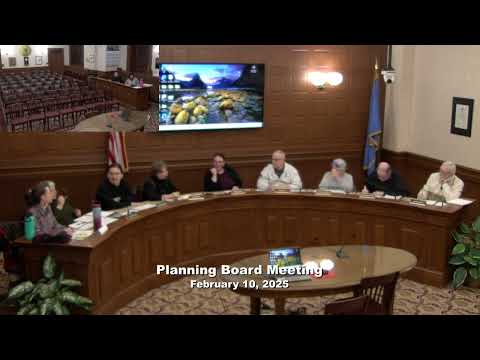
Lewiston Planning Board opens discussion on Planned Unit Development ordinance, asks staff for visuals and case studies
Summary
Lewiston planning staff introduced a draft framework for a Planned Unit Development ordinance; the Planning Board asked staff to return with visuals, sample projects and draft incentive language to encourage density, mixed use and affordable options.
Lewiston planning staff introduced a draft framework for a Planned Unit Development (PUD) ordinance and the Planning Board directed staff to return with visuals, sample projects and draft incentive language.
Craig Tebow, the city's land use planner, opened the discussion by explaining what a PUD would permit that the current zoning does not: an integrated design that can allow multiple principal structures, modified bulk/space standards and varied ownership models where the land can be held in common rather than subdivided into individual lots.
"Figure 2 would not be allowed under the current ordinance," Tebow said, describing an illustration showing 12 single-family structures on a single lot, a configuration the current code treats as multiple principal structures and therefore disallows in most zones.
Board members broadly supported a PUD approach that encourages higher density, mixed uses and innovative ownership models (for example, community land trusts or condominium-style ownership over shared land). Several members suggested the board begin by allowing residential PUDs with accessory commercial uses, and to defer consideration of industrial PUDs until after staff develops a working residential/commercial draft. Auburn's ordinance and developments there were cited as examples staff should document and, if possible, visit.
Board members also discussed thresholds and limiting conditions: minimum site size (options discussed included approximately 2'3 acres or a threshold of a minimum number of structures), whether a PUD should be limited to properties on public sewer, and whether septic-based projects should be allowed only by exception. Several members urged focusing PUDs near existing infrastructure to avoid new public costs for sewer and water extensions.
On density and form, members asked staff to consider structure-based thresholds (number of structures) rather than units (to avoid ambiguity when buildings contain multiple units) and to consider special rules or density allowances for tiny houses. The board asked staff to draft optional incentives the council could offer in exchange for public benefits: density bonuses tied to affordability or workforce-housing commitments, public-access easements for conserved shoreline or wetland areas, and requirements or incentives for delayed vehicle purchases until a planned vehicle-wash facility is in place (a theme from the LCIP discussion).
Members favored a staged, collaborative process for major PUD proposals: an early, nonbinding workshop or pre-application meeting with staff and the board to surface constraints and expectations before an applicant commits significant purchase or design costs. The board said such an early workshop would help applicants and staff refine proposals and reduce avoidable effort and expense.
The board asked staff to return with: - Visual examples from Auburn, York and other Maine communities (addresses or project pages where possible) and a proposed field trip to review nearby PUDs. - Draft threshold language (minimum acreage or minimum number of structures/units) and options for how to treat tiny houses. - Draft incentive language (density bonuses tied to affordability, public-access conditions for conserved open space, parking-reduction options tied to transit or shared-vehicle strategies). - Suggested procedural steps: a required pre-application workshop for large PUDs and a recommended approval sequence for phased developments.
Staff said it would bring a revised draft with illustrations and example case studies to the board's next meeting. The board did not take formal action on the ordinance text; the session was a preliminary policy discussion and direction to staff.
AI generated
The text on this page is AI generated. Summaries, highlights, analysis, and video transcripts are all produced from the original source material.
AI can make mistakes, so if you spot one, and we will fix it for everyone.
Note: the source content is unaltered by us. Any content source we link to, be it a video, an audio recording, or a document, is presented exactly as its publisher released it. That publisher is usually a government body, sometimes an individual official or another organisation.