Get Full Government Meeting Transcripts, Videos, & Alerts Forever!
Get email alerts on the Transgender Student Policy topic
No spam. Unsubscribe anytime.
Hundreds of public commenters urge board to revise proposed name-change policy; students and advocates warn of harm
Summary
Dozens of speakers — students, teachers and youth-service advocates — told the District 11 board that requiring parental consent for a student'chosen name would put transgender and gender-nonconforming students at risk. The board directed staff to run a shorter draft by legal counsel and return a revised policy in March.
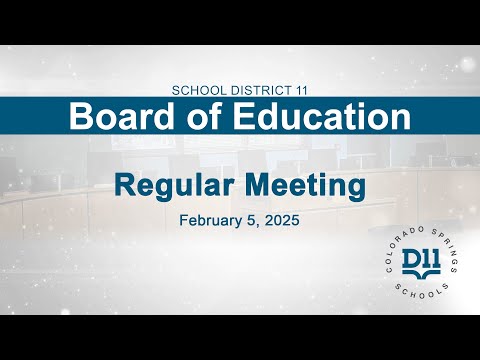
Colorado Springs School District 11 board members heard more than an hour of public comment on Wednesday about a proposed policy on students'chosen names. Speakers included current and former students, nonprofit youth-service leaders and teachers who urged the board to remove a parental-consent requirement or to revise the policy so it would not "out" students to unsupportive families.
The board heard from Michelangelo Crewson, who identified himself as a junior at Paloma High School and as a transgender man. "I do truly believe that transgender people deserve the same rights and safeties as everyone else," Crewson told the board, describing the cost to students when schools disclose identity information before a student is ready.
The comments came amid debate over a draft District 11 policy labeled ACA that would formalize how the district handles a student's request to be known by a name different from their legal name. The measure is a response to Colorado House Bill 24-1039; the board has been discussing different text and operational guidance since late 2024.
Why it matters: Speakers and area youth providers said the proposed draft — as written in earlier versions — could force transgender students to choose between family trust and safety at school. Inside Out Youth Services staff, faith leaders and student speakers told the board that requiring parental consent can increase risks of mental-health crises, family rejection and homelessness.
What speakers said - Angie Hackett Larson, co-executive director of Inside Out Youth Services, said the board'level policy "will hurt students" as written and urged the board to consult youth-service experts and clinicians before finalizing language. - Reverend Josh Rumpel urged district staff and teachers to continue using a student's chosen name regardless of the policy, saying, "You are loved, not in spite of your identity, but simply because you exist." He described research showing that supportive adults reduce suicide risk.
Supporters of parental notification and parental-rights provisions also addressed the board, arguing that parents should not be kept uninformed about a child's identity or records. The board did not take a vote on ACA on Wednesday.
Board direction and next steps Board members discussed two alternate approaches: keep a longer policy that included operational detail, or adopt a shorter, high-level policy that establishes the district's obligation and leaves operational steps to administration. Several members signaled support for a shorter, higher-level policy but asked that the draft explicitly reference the family-privacy protections already governed by federal law.
By the end of the meeting the board directed staff to: - Incorporate a brief reference to student-record protections (FERPA) and disclosure to third parties into a shorter ACA draft; and - Send that revised draft to district legal counsel for review and return the item as an action item at the board's March meeting.
What the district said Superintendent Michael Gall and district counsel have previously told board members that the district must implement a written policy to comply with HB 24-1039 and that operational details (for example, how staff inform students about parental notification) are typically handled by administrative procedure rather than policy.
Context and public response Many speakers said they had personal experience of harm when family members learned about a student's gender identity, and several recounted suicide attempts, homelessness, or family violence after being "outed." Inside Out and other advocates cited research and local service caseloads they say link forced outing to worse mental-health outcomes.
The board's next step will be a legal review of the shorter ACA draft and a planned March action item. The discussion Wednesday made clear that the board remains divided on the balance between parental notification and student privacy, and that community members expect a prompt, transparent update when legal counsel's review is complete.
Ending note: Numerous speakers asked teachers and staff to continue using students' chosen names in day-to-day interactions, and several board members publicly encouraged staff to prioritize student safety while the policy is finalized.