Get Full Government Meeting Transcripts, Videos, & Alerts Forever!
Get email alerts on the Bell Schedules topic
No spam. Unsubscribe anytime.
Poudre School District continues bell-time study; board asks staff to explore swap of middle- and high-school tiers
Summary
Board members and staff reviewed multiple routing scenarios that would shift school start times, asked for further analysis (including a potential swap of middle- and high-school tiers), and stressed a preference for options that are cost-neutral given budget and bus-fleet constraints.
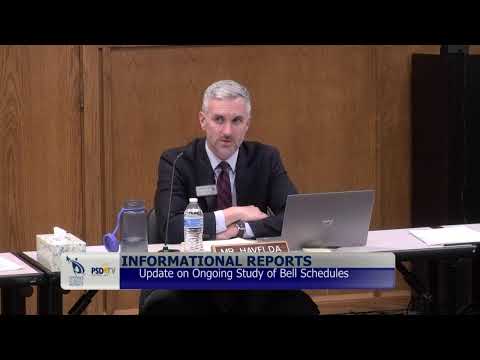
Poudre School District R-1 officials on Jan. 28 updated the Board of Education on an ongoing study of school bell schedules and asked staff to model additional scenarios, including swapping middle- and high-school tiers and testing cost-neutral options.
The district’s chief financial officer, Dave Montoya, told the board the three-tier routing system adopted in August 2024 reduced about 10 bus routes and helped transportation stabilize after driver shortages during the COVID era. “For the first time since 2020 we had the proper number of drivers either on staff or in a class getting ready to graduate,” Montoya said. He added the work also produced an estimated $1.1 million of budgetary savings compared with the prior system.
Why this matters: board members and many parents raised concerns about the earliest middle-school start (07:30) and late elementary start (09:05) that followed the district’s August routing change. The board asked staff to prioritize options that lessen early wake-up times for middle-schoolers without increasing the district’s transportation costs.
Montoya walked the board through three families of options First Consulting and district routing staff modeled. One option shifts the existing three-tier start times later (for example 08:00, 08:30 and 09:05); another moves the first two tiers by 15 minutes (07:45, 08:25, 09:05); and a third shifts the whole day later (for example 08:00, 08:45, 09:35). He said compressing the morning “operating time” (the window available to stagger pick-ups) requires more buses and routes because more students must be picked up in a shorter interval.
Board members pressed for scenarios that would not increase routing costs. “Any scenario that raises cost, I won’t vote for,” Director Connor Duffy said during the discussion. Several board members recommended testing whether flipping the first and third tiers — putting high schools in the earliest tier and middle schools in the latest tier — reduces conflicts with after-school athletics and work schedules for high-school students while moving middle-school starts later. Superintendent’s staff and Montoya agreed to ask the consultant to run that swap and return results.
Board members also asked staff to explore other trade-offs: modest 10–15 minute shifts that preserve the district’s operating window, how changes would affect extracurriculars and athletics, and whether revising eligibility radii for bus service (so fewer neighborhood students are bus-eligible) could reduce route needs. Montoya cautioned about fleet condition and supply-chain constraints: the district’s average bus age is high, recent bus orders are delayed, and the district faces difficulty adding routes quickly because of vehicle and driver availability.
Community members had also raised bell-time concerns during public comment. Parent Julie Wenzel, who volunteers as a crossing guard, told the board she sometimes sees students and drivers arriving at school before dawn and urged the board to “use student wellness and safety as your compass” when reviewing start times.
Next steps and timeline: the board directed staff to (1) ask First Consulting to model a high-school/middle-school tier swap and a 15-minute later variant of option 2, (2) return cost estimates that show changes that are net-neutral for the transportation budget if possible, and (3) develop engagement plans to solicit family feedback on any scenarios that are financially viable. Staff said additional modeling and community outreach will take weeks and that any change for the 2025–26 school year would need to respect choice windows and secondary configuration timelines.
Board members underlined that they prefer to avoid repeated disruptive changes and want any future shift to be durable and explainable to families.