Get Full Government Meeting Transcripts, Videos, & Alerts Forever!
Get email alerts on the Pensions topic
No spam. Unsubscribe anytime.
Committee advances bill allowing OPERS death benefits to be sent directly to funeral providers
Summary
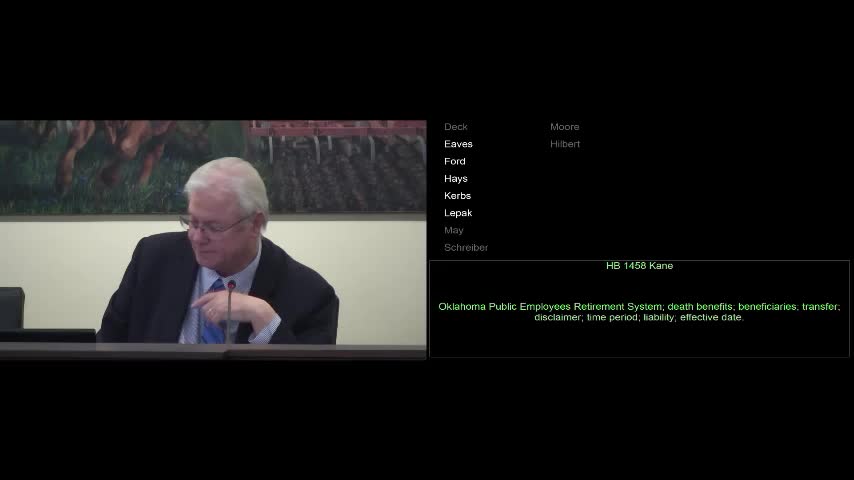
The House committee voted to report House Bill 1458 out of committee, changing how Oklahoma Public Employees Retirement System death benefits may be designated so funds can be directed to funeral homes as a qualified disclaimer rather than an assignment.
The House Committee on Banking, Financial Services and Pensions voted to report House Bill 1458 out of committee, advancing a statutory change that would let beneficiaries of Oklahoma Public Employees Retirement System (OPERS) members direct death benefits to a funeral home.
Representative Cain, who presented the bill, said, "The purpose of HB 1458 is to amend statute to enhance the efficiency for OPERS members and their beneficiaries by modifying the process for designating a funeral home as the beneficiary for Oklahoma Public Employee Retirement System death benefits." He explained that, under the bill, a beneficiary could "elect to reject the death benefits and send those funds to the funeral provider," characterizing the transfer as a "qualified disclaimer rather than an assignment for tax purposes."
The measure drew no substantive questions after the presentation. A motion of "do pass" was made and seconded; the committee recorded seven yays and no nays and reported the bill out of committee.
The bill, as described in committee, focuses narrowly on the mechanics of how death benefits may be designated and on clarifying the tax treatment of transfers to funeral providers. The committee did not alter the fundamental eligibility rules for OPERS benefits in the remarks on the record.
With the committee vote complete, the bill will move to the next step in the legislative process for further consideration by other committees or the full chamber.