Get Full Government Meeting Transcripts, Videos, & Alerts Forever!
Get email alerts on the Nontraditional Placements topic
No spam. Unsubscribe anytime.
Ombudsman, Cabinet and providers outline scope of children placed in DCBS offices and gaps in placements
Summary
A preliminary ombudsman assessment found dozens of children placed in nontraditional settings (DCBS offices) over a recent period; committee discussion and provider testimony highlighted variable ages, short average stays, and gaps in higher-acuity placements and facilities.
A preliminary assessment by the Office of the Ombudsman and testimony from the Cabinet for Health and Family Services (CHFS) and residential providers described ongoing use of DCBS office space as unlicensed, nontraditional placements for children when other placements are unavailable.
The ombudsman's preliminary review of a mid‑June through October period identified 49 children who were placed in office buildings during that interval. "They looked at 49 kids that were placed in in office buildings during that time," Brian Morrow, division director for citizen services and policy integrity in the ombudsman office, told the committee. Morrow said 10% of those 49 children had no documentation of behavioral or disability diagnoses, 33% (16 children) were removed directly from their homes, and the report listed ages ranging down to infants of 1, 2 and 3 years. For that sample period Morrow said the average age was about 13, and he said the longest documented stay in the ombudsman preliminary tally was 35 nights.
CHFS presented separate operational data covering a tracked time period that showed somewhat different summary statistics: the cabinet's slide set reported an average of 2.8 consecutive days in a nontraditional placement (range 1 to 25 days), an average age of 15 for youth counted in that metric, and that 66% of those youth were male and 34% female. Commissioner Lisa Dennis said the tracked dataset and the ombudsman sample cover different windows and purposes, prompting the committee to request a deeper, harmonized analysis.
Committee members and witnesses framed three separate issues. First, lower-acuity placement gaps — children who leave unsafe homes but do not present pronounced violent behavior — often reflect brokered capacity limits in foster homes and rapid placement needs that can result in same‑day or overnight office stays. Second, higher-acuity children who display aggressive or violent behavior are difficult to place because residential providers worry about safety, staffing and their facility culture; cabinet officials and providers said those children sometimes end up in offices when no higher-level bed is immediately available. Third, the absence of clear, consistent policies or licensing for nontraditional placements raised questions about what happens to children while they are housed in offices.
Secretary Eric Friedlander acknowledged the problem is national in scope and said some states have addressed it by creating specific programs or engaging faith‑based and community partners; he told the committee, "there is no question that we need some sort of facility in Kentucky where the focus is these kids." Commissioner Dennis described current interventions — enhanced rates, daily interagency morning meetings to coordinate cases, targeted provider meetings, intensive therapeutic supports and a provider outreach effort — and said those efforts have modestly reduced certain tracked metrics but that deeper analysis is required.
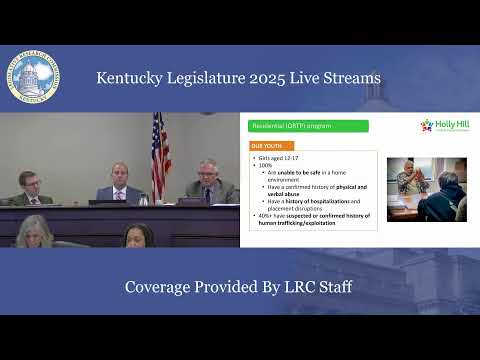
Residential providers Holly Hill and Maryhurst described how they evaluate referrals and their capacity limits. James Sherry, CEO of Holly Hill Child and Family Solutions, said his program participates in pilot referral arrangements and focuses on girls with complex trauma (including a high share with suspected trafficking histories); he said Holly Hill has accepted children referred directly from office placements in some cases. Paula Garner, CEO of Maryhurst, said her facility generally will attempt to serve referred youth but must decline cases when acute violence, arson risk or other safety drivers exceed the program's capacity. "Our absolute focus and priority right now is safety and security and making sure that we can sustain the services that we currently have," Garner told the committee.
Committee members pressed for additional detail: a statewide inventory of provider capacity and populations served, documentation of which providers declined specific placements and why, and a harmonized set of policy options for nontraditional placements (for example, temporary licensed shelter space versus ad-hoc office stays). The committee also discussed Senate Bill 111, a separate measure referenced by the chair that would create higher-level processes and detention options for youth who require acute psychiatric care, and members asked that the ombudsman and cabinet continue the deeper assessment and return with more granular findings.
The discussion did not produce a committee vote on policy changes but resulted in committee direction to obtain additional, harmonized data and to continue oversight and collaboration with providers.