Get Full Government Meeting Transcripts, Videos, & Alerts Forever!
Get email alerts on the Sludge Landfill Expansion topic
No spam. Unsubscribe anytime.
City of Gardner presents draft environmental report for sludge landfill expansion; residents raise health, odor and groundwater concerns
Summary
City of Gardner officials and consultants presented the Draft Environmental Impact Report (DEIR) for an 8.75‑acre sludge landfill expansion and took public comment about odors, groundwater contamination and alternative disposal options.
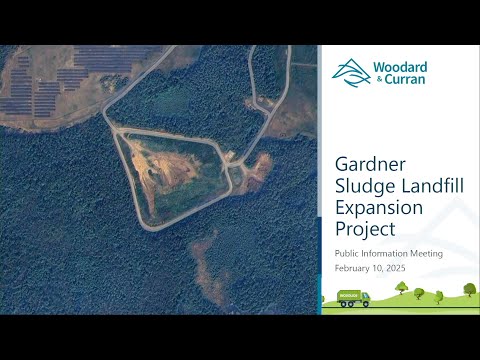
City of Gardner officials and consultants presented the Draft Environmental Impact Report for a proposed 8.75-acre expansion of the city’s existing sludge landfill at a public information meeting, and took public comment about odors, groundwater contamination and alternatives.
Megan Gatto, project manager for Woodard & Curran, told the meeting the presentation was “about the Gardiner Sludge Landfill Expansion Project” and introduced the DEIR and public‑involvement plan (PIP) being submitted under the Massachusetts Environmental Policy Act (MEPA). The DEIR is posted on the city website and, according to the presentation, is expected to be filed with MEPA at the end of the month for a formal public review period.
The project would add an 8.75‑acre western extension at the city’s existing landfill on West Street and increase disposal capacity by roughly 276,500 cubic yards, a volume city staff conservatively estimated would meet the city’s biosolids disposal needs for about 17 years (through approximately 2044). Project design elements described in the DEIR include excavation of up to 20 feet of soil, creation of a subbase built a minimum of 4 feet above seasonal high groundwater, five impermeable layers for groundwater protection, leak detection, and a leachate collection system that would return liquids to the wastewater treatment plant for treatment.
Why it matters: the city says the existing landfill, which began operations in 1990, is approaching capacity (projected to reach capacity between 2027 and 2030 based on the latest annual operations report). City staff framed the expansion as a locally controlled, permittable and cost‑effective way to maintain wastewater services without significantly increasing sewer rates. Officials also described a MEPA schedule that would allow state agencies and the public 30 days of formal comment after the DEIR is published in the Environmental Monitor.
Alternatives analyzed: the DEIR’s alternatives chapter compares (1) the proposed landfill expansion; (2) landfill closure with off‑site hauling of biosolids to third‑party receiving facilities; (3) use of a planned Fitchburg Biosolids Management Facility (BMF) as a regional receiving site; and (4) converting the Gardner wastewater treatment facility to an advanced process using hydrothermal carbonization (HTC). The presentation summarized the consultant team’s conclusion that hauling and certain regional options entail substantial cost and capacity uncertainty and that Fitchburg’s project and HTC currently face timing, funding and permitting uncertainties that make them higher‑risk alternatives for meeting the city’s near‑term disposal needs.
Public comments and concerns: more than two dozen attendees spoke during the public comment period. Common themes included:
- Odor and air quality: multiple speakers said odors from the current sludge landfill affect nearby neighborhoods and cemeteries. Mary E. Marsh (resident) said the site’s odor had caused headaches and nausea during cemetery visits and that “expansion with another 7‑story pile of human waste is not gonna make the air any cleaner.” Jeff Legro (resident) said odors have become less frequent but asked whether expansion could worsen the problem and urged the city to consider alternatives that generate energy.
- Groundwater and chemical contamination: several residents reported detection of contaminants in nearby ponds and wells. Susan Russo (resident) reported that consultants found 1,4‑dioxane in a nearby pond and urged the city to hire a licensed site professional to determine sources and expand monitoring. Multiple speakers referenced PFAS, alleged monitoring‑well failures, and past releases of leachate into wetlands.
- Hydrology and nearby water supplies: speakers asked about proximity to the Otter River, Templeton public wells and the Millers River watershed, and called for clearer explanations of downstream exposure risks and replacement plans should wells be contaminated.
- Long‑term liability and costs: residents and commenters (including Alan Russo and Paul DeMeo) described the expansion as a “money pit” that will generate long‑term post‑closure obligations, and urged the city to pursue regional, revenue‑generating processing options such as anaerobic digesters or HTC.
- Environmental justice and public notice: commenters said environmental justice populations had not been adequately engaged and requested additional site visits and mapping (one speaker asked for flagging of the proposed expanded footprint).
City process and next steps: Gatto and city staff said the DEIR and the PIP are available on the city website and that hard copies are at City Hall, the city clerk’s office, the Levi Hayward Memorial Library and the Department of Public Works. The presentation stated that written comments may be emailed to slf@gardner‑ma.gov (the team said the email would be accepted through Feb. 15 as an informal opportunity) and that the city anticipates filing the DEIR and PIP with MEPA on Feb. 28; if MEPA deems the filing complete it will be published in the Environmental Monitor and trigger a formal 30‑day comment period. The presentation also noted that the DEIR includes a cataloged response to prior comments (chapter 11) and a mitigation chapter summarizing proposed protective measures (chapter 10).
What the DEIR says about design and monitoring: the team described multiple containment features (five impermeable layers, leak detection and a leachate conveyance system) and ongoing landfill operation and maintenance tasks, including daily, weekly, monthly and quarterly inspections and contracted environmental monitoring. The DEIR also reports the project footprint was reduced early in the process to avoid nearby wetlands identified during conservation commission review.
Requests from the public: commenters urged the city to collect additional data comparing the HTC and other processing alternatives, to commission independent testing for 1,4‑dioxane and PFAS, to repair and expand monitoring wells, and to provide clearer mapping of all nearby surface waters (speakers named Bailey Brook, the Otter River and the Millers River watershed). Several speakers asked the city to delay committing to an all‑at‑once, 17‑year landfill solution and instead pursue interim hauling or phased solutions while advanced processing options are pursued regionally.
No final decision: the meeting was informational and no formal vote or approval occurred. City staff said comments collected at the meeting and in writing will be cataloged and addressed in revisions to the DEIR prior to MEPA’s review.
A closing note: the project team encouraged attendees to review the DEIR and PIP online, submit written comments by the stated deadlines and noted the city will post the meeting recording to its YouTube channel.