Get Full Government Meeting Transcripts, Videos, & Alerts Forever!
Get email alerts on the Veterans Affairs topic
No spam. Unsubscribe anytime.
Committee advances bill to create state accreditation for county veterans service officers
Summary
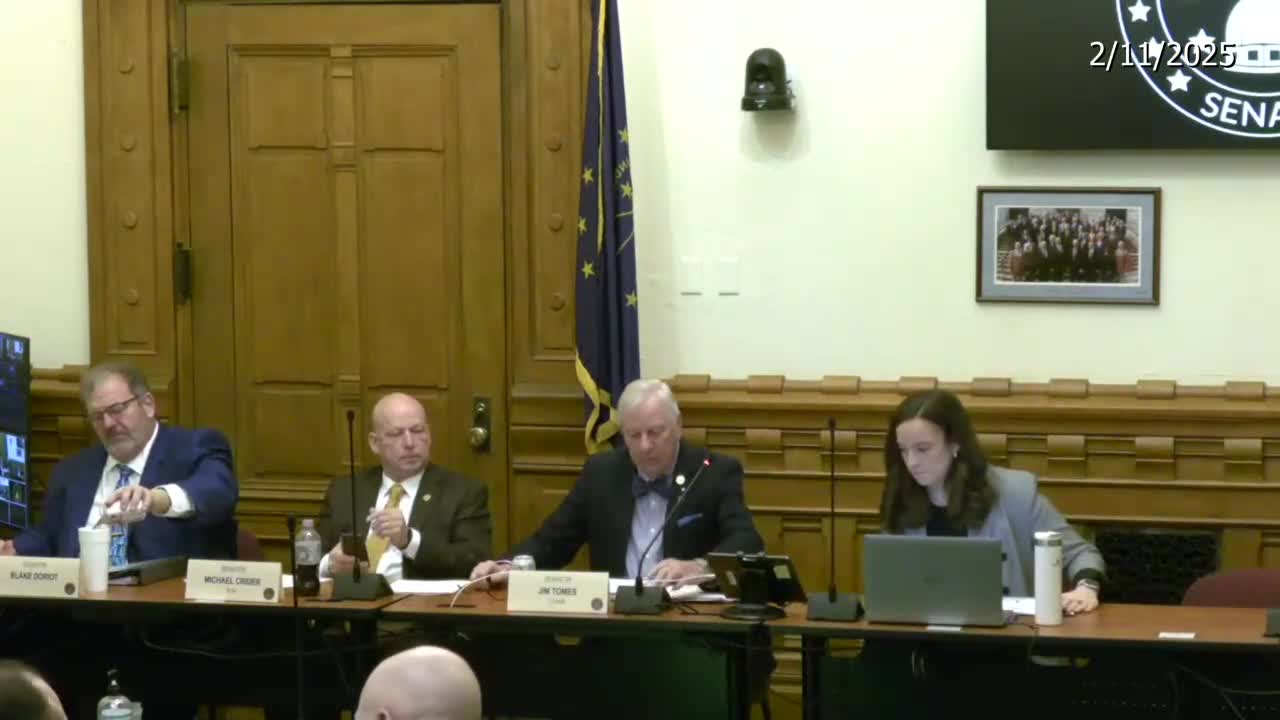
Senator Baldwin, sponsor of Senate Bill 433, told the Indiana Senate Veterans Committee on the bill’s presentation that the amendment creates a state accreditation program and gives counties time to come into compliance.
Senator Baldwin, sponsor of Senate Bill 433, told the Indiana Senate Veterans Committee on the bill’s presentation that the amendment creates a state accreditation program and gives counties time to come into compliance.
The amendment requires the Indiana Department of Veterans Affairs (IDVA) director to design an accreditation program, directs county veterans service officers (VSOs) and their assistants to meet standards the director prescribes, and sets a deadline for the department to begin the program. The committee voted 9-0 to advance the bill out of committee.
The bill’s sponsor, Senator Baldwin, said the amendment “allows the director sitting behind me to create an accreditation program that directs veteran service officers to comply with certain rules and regulations” and gives counties “some time to come into compliance.” Baldwin told the committee the change was prompted in part by an unclear split of responsibilities between the state and counties and by a prior lawsuit involving Hamilton County and the state.
IDVA Director Gabriel Adams testified in support and described the amendment as the product of months of work with county VSOs and other stakeholders. “We wanted to testify this morning in support of Senate Bill 433. We’ve worked with Senator Baldwin and constituents and County veteran service officers to help create better language, better continuity and better reporting,” Adams said.
County VSOs and association leaders who testified largely supported the amendment but urged attention to training, pay and enforcement. Alex Dobson, Steuben County Veterans Service Officer and president of the Indiana Veterans Service Officers Association, said some counties lack access to federal systems and tools: “There are 29 counties right now that are not using VBMS access,” Dobson said, referring to the U.S. Department of Veterans Affairs’ Veterans Benefits Management System, and he told the committee that some VSOs have not obtained PIV cards that enable secure access.
Advocates and several testimony givers said standardized training and state-supported accreditation could raise performance. Chris Bertrand Golomski, vice president of the Indiana Veterans Service Officers Association and Marion County VSO, described a desire to return to longer centralized training: “We want to see it come back to that roots,” he said, referring to a week-long training model with testing that some testified used to exist.
Opponents and some veteran advocates said state law and federal accreditation standards already require accreditation and that the bill, as drafted, risks duplicating existing law without stronger enforcement. Jim Beyerle of the Military Veterans Coalition of Indiana said turnover and low pay in small counties are root problems: “About 9% of the county veteran service officers leave their job annually,” he said, arguing salary, workload and local hiring decisions explain uneven service more than missing statutory language.
Lisa Wilkin, a U.S. Air Force veteran and longtime advocate, said she opposed the bill until she reviewed the amendment but urged the General Assembly to add enforcement mechanisms. Wilkin recounted efforts to require accreditation in state code and suggested consequences for noncompliance: “When we got the law passed requiring our county VSOs to be accredited, the teeth that we proposed…was tie it to their road funding,” she said, arguing counties are unlikely to change hiring practices without a penalty.
Committee members asked how quickly standards would be adopted and how enforcement would work. Senator Buck noted the amendment sets a July 1 deadline for the department to produce standards; Director Adams said the Indiana Veterans Affairs Commission would develop standards and set reasonable compliance timelines for county VSOs. Adams also said the department plans to rely on regional district service officers to communicate standards and help counties come into compliance.
The amendment also allows counties to seek approval to share a VSO or enter cost‑sharing agreements with neighboring counties as an option for small or under-resourced counties. Supporters said the change aims to preserve local employment of VSOs while achieving statewide consistency; critics said the state already has code requiring accredited VSOs and that enforcement, pay and staffing levels must be addressed to achieve uniform service.
The committee voted to move the amended bill by roll call; the recorded committee votes were: Senators Thomas (yes), Kreider (yes), Dorio (yes), Maxwell (yes), Buck (aye), Charbonneau (aye), Byrne (aye), Ford (yes) and Spencer (yes). The tally was 9-0 in committee.
The bill will proceed to the next stage of legislative consideration with the amendment. Supporters said it provides a structure to create consistent standards; critics asked lawmakers to pair any new accreditation regime with clear enforcement and attention to funding and staffing in counties that struggle to meet federal and state requirements.