
Carson City planning commission backs 62‑unit Perry Street townhome project, recommends city council approval of related amendments
Get AI-powered insights, summaries, and transcripts
Subscribe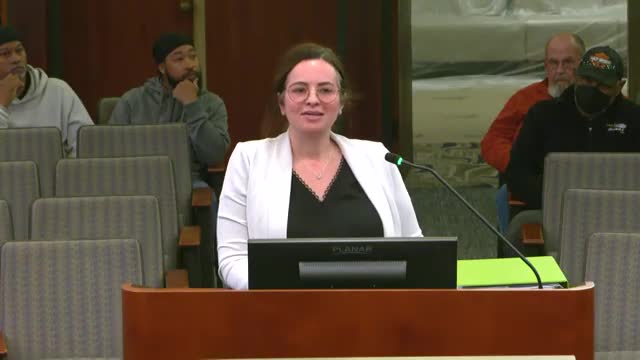
Summary
The Carson City Planning Commission voted 8‑0 to adopt a resolution recommending approval of an addendum to the general plan EIR, site plan and design review, and to forward a general plan amendment, specific plan amendment and amended development agreement for the 21611 Perry Street project to city council.
The Carson City Planning Commission on a unanimous 8‑0 vote recommended that the City Council approve a package of amendments and permits to allow a proposed 62‑unit townhome project at 21611 Perry Street.
Planning consultant Leila Carver told commissioners the applicant proposes to construct 62 three‑story townhomes on a 2.8‑acre vacant site bounded by Perry Street, Carson Street and the Dominguez Channel. Carver said the application package includes a general plan amendment, a Perry Street specific plan amendment, an amended and restated development agreement, a site plan and design review, a vesting tentative tract map and an addendum to the Carson general plan EIR.
The project would include 10 residential buildings with a unit mix Carver described as eight 2‑bedroom, 27 3‑bedroom and 27 4‑bedroom townhomes; private two‑car garages and 26 guest spaces; roughly 29,000 square feet of common open space; and private open space averaging about 76 square feet per unit. Carver said building heights would range from about 35 to 40 feet and the applicant is providing 150 parking spaces where the project’s minimum requirement is 137.
Nut graf: The site has a contamination history tied to removed underground storage tanks. Staff and the applicant said regulatory clearances from state and regional cleanup authorities will be required before any occupancy, and the project moves forward only if those agencies approve lifting or amending existing deed restrictions that currently limit the site to nonresidential uses.
Commissioners and staff spent substantial time on the site’s environmental history and regulatory process. Carver summarized prior remediation: contaminated soil tied to underground storage tanks was removed in 2014 and the Regional Water Quality Control Board issued a “no further action” finding for the removed soil in 2015, which led to an existing land‑use covenant restricting residential uses. Carver said groundwater monitoring wells remain on site and semiannual monitoring continues per Water Board requirements.
Brendan Kotler, speaking for the applicant, said the site’s groundwater monitoring is part of a broader regional monitoring network and that the developer has been coordinating with the California Department of Toxic Substances Control (DTSC). Kotler said DTSC involvement becomes required when residential uses are proposed on sites with potential groundwater concerns and that DTSC could require a human health risk assessment, vapor‑intrusion testing, additional remediation, and operations/maintenance or engineering controls (for example, vapor barriers and indoor air monitoring) before units could be occupied. "DTSC only gets involved when there are residential projects on former sites that might have groundwater issues, specifically to address any risk to vapor intrusion," Kotler said.
Assistant City Attorney Joe Thomas and planning staff clarified how conditions of approval would control the sequencing of regulatory sign‑offs and permits. They said the project’s conditions require executed amendments to the Water Board land‑use covenant and a DTSC CLARA agreement (as referenced in staff materials) and that the city will not issue building permits or certificates of occupancy until the applicable regulatory agencies have approved the site for residential occupancy. As Thomas summarized to commissioners, proof of compliance from the Water Board and DTSC must be submitted prior to issuance of permits and again before any certificate of occupancy would be issued.
The development agreement amendment before the commission would preserve the site owner’s vested rights previously granted for a self‑storage project while allowing the residential option; staff said the existing DA (vested to the storage project) would remain in force and that the DA term will remain unchanged and expire in 02/2037. The applicant proposed community benefits totaling $1,800,000 in exchange for the vested rights, described in staff materials as including a development impact fee contribution, a $250,000 annexation to a CFD, a $250,000 contribution to the citywide commercial façade improvement program and a $50,000 development agreement fee.
Staff also presented a traffic comparison showing the residential proposal would generate an estimated 446 daily trips (about 30–35 peak hour trips) and stated that projected trip generation is lower than the previously approved self‑storage project; the city traffic engineer did not require additional level‑of‑service analysis on that basis.
Public comment was limited to one speaker, Calvin Pratt, who said he lives near the vacant lot and opposed residential use because of existing traffic congestion on Perry Street related to nearby commercial uses, and suggested the previously approved storage use would be preferable.
Following applicant and staff remarks, Vice Chair Louie Diaz moved to adopt Planning Commission Resolution No. 25‑2881 recommending approval of the addendum to the general plan EIR, site plan and design review and forwarding the general plan amendment, specific plan amendment and development agreement to the City Council; Commissioner Huff seconded. The motion included the revisions to the development agreement described in staff materials (Exhibit F) and the revised conditions of approval read into the record.
Votes at a glance: The motion to adopt Resolution No. 25‑2881 passed unanimously, 8‑0 (Madam Chair Thomas: yes; Vice Chair Louie Diaz: yes; Commissioner Dactaso: yes; Commissioner Guerra: yes; Commissioner Huff: yes; Commissioner Mfume: yes; Commissioner Johnson: yes; Commissioner Wilson: yes).
The commission’s approval is a recommendation to the City Council; final approvals and any change of use to residential require the specified regulatory clearances from DTSC and the Regional Water Quality Control Board and the council’s action on the general plan and specific plan amendments. If the regulatory agencies do not approve residential use, the applicant retains the option to pursue the previously vested self‑storage project, staff noted.
The commission also discussed project implementation details, including relocation of monitoring wells (a condition), timing of executed amendment documents and that additional sampling or remediation could be required by DTSC or the Water Board as part of the CLARA process. The commission closed the public hearing after one public comment and voted to forward the recommendations to city council.
The commission meeting adjourned after brief member remarks and routine announcements.