Get Full Government Meeting Transcripts, Videos, & Alerts Forever!
Get email alerts on the Complete Streets topic
No spam. Unsubscribe anytime.
Carbondale commission sends complete-streets resolution, outlines Highway 133 and low-cost projects
Summary
The Carbondale Bike/Ped Commission approved forwarding a draft complete-streets resolution and an attached ten-point exhibit to the Town Board for consideration, and discussed priorities including Highway 133, tactical urbanism demos, wayfinding, sidewalks, data collection and legal limits on subcommittees under the state sunshine law.
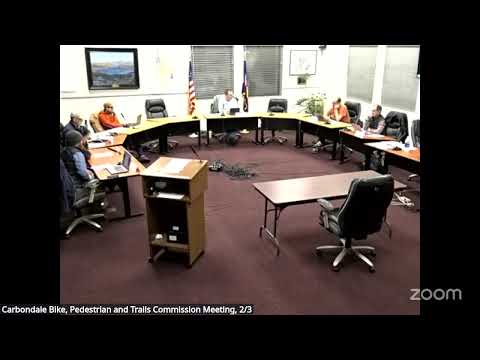
The Carbondale Bike/Ped Commission voted to send a draft complete-streets resolution, together with an attached ten-point exhibit, to the Town Board for consideration at the trustees' upcoming meeting. Commissioners spent the remainder of the session prioritizing near-term projects and discussing procedural barriers that affect how the commission can work between meetings.
Why it matters: The resolution is intended to formalize the commission's endorsement of complete-streets principles and set direction for implementing elements of the town's recently approved mobility/streets plan (MAP). Commissioners said they want visible, affordable actions this year to show progress while continuing longer-term planning for larger infrastructure and policy changes.
The vote and what was sent: The commission approved forwarding the resolution plus “Exhibit A” (a ten-point set of recommended priorities and design elements) to the Town Board for consideration. The motion to forward the packet was moved and seconded at the meeting and was approved by the members present. (The minutes maker and roll-call details were recorded as part of the meeting; the transcript records voice approval and subsequent staff confirmation that the packet would be delivered to trustees.)
Key priorities discussed: - Highway 133: Commissioners identified the stretch of Highway 133 closest to downtown — roughly from the north end of the City Market area through the traffic circle toward Kendrick — as their top, most complex priority. They recommended continued engagement with Colorado Department of Transportation (CDOT) and the trustees, noting CDOT will present a large printed map at a separate working session. Commissioners emphasized the need to focus limited resources on the segments with the most pedestrian and bicycle activity.
- Tactical urbanism and demonstration treatments: The group discussed doing low-cost, temporary or demonstration treatments (for example, painted treatments, flower pots, or temporary traffic circles) on priority intersections to test concepts before committing to larger capital work. Several commissioners said demonstration projects should be paired with measured data collection and public feedback so the town can assess effectiveness.
- Low-cost maintenance and quick wins: Repainting crosswalks and sharrows, fixing signage, and other maintenance-type actions were identified as affordable, high-visibility steps the town can pursue quickly to signal progress.
- Wayfinding and gateway: Commissioners recommended a wayfinding program and gateway treatments at town entry points to signal slower speeds and a bike/ped-friendly environment. They noted two of the main entrances are CDOT highways and will require coordination; county roads may allow more flexibility.
- Sidewalk “missing links” and prioritization: The commission highlighted filling sidewalk gaps where pedestrian routes now force people into the roadway as another priority for safety and connectivity.
- Transit and the downtowner test: Commissioners discussed coordinating with the regional transit provider (RAFTA) and the local downtowner/circulator pilot. They said the pilot needs monitoring and possible cost-share planning for next fiscal years if the service continues.
Process, permits and safety constraints: - Traffic-control standards: Commissioners and staff repeatedly noted that certain devices (traffic signals, regulatory signs) are governed by the Manual on Uniform Traffic Control Devices (MUTCD) and related engineering warrants. Several speakers cautioned against temporary four-way stops without prior study, saying that temporary installations can create safety problems and that warrants and data collection are the appropriate first step.
- CDOT coordination: For projects affecting state highways (two of the town’s main entrances), CDOT approval will be required. Commissioners cited prior instances where nonstandard signage or graphic elements had to be removed because they were on CDOT right-of-way.
- Sunshine law and subcommittee limits: Commissioners debated whether to remain a formal appointed commission (which makes them subject to Colorado open-meeting/sunshine rules) or to operate instead as an informal citizen group. Several members said state law and town practice limit workgroup membership and email exchanges when more than two commission members participate, forcing many workarounds such as two-person subcommittees or formally noticed meetings. The commission asked staff and the town attorney to clarify allowable formats to permit more productive pre-meeting work without violating open-meeting rules.
Next steps and staff direction: The commission asked staff to format the resolution and exhibit in the town’s standard resolution template, provide editable copies for numbering, and deliver the packet to trustees for the scheduled trustees meeting (date discussed in the session). Commissioners also agreed to pursue quick maintenance items and to form small two-person teams to scope demonstration projects and gather baseline data (traffic counts, speed and pedestrian/bike counts) before piloting changes.
Meeting close: Commissioners asked staff for a clearer description of the legal limits on subcommittee work and email discussion and requested follow-up on coordination with CDOT for Highway 133. The meeting adjourned after chair comments praising the MAP adoption and the commission’s work on it.