Get Full Government Meeting Transcripts, Videos, & Alerts Forever!
Get email alerts on the Water Rights topic
No spam. Unsubscribe anytime.
Trustees hear technical briefing on Carbondale water‑rights portfolio, augmentation tools and next steps
Summary
Town trustees received a technical briefing on Colorado water law, Carbondale’s water‑rights portfolio (ditches, wells and contract storage), and planning tools such as augmentation plans, watershed agreements and conditional rights.
Town of Carbondale trustees received a detailed, three‑part briefing on municipal water rights, administration and resilience from the town attorney, water consultants and town staff. Presenters outlined Colorado water‑law basics — including prior appropriation and beneficial use — then mapped those rules onto Carbondale’s portfolio of ditches, wells and contract storage, and concluded by identifying planning steps the trustees could request staff to pursue.
Susan (town legal presenter) opened with a primer on Colorado water law: water is a property right, governed by prior appropriation (“first in time, first in right”), and rights are quantified by beneficial consumptive use. She explained that senior water rights are protected in times of scarcity and that more junior rights must curtail diversions when a senior call is placed. She also described conditional water rights (a mechanism that allows holders — typically municipalities — to reserve water for future development but requires periodic showings of progress in water court).
Ashley Moffett, principal with LRE Water, and Mark (town staff) then described Carbondale’s physical and legal supplies. Key sources named in the briefing include: the Nettle Creek diversion system (historic municipal source), several town‑owned and town‑held irrigation ditch rights (Bowles & Holland, Carbondale Ditch, Rockford Ditch and others), the Crystal River well field and Roaring Fork well field, and 500 acre‑feet of contract water in Ruedi Reservoir. The presenters noted a critical 1988 change case that re‑quantified consumptive use on several irrigation ditches and gave the town the legal ability to use those consumptive‑use credits to backstop municipal diversions at its wells and other points of diversion.
Presenters emphasized limits and protections: many of the town’s most valuable credits are pre‑1922 irrigation seniorities (which would generally be protected if a Colorado River Compact call occurred). The briefing also flagged two Colorado River‑basin rights that often shape calls on the main stem — the Shoshone hydro right and the Cameo diversion pool — and described how trans‑mountain diversions and return flows affect local in‑stream conditions.
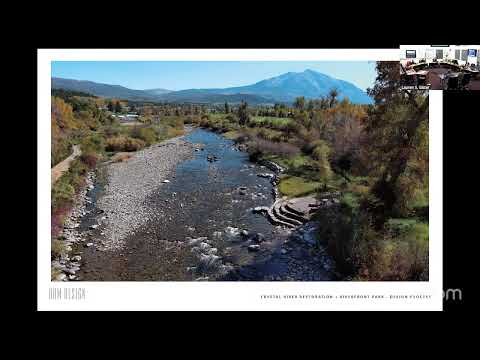
Trustees asked how the town should respond when the Crystal River looks “bone dry” in summer. Presenters said the town acting alone — for example, by stopping its own ditch diversions — would likely produce little net benefit because other upstream diverters could then increase their diversions. Meaningful, durable increases in streamflow typically require coordinated agreements among the many rights holders in a watershed or acquisition/leasing of consumptive‑use credits by a holder such as the Colorado Water Conservation Board.
The consultants reviewed policy tools: watershed management agreements (local voluntary compacts among irrigators and municipalities), leases or sales of consumptive‑use credits to the state for in‑stream use, augmentation plans that allow junior municipal diversions while preventing injury to senior users, and storage or contract water acquisitions as backstops. They cautioned these approaches can be legally and administratively complex and, in many cases, costly.
Presenters reviewed municipal planning rules. The trustees were reminded that when municipalities seek conditional water rights for future growth, courts typically evaluate a planning horizon (commonly a 50‑year planning period for municipal needs) and require proof the municipality is actively developing the conditional right to prevent speculation.
Trustees discussed wildfire resiliency and firefighting capacity. Staff and consultants said municipal water systems, including Carbondale’s, are not sized to sustain extended, large‑scale urban conflagrations solely by local water supply; fire response also relies on mutual aid, drafting from open water and other firefighting resources. Presenters pointed to the town’s redundant mix of sources (gravity‑fed high‑elevation supply, groundwater wells, and raw‑water ditches) as a relative strength compared with some other mountain towns.
Presenters also noted administrative tools the town already uses: a dedicated ordinance requiring water‑right or cash‑in‑lieu contributions for new development (the current code sets a dedication of 0.75 acre‑feet per equivalent residential unit, priced in the ordinance era at $3,000 per acre‑foot, a value trustees were told is long overdue for review) and the town’s periodic filings and an accounting model the division engineer requires to show compliance with change decrees and augmentation plans.
Trustees asked staff to return with a proposal for next steps; board members expressed support for a combined update of the town’s water‑rights and infrastructure master plan to better align legal supply, physical delivery capacity and future growth assumptions. Trustee Colin urged the town to actively pursue resiliency options and to continue cultivating relationships with neighboring irrigators to enable cooperative watershed responses in drought years.
No formal vote was taken. Trustees directed staff to draft a scope and cost for an updated water/infrastructure master plan and to circulate the technical materials presented at the meeting for trustee review.