Get Full Government Meeting Transcripts, Videos, & Alerts Forever!
Get email alerts on the Parks Signage topic
No spam. Unsubscribe anytime.
Carbondale trustees briefed on Crystal River interpretive signage; installation planned for late March
Summary
Designers from DHM Design presented a 16-panel interpretive and regulatory signage package for the Crystal River Riverfront Park, saying panels are in fabrication and will be hand‑installed within a narrow migratory‑bird closure window in late March. Trustees asked about map orientation, maintenance and dog‑policy visibility.
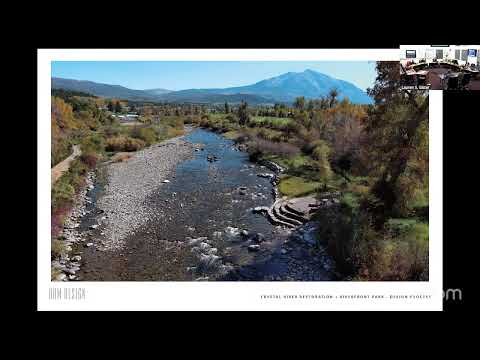
Designers presented a 16‑panel interpretive and regulatory signage package for the Crystal River Riverfront Park and told the Town of Carbondale Board of Trustees the signs are being fabricated and scheduled for installation in the last two weeks of March.
Jason James, landscape architect with DHM Design, said the signs are intended to interpret restoration work, show on‑site processes and give visitors context they can see at the sign location. “You can stand in the spot where you’re looking at the sign and you’re looking at the events or the context or the activities that are happening right in front of you,” James said.
The designers described a family of signs: a large entry kiosk with regulatory information and partner acknowledgments, an outdoor‑classroom cluster of larger panels for school groups, and a tapering series of smaller interpretive panels down the river trail. Sabra, a DHM designer, said the identity and logo draw on river contours and trout scale patterns; color choices are derived from the park’s natural palette with controlled “pops” to emphasize key details.
Trustees and staff were given details on materials and maintenance. The panels will be printed on UV‑ and vandal‑resistant polycarbonate and mounted on Corten (rust‑colored) steel posts. James described the printed panels as replaceable and said the expected useful life for the graphics is roughly 8–10 years, depending on exposure. He said the panels are mounted with concealed fasteners so they can be removed and replaced without dismantling the supporting steel.
Installation will be hand‑carried and largely completed with hand tools because of a narrow site‑access window tied to a mandatory seasonal wildlife closure for migratory birds and bald eagles, the designers said. “They may use battery power tools, but we have a very narrow installation window that has to do with the closure for bald eagles,” James said.
Trustees’ questions focused on wayfinding, maintenance and regulatory clarity. Trustee Ross asked that maps be oriented to the viewer on every panel so “east is east and west are the way we’re facing,” citing common wayfinding mistakes on other trails. Trustee Christina asked about longevity; designers replied that panels in indirect sunlight would last about 8–10 years before needing replacement and that the polycarbonate prints can be swapped in the field.
Trustees also pressed for clarity on dog restrictions. James and Sabra said regulatory requirements will be consolidated on an entry kiosk and reinforced with iconography on a vertical column near the main gate: “no camping, no glass bottles, no dogs,” illustrated to make rules clear without adding many small signs. Trustees asked staff to monitor whether the consolidated regulatory signage eliminates temporary “store‑bought” no‑dog signs that have been used on the site.
Board members also discussed the park logo and whether the design language should be extended to other parks. Trustee Colin suggested the signage palette and identity could be used across town parks for a consistent visitor experience.
Trustee Yalena noted staff plans for a grand‑opening event after the mandatory wildlife closure and after signs are installed. Several trustees asked staff to circulate a high‑resolution PDF of the signage package.
The presentation team credited multiple local partners, including River Restoration, Roaring Fork Conservancy and county healthy‑rivers programs, for technical review and stakeholder input during the year‑long design process.
The trustees took no formal vote. Staff and the designers said they will return progress updates as fabrication and the installation schedule advance.