Get Full Government Meeting Transcripts, Videos, & Alerts Forever!
Get email alerts on the Education topic
No spam. Unsubscribe anytime.
Senate advances Reid Act fix to allow reduced instructional hours for secondary teachers' training
Summary
The Minnesota Senate on Feb. 10 debated a narrow change to the Reid Act implementation that would let school districts reduce instructional hours in order to make time for required teacher training during the 2025–26 school year.
The Minnesota Senate on Feb. 10 debated a narrow change to the Reid Act implementation that would let school districts reduce instructional hours in order to make time for required teacher training during the 2025–26 school year.
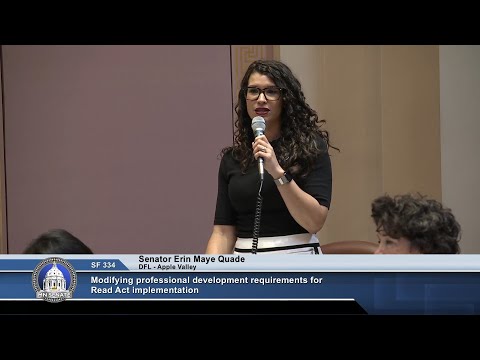
Sponsor Senator May Quade told colleagues the bill is a “very short and simple” piece of the broader Reid Act package and said the change is intended to give teachers time for required training. “This amendment just clarifies that the hours of instruction reduction is applicable to secondary schools only for the 2526 school year,” Quade said while offering the A2 amendment.
The A2 amendment was adopted on voice vote and the bill proceeded as “Senate File 334 as amended.” Senator Duckworth, speaking in support, urged continued bipartisan work to expand approved options districts may use to meet instructional-hour requirements and said many districts want “more than just the 3 that are currently available to them” for meeting instructional requirements.
Nut graf: The change before the Senate narrows the 2025 portion of Reid Act implementation to permit reduced classroom hours at secondary schools so teachers can receive required training. Supporters said the amendment clarifies which grade levels the relief targets and was agreed to by the bill’s coalition.
Details and context
Senator May Quade said the broader Reid Act investment last biennium exceeded $100 million for evidence-based literacy efforts and that the bill under consideration is an urgent, limited amendment focused on implementation logistics for the coming school year. Quade described the amendment as a drafting clarification meant to ensure the reduction applies only to secondary schools for the 2025–26 school year.
Senator Duckworth commented that the bill is a helpful step and called on colleagues to continue bipartisan conversations about additional instructional options and curricula for educators and districts.
Action in the chamber
- A2 amendment to Senate File 334 (clarifies reduced instructional hours apply to secondary schools for 2025–26) was offered by Senator May Quade and adopted by the Senate (voice vote). - The transcript records the Senate proceeded with “Senate File 334 as amended” and a roll call was started in the excerpt, but the final vote tally or disposition of the amended bill is not recorded in the transcript provided.
What the bill would do
According to the sponsor’s floor remarks, the provision would permit districts to reduce instructional hours for students in the 2025–26 school year to create time for teacher training required by the Reid Act. Supporters characterized the measure as a narrowly targeted, temporary implementation adjustment; the transcript contains no final enrolled-text language and no details on how individual districts would document or report such reductions.
Missing details and limits
The transcript and floor remarks do not specify: how many hours may be reduced, whether reduced hours would affect seat-time or graduation requirements, which specific teacher training activities qualify, or what state reporting or approval (if any) would be required for a district to use the reduced hours. Those operational details are not recorded in the excerpt and are therefore not asserted here.
Ending
Floor supporters described Senate File 334 as a limited implementation fix to the Reid Act intended to give educators time for required training in 2025–26. The amendment clarifying that the relief applies only to secondary schools was adopted on the floor; the transcript provided does not include the bill’s final roll-call outcome in this session excerpt.