Get Full Government Meeting Transcripts, Videos, & Alerts Forever!
Get email alerts on the Grants Management topic
No spam. Unsubscribe anytime.
Auditors tell House panel statewide grants oversight lacks standards, enforcement
Summary
Legislative auditors told the House Fraud Prevention and State Agency Oversight Committee that Minnesota’s statewide grants policies lack detail, agencies often fail to follow existing rules, and data systems and training are insufficient to give the Legislature a reliable view of $‑scale grant spending to nonprofits.
The Office of the Legislative Auditor told the Minnesota House Fraud Prevention and State Agency Oversight Committee on Feb. 10 that statewide grants management policies often lack detail, agencies commonly fail to follow those policies, and the state’s accounting data do not give the Legislature an adequate picture of grant activity.
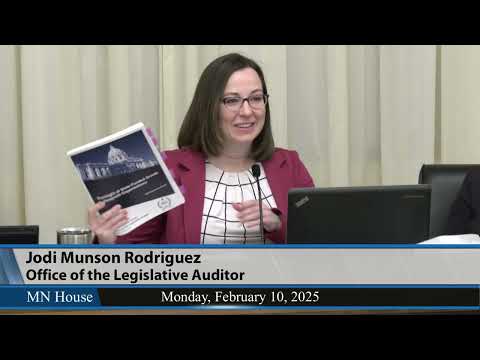
For the record, Legislative Auditor Judy Randall and Deputy Legislative Auditor Jody Munson Rodriguez presented findings from the Office of Legislative Auditor’s 2023 evaluation “Oversight of State‑Funded Grants to Nonprofit Organizations,” and its follow‑up materials. Randall and Munson Rodriguez said the report found widespread noncompliance with grants management policy, gaps in training and tools for grant managers, and limited statutory authority to enforce policy.
The issue matters because state agencies award roughly $514 million a year to nonprofit organizations, on average, according to the auditors’ review of fiscal 2018–2022. Auditors said agencies awarded grants to about 2,400 unique nonprofit organizations in that five‑year period; the median award was about $68,000 and 75% of awards were under about $440,000. Chair Kristin Robbins said the committee was formed to dig into this kind of issue after press reports and concerns about large fraud schemes.
Auditors’ findings and examples
Deputy Legislative Auditor Jody Munson Rodriguez told the committee that the Department of Administration’s Office of Grants Management (OGM) policies cover the grant lifecycle but often “lack important detail” on how agencies should implement them. Examples cited by Munson Rodriguez included: pre‑award financial reviews that do not require stepped‑up monitoring for high‑risk grantees; progress‑report requirements that lack standardized content or format; monitoring visits that may be conducted by telephone rather than on‑site; and no firm time frames for completing closeout reviews.
Randall and Munson Rodriguez said those policy gaps help explain repeat findings from OLA audits and evaluations across multiple agencies. Auditors also described uneven agency capacity: only 40% of surveyed grant managers reported using an electronic grants management system, and many grant management duties are handled by staff with other primary responsibilities.
Data and enforcement problems
Auditors said Minnesota’s accounting system (SWIFT) is not designed to provide comprehensive, programmatic information about grants. Munson Rodriguez said OLA had to cross‑check SWIFT against other sources, including the IRS nonprofit database, to identify nonprofit grantees. The auditors recommended the Legislature consider options to improve statewide grant data and assess a single grants management system; the Legislature in 2023 directed the Department of Administration to assess a single system’s viability, the auditors said.
On enforcement, auditors told the committee statutes provide limited authority to enforce agency compliance with OGM policy. Randall said the Legislature in 2023 gave the Department of Administration some new discretionary powers—such as limited suspension or debarment authority—but many duties remain discretionary rather than mandatory.
Training, conflict of interest and monitoring
Auditors urged mandatory baseline training for grant managers. Munson Rodriguez said many grant managers have strong program knowledge but lack training on specific policy steps—financial reconciliation, detecting fraud and required closeout procedures—that cause unintentional noncompliance. Randall said requiring training on grants management policy generally would cover topics such as reconciliation and monitoring without the Legislature needing to list every module in law.
Committee members pressed auditors on conflict‑of‑interest documentation and monitoring visits. Munson Rodriguez and Randall said OLA continues to find instances where conflict‑of‑interest disclosures are not documented in grant files, and that while some agencies have automated disclosure checklists, others rely on ad hoc or verbal disclosures that leave no paper trail. Auditors said on‑site monitoring visits provide the most reliable verification but acknowledged travel and staffing resources constrain agencies; they recommended on‑site visits be required for grants above appropriate thresholds.
Legislatively named grants and agency oversight
Auditors reiterated a long‑standing OLA recommendation that the Legislature avoid naming specific grantees in appropriation language when possible. Randall said naming grantees in law can create mixed signals: agencies are required to follow OGM policies for all grants, but legislatively named grants frequently receive less active oversight in practice because the award is predetermined.
Legislators’ reaction and next steps
Members of both parties said they planned follow‑up. Representative Dave Pinto asked whether the committee would hear from OGM; Chair Kristin Robbins said OGM will be invited to present to the committee so members can review what the department implemented after the 2023 law changes. Several members asked OLA to provide examples of stronger agency practices and suggested the committee consider whether to require training, strengthen data collection, or increase external or internal auditing of grants.
No formal committee actions or votes were taken at the hearing. The chair closed the meeting after naming the auditors’ update booklet in members’ packets as a resource and scheduling the committee’s next meeting for Monday at 8:15 a.m.
Ending
The auditors left the committee with a list of implementation items: strengthen OGM policies (more specific standards for progress reports, monitoring and closeouts), expand training for grant managers, improve statewide grant data and consider enforcement options. Committee members signaled bipartisan interest in pursuing follow‑up briefings, including a presentation from the Office of Grants Management and possible proposals on training and data improvements.