Get Full Government Meeting Transcripts, Videos, & Alerts Forever!
Get email alerts on the Public Health Budget Mdh topic
No spam. Unsubscribe anytime.
MDH asks Legislature to backfill federal cuts, raise fees for water, licensure and inspections
Summary
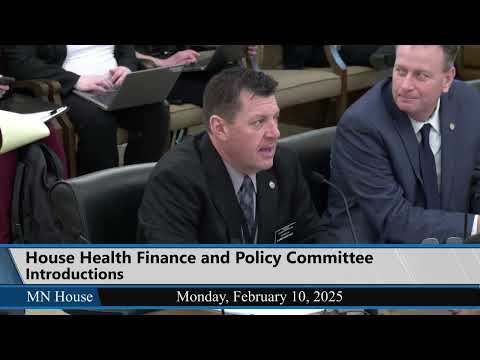
At a Feb. 10 House Health and Finance Policy hearing, Minnesota Department of Health Commissioner Brooke Cunningham urged state funding to replace waning federal COVID-era support and asked for multiple fee increases to maintain inspections, drinking-water protection and regulation of assisted-living and health facilities.
Commissioner Brooke Cunningham, of the Minnesota Department of Health, told the House Health and Finance Policy Committee on Feb. 10 that MDH needs state support to absorb expected federal funding reductions and to maintain core public-health services.
"At MDH our mission is to protect, maintain and improve the health of all communities," Cunningham said, summarizing the department's role in everything from infectious-disease response to drinking-water protection, newborn screening and WIC services.
Cunningham framed the request as a response to shrinking federal support and rising operating costs. She told the committee that local public-health departments across Minnesota spend about $400 million collectively while the state's health-care spending approaches $67 billion, and that the number of local public-health full-time equivalent staff per 100,000 people has fallen roughly 22% over the last 20 years.
The department's budget package includes two main General Fund cost proposals plus several fee increases and budget-neutral changes. The largest General Fund ask is to sustain infectious-disease prevention and response capacity as COVID-era federal funding declines. Cunningham noted continuing threats such as bird flu, Ebola-related events noted by federal partners, and rising tick- and mosquito-borne illness, and she said an aging population and more people living in congregate care increase vulnerability.
Key proposals and details
- Infectious-disease prevention and response: state funding to replace federal COVID-era investments that supported outbreak detection, testing and response teams.
- Public water and well programs: a proposed increase in public-water-supply fees to offset an MDH projection of a $60–$70 million reduction in EPA funding over three years. MDH noted that about 80% of Minnesotans rely on public water systems and roughly one-fifth rely on private wells.
- Assisted-living licensure and facility regulation: fee increases to support licensing, inspections and certification work for assisted-living and other regulated health facilities; MDH says the number of assisted-living providers rose about 25% since the last fee adjustments in some categories and that fees in many licensing buckets have not been updated for years (examples given: engineering plan review fees not updated since 2013; HMO fees not updated since 1999).
- Food, pools and lodging: a proposed licensing fee increase MDH estimates will raise roughly $5.4 million annually. MDH said the revenue will primarily fund additional inspection capacity, credentialing and data-system upgrades and that without it mandated inspection frequencies and plan-review timeliness would slip.
- Radioactive materials and X-ray regulation: fee increases for radioactive-material licenses (MDH enforces NRC agreements) and a proposed statutory change to move X-ray inspections from a fixed four‑year interval to a risk‑based interval; X‑ray fees were last adjusted in 2009.
- Asbestos statute change: MDH requested amending Minnesota Statutes §326.72 to remove the word "intending," which the department said limits enforcement when permit thresholds are circumvented.
- Operations adjustment: a modest General Fund request (Cunningham described $2.4 million in operations adjustments in committee questioning) to cover higher personnel compensation and nonpersonnel operating costs such as IT, rent, utilities and legal services.
Budget‑neutral proposals
Cunningham also described several budget‑neutral or reauthorization requests: continuing and removing the sunset on the Early Hearing Detection and Intervention advisory committee; changing the maternal and child health advisory task force into an advisory committee (so it would not sunset and could reimburse members); restoring part of last-session reductions to local cannabis and substance-misuse prevention grants by shifting funds within the substance-use appropriation; authorizing direct access for tribal governments to American Indian Health special-emphasis grants (no competition); reauthorizing the State Trauma Advisory Council; and extending the PFAS biomonitoring project for firefighter health research to complete its work.
Committee questions and concerns
Committee members pressed for more detail about how specific fee increases would be used. Representative Danny Nadeau and Representative Nadal (transcript identification) asked for explicit breakdowns of the $5.4 million food/pool/lodging revenue and how much would go to staffing, credentials and the hospitality fee. Cunningham said about 70% of the aggregated hospitality/ licensing revenue increase would be fee revenue, with roughly 25% coming from an increased hospitality fee; she offered follow-up from environmental-health division staff for detailed accounting.
Representatives also asked about assisted-living enforcement and whether pandemic-era enforcement actions used the same rules as today; Cunningham said MDH would follow up with the health regulation team to provide specifics to the committee. On well-management and county fees, Tom Hogan, MDH Environmental Health Division director, told the committee that well fees are paid through the property-transfer mechanism, and MDH is discussing automation with county recorders to reduce county burden.
Why this matters
Cunningham said investment in public health yields high returns: MDH cited a median $14.30 return for every $1 invested in public-health interventions and presented examples (a $35 million prevention effort on physical activity and smoking produced an estimated $365 million in avoided obesity-related spending). The department argued that without state action to replace federal reductions and update long‑outdated fees, inspection timeliness, regulatory capacity and data systems will degrade.
What did not change today
No formal committee votes were taken at the hearing. Cunningham emphasized MDH seeks continued partnership with the Legislature and invited follow-up from members and subject-matter staff.
Ending note
Cunningham closed by introducing staff in the room who would follow up with committee questions, including Autumn Baum (assistant legislative director) and Bridal White (finance)."We want to be your partners in protecting, maintaining and improving the health of all Minnesotans," she told lawmakers.