Get Full Government Meeting Transcripts, Videos, & Alerts Forever!
Get email alerts on the Transportation Funding topic
No spam. Unsubscribe anytime.
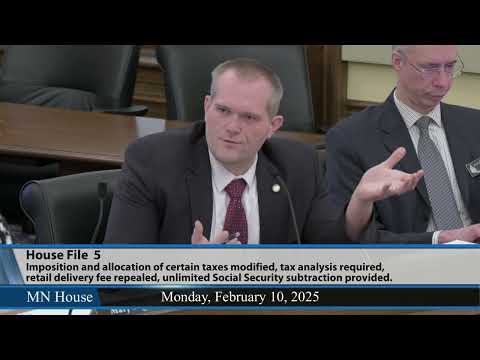
House committee advances HF5 to Taxes after debate over delivery fee, gas tax indexing and Social Security subtraction
Summary
The Minnesota House Transportation Committee voted to send House File 5 to the House Tax Committee after lengthy testimony and several roll-call amendment battles, with the motion to move the bill approved 8-7.
The Minnesota House Transportation Committee voted to send House File 5 to the House Tax Committee after lengthy testimony and several roll-call amendment battles, with the motion to move the bill approved 8-7.
HF5, sponsored by Representative Sarah Joy, would fully subtract Social Security income from state taxable income, repeal the retail delivery fee enacted in 2023, and remove or cap the automatic inflation indexing of the state gas tax — changes the bill’s proponents say will make Minnesota more affordable. Opponents from the Minnesota Department of Transportation, local governments, transit advocates, labor unions and many businesses warned the changes would reduce dedicated transportation revenue and put projects, safety improvements and transit operations at risk.
Why it matters: Committee fiscal staff estimated the delivery-fee repeal and the gas-tax cap would reduce transportation-related revenues by roughly $131 million in the 2026-27 biennium and $112 million in 2028-29. Minnesota Department of Transportation Commissioner Nancy Daubenberger told the committee that even before HF5 the state faces an annual funding gap for roads of almost $2 billion for networks funded through the highway-user distribution fund. "If the legislature enacts reductions in planned transportation investments that would result from House File 5, pavement, bridge and other roadway infrastructure conditions will suffer," Commissioner Daubenberger said.
Author and bill scope: Representative Sarah Joy, the bill’s sponsor, told the committee HF5 is intended to reduce costs for seniors and other households by cutting taxes on Social Security and repealing what she called burdensome new fees. "This is making Minnesota more affordable for seniors and everybody," Joy said during her presentation. Joy described the measure as a work in progress and said she expects continued bipartisan work as the bill advances.
Business and retail testimony: Steve Bartle, director of government relations for the Minnesota Grocers Association, and Bruce Neustad of the Minnesota Retailers Association said the delivery fee has imposed substantial administrative and compliance costs on retailers, especially small stores. Bartle told members that retailers face software upgrades, additional staffing and transaction fees that can exceed the 50-cent delivery charge collected per order, and that the fee applies to many common household items. "The added cost of system upgrades and administration impacts operations' bottom line and are ultimately reflected in the price of goods on store shelves," Bartle said.
Local governments and townships: Testimony from the Minnesota Association of Townships and county officials said many local governments already carry a large share of the state’s road network and rely on state funds to maintain it. Grama Berg Moberg of the Minnesota Association of Townships said townships—roughly 16% of the state population but responsible for about 41% of road miles—face growing funding pressures. Scott County Board Chair Dave Beer said counties want to be made whole if state funding is reduced and asked legislators to coordinate changes with local delivery agencies.
Transit, labor and safety concerns: Labor union representatives and transit and environmental advocates urged rejection of the bill’s transportation cuts. Chris Fretzen of LiUNA (laborers union) warned that repealing the delivery fee and other revenue reductions would cut roughly $100 million in road and bridge funding over two years and that indexing the gas tax is necessary to keep pace with construction costs. Peter Regenius of the Sierra Club and Move Minnesota Action’s Nasir Akati urged lawmakers not to undermine recent investments in bus rapid transit and other transit expansions begun under the 2023 transportation law. "It is not the time to undermine it," Regenius said, pointing to measurable ridership gains on recent BRT lines.
Amendments and committee action: The committee considered and voted on multiple amendments. The author's A1 amendment (an author's technical amendment) was adopted by voice. Lehi Cagle’s A2 (which would have restored the delivery fee repeal) failed on roll call. Several proposed amendments removing the Social Security subtraction and the gas-tax indexing also failed or were withdrawn, while an A6 amendment requiring an analysis of the bill’s transportation funding impacts passed. An A9 amendment adjusting the registration-fee analysis language also passed. After all amendments, the committee approved a motion by Representative Joy to move HF5, as amended, to the House Tax Committee; the roll call recorded 8 ayes and 7 nays.
Votes at a glance: HF5 — Motion to move bill to Taxes (as amended): Passed on roll call, 8–7 (ayes–nays). A1 (author's amendment): Adopted (voice). A2 (restore delivery fee repeal): Failed (roll call; committee announced amendment did not prevail). A3 (remove Social Security subtraction): Withdrawn by the sponsor. A4 (remove gas tax indexing): Failed (roll call). A5 (remove motor-vehicle registration analysis): Failed (roll call). A6 (require fiscal/transportation-impact analysis): Adopted (voice). A7 (keep delivery fee to Transportation Advancement Account, delete rest of bill): Failed (voice). A8 (proportional distribution of cuts by population): Failed (voice). A9 (add migration/registration-fee language to analysis): Adopted (voice).
What’s next: HF5 will now be considered by the House Tax Committee. Representative Joy and several members signaled a desire to continue negotiations and to produce additional analyses and data before final votes. Commissioner Daubenberger and MnDOT said they will provide requested condition and funding information to the committee.
The committee hearing included roughly two dozen testifiers and spanned several hours with detailed questioning from members about fiscal impacts, local effects and tradeoffs between affordability and transportation investment.