Get Full Government Meeting Transcripts, Videos, & Alerts Forever!
Get email alerts on the Transit Funding topic
No spam. Unsubscribe anytime.
Metropolitan Council proposes advance to MnDOT, free Metro Mobility rides and $32.45M general‑fund cut; committee probes long‑term impact
Summary
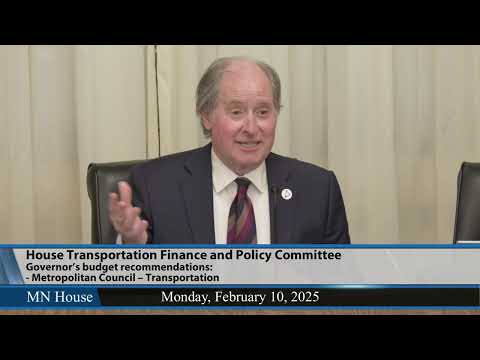
Metropolitan Council Chair Charlie Zelle told the Minnesota House Transportation Committee that the council is proposing to advance cash to MnDOT to coordinate a highway/transit project, to continue free rides for Metro Mobility users on fixed‑route service, and to accept a $32,454,000 annual reduction in state general‑fund transit aid.
Metropolitan Council Chair Charlie Zelle told the Minnesota House Transportation Committee that the council is proposing three linked budget and policy moves: advance cash to the Minnesota Department of Transportation (MnDOT) to coordinate a major highway reconstruction with a transitway build; continue making Metro Mobility riders eligible for free trips on fixed‑route service; and accept a $32,454,000 annual reduction in the council’s state general‑fund appropriation for Metro Transit.
Why it matters: the package mixes a financing maneuver, a service change intended to shift some paratransit riders to fixed‑route service, and a sizable ongoing operating cut that Met Council officials said will be manageable in the near term but will reduce resources available for expansion and long‑term capital maintenance.
Zelle described the proposed MnDOT advance as a temporary use of council reserves to synchronize a state highway reconstruction and bus rapid‑transit (BRT) construction so both projects can proceed at once. Zelle said that coordinating the projects would reduce disruption and lower total costs; he framed the move as an interagency loan, not a permanent reallocation of funds.
On the Metro Mobility pilot, Charles Carlson, executive director of Metropolitan Transportation Services at the Met Council, told the committee the program has produced fixed‑route trips certified as Metro Mobility trips during the pilot. “During the pilot period, about 75,000 folks, certified Metro Mobility rides occurred on the fixed route system,” Carlson said, and Met Council staff told the committee that if a mature program diverted only about 2 percent of Metro Mobility trips to fixed route the state could realize savings on the higher‑cost paratransit program.
The third item is a reduction in a legacy general‑fund appropriation to Metro Transit. Zelle said the council can absorb the cut in the near term because new and diversified revenue streams — including the 0.75 percent metropolitan sales and use tax enacted in 2023 — have improved the agency’s fiscal position. He cautioned, however, that the cut would reduce the council’s capacity for future service expansion and long‑term capital maintenance.
Representatives on the committee pressed Zelle and Met Council staff on the practical effects of the cut. Representative Bjorn Wilson asked what the reduction would affect and when; Zelle and Carlson told the committee the impacts are likely to appear in later years as reserves are drawn down and as the system takes on the operating costs of new lines opening in the next several years (the council cited multiple projects opening this year and the Green Line extension scheduled for 2027). Representative Lucy Ream and others asked whether the cut would prevent construction of a new BRT line; Zelle responded that the cited figure represents near‑term operating savings rather than capital funding and that capital build‑out typically uses a mix of federal, local and state capital dollars.
Committee members also asked for data behind the Metro Mobility pilot. Carlson said the pilot generated roughly 75,000 fixed‑route rides by certified Metro Mobility users and that Met Council staff are continuing to collect and analyze data on how many trips would shift permanently to fixed route.
Several members raised the scale of new revenues tied to the metropolitan sales tax. Fiscal staff Andy Lee told the committee that the 0.75 percent metro sales and use tax is estimated to produce roughly $465 million in 2025 and grow to roughly $493 million in 2027 for the Metropolitan Council’s share (the transcript and staff handouts gave a four‑year Metropolitan Council total of about $1.739 billion across fiscal 2024–27).
No formal committee action or vote on the Met Council proposals occurred at the hearing. Zelle closed by saying the council will return for a deeper briefing on transit programs and budget details.
Ending: Committee members told Zelle they would continue to press for detail as the legislature moves into longer budget and policy deliberations; the committee scheduled further hearings and asked Met Council and fiscal staff to provide additional supporting data on the pilot and on long‑range operating projections.