Get Full Government Meeting Transcripts, Videos, & Alerts Forever!
Get email alerts on the Building Energy Performance Standards topic
No spam. Unsubscribe anytime.
Council hears DEP and Green Bank on revised Building Energy Performance Standards; vote set for Feb. 25
Summary
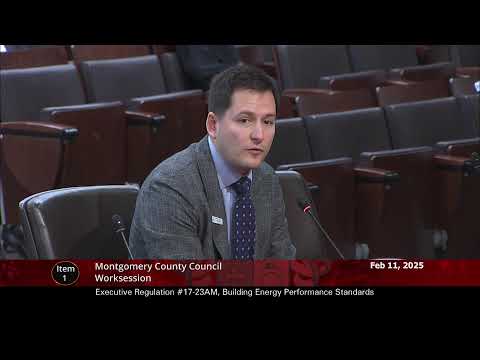
The Montgomery County Council review of revised executive regulation 17-23 (Building Energy Performance Standards) focused on compliance options, a 30% performance cap, funding through the Montgomery County Green Bank and a Feb. 25 scheduled council vote.
The Montgomery County Council on a Feb. 2025 work session reviewed amended executive regulation 17-23 (Building Energy Performance Standards, BEPS) and heard Department of Environmental Protection (DEP) and Montgomery County Green Bank staff explain implementation details, funding and technical assistance. The Transportation and Environment Committee recommended approval 3–0; the council scheduled action for Feb. 25, with a statutory 60‑day method-2 deadline of Feb. 28 noted in the session.
Why it matters: BEPS implements a county law directing large commercial and multifamily buildings to benchmark energy use and meet interim and final performance standards over a long timeline. The regulations define how standards are calculated, include compliance options and set explicit flexibilities to account for building differences and concerns raised by hospitals, life-science firms, affordable-housing providers, common-ownership communities and others.
Department presentation and key changes: John Monger, director of the Department of Environmental Protection, said the regulations were revised after year-long stakeholder engagement and emphasized the program's role in meeting county climate goals. He described the addition of a 30% performance cap and other modifications as responses to stakeholder input: "This provides flexibilities for those buildings that are furthest away from their standard," Monger said. Emily Curley, DEP's Building Energy Performance Programs manager, summarized how standards are set and compliance options: covered buildings (commercial and multifamily 25,000 square feet and larger, roughly 1,800 countywide) must benchmark annually (data due June 1) and receive a baseline, interim standard and a final standard; the final standard is the greater of a type-specific site energy intensity or a cap of a 30% reduction from the building's baseline.
DEP outlined two primary compliance paths. Under the performance path, owners must achieve a normalized net site energy-use intensity at or below their interim or final standard. Under the Building Performance Improvement Plan (BPIP) path, owners submit a tailored retrofit plan focused on cost-effective measures; buildings that file a BPIP must implement measures with simple paybacks of five years or less before the final deadline. DEP also designated a set of "specially designated buildings"—including affordable housing, common ownership communities (condos/co-ops), nonprofit-owned buildings, hospitals, houses of worship, private schools and small-business-owned buildings—which are evaluated using a shorter payback threshold for cost-effectiveness (a 10‑year payback or the equipment life, as defined).
Funding, technical assistance and the Green Bank: Councilmembers and DEP staff emphasized the role of funding and a technical-assistance pipeline. Steven Murrell, CEO of the Montgomery County Green Bank, said the Green Bank received $68,000,000 through the federal Greenhouse Gas Reduction Fund (GGRF) competition and will use those funds to subsidize technical assistance and to leverage private capital for projects. Murrell described a technical-assistance roster that has grown to more than 30 providers, and the Green Bank's ability to bridge tax credits and provide financing so owners do not front full costs waiting for federal incentives. "We have a cadre of service providers in our technical assistance program," Murrell said, and the bank plans a revolving approach to preserve capital and to support a multi-year pipeline of projects.
Council questions and discussion: Councilmembers pressed staff on state–local coordination (the council's regulations aim to remain compatible with pending state BEPS actions), public-health co-benefits such as lower indoor nitrogen dioxide levels, staffing and outreach capacity at DEP, and protections for renters and naturally occurring affordable housing. DEP and Green Bank staff said the long compliance timeline (final standards generally set in the late 2020s–mid 2030s) gives buildings time to assess and phase in measures, and that DEP provides benchmarking scorecards, help-desk support, and outreach through the Building Performance Improvement Board and Green Bank programs. DEP staff also noted that about one-third of covered buildings already meet their final standard based on existing benchmarking data.
Actions recorded in the session: the Transportation and Environment Committee previously recommended approval 3–0 of the revised regulation; the council president announced a scheduled council vote for Feb. 25 and reminded members the method-2 deadline for action is Feb. 28 (if no council action occurs, the executive's transmitted version would take effect by default). The Green Bank confirmed resources and a BEPS readiness program to help owners complete benchmarking, feasibility studies and implement measures.
What remains: The council will decide whether to approve the regulation on Feb. 25, extend the method-2 deadline, or take no action (which would allow the executive's transmitted regulation to take effect by default on the statutory timeline). DEP and the Green Bank will continue outreach and technical-assistance enrollment; councilmembers asked staff to continue public communication to reduce uncertainty and to coordinate with the state as its legislative process proceeds.
Speakers and staff cited during the session included Council President Kate Stewart; Chair Glass (Chair, Transportation and Environment Committee); Councilmembers Balcom, Lukey, Friedson, Malcolm, Sales, Mink and others; John Monger, director, Department of Environmental Protection; Emily Curley, DEP Building Energy Performance Programs manager; Stan (DEP climate team lead); Steven Murrell, CEO, Montgomery County Green Bank; Louis (DEP engineering staff); and representatives of hospitals and housing stakeholders.