Get Full Government Meeting Transcripts, Videos, & Alerts Forever!
Get email alerts on the Csi Schools topic
No spam. Unsubscribe anytime.
PGCPS outlines supports for 24 CSI schools; principals describe strategies to boost attendance and instruction
Summary
Prince George's County Public Schools presented its districtwide approach to supporting 24 schools designated as Comprehensive Support and Improvement schools during the Feb. 10 Academic Achievement Committee meeting, and three principals described on‑the‑ground strategies to improve attendance, instruction and school leadership.
Prince George's County Public Schools presented its districtwide approach to supporting 24 schools designated as Comprehensive Support and Improvement schools during the Feb. 10 Academic Achievement Committee meeting, and three principals described on‑the‑ground strategies to improve attendance, instruction and school leadership.
The Maryland State Board of Education designates Comprehensive Support and Improvement (CSI) status. Kia McDaniel, director of curriculum and instruction, told the committee that PGCPS currently has 24 CSI schools: 15 elementary, three middle, three K–8 and three high schools. "A CSI school stands for a comprehensive support and improvement school," McDaniel said.
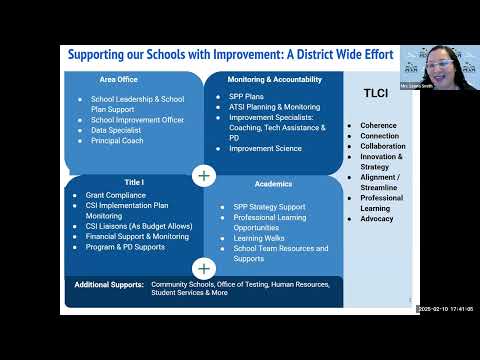
PGCPS staff said the district combines cross‑departmental coaching, principal institutes, targeted professional development and community schools funding to help CSI schools meet state exit targets. McDaniel described a biweekly steering committee that coordinates supports across Accountability, Academics, area teams and Title I and said the district has launched a cross‑departmental school plan review protocol. "We want to make sure that we are eradicating any silos unintentionally and that we are all working together to support our students, our families, and our schools," she said.
Principals from Doswell Brooks Elementary, Samuel P. Massey Academy and Bladensburg High School described site-level practices. Dr. Anita Stoddard, principal at Doswell Brooks, said her school’s special education population is high because Deaf and Hard of Hearing students served there all have individualized education programs; she said the school’s special education population is 29 percent. Doswell uses quarterly "stat days" for teachers to present and discuss data, and Stoddard highlighted a CSI liaison who leads the school’s CSI plan and coaches teachers. "She is the person who says, 'daughter, we need to do this,'" Stoddard said of the liaison.
Brandy Smith, principal of Samuel P. Massey Academy, said the preK–8 neighborhood school serves about 480 students and that the school's CSI designation is for students with disabilities. She said the school has focused heavily on chronic absenteeism and staff professional learning; chronic absenteeism fell from 50 percent in school year 2022–23 to 40.7 percent at the end of 2023–24 and to about 28 percent currently, Smith said. Strategies include a middle‑school mentorship program, attendance incentives, home visits and funding for two student advocates and a parent engagement assistant.
Lisa Faulkner Jones, principal of Bladensburg High School, said the high school enrolls about 2,164 students and serves a highly transient population. She said multilingual learners have shown gains through schoolwide language strategies and that some students are earning the Seal of Biliteracy. "At the core of OGAP ... OGAP is teacher knowledge and professional development grounded in mathematical educational research," Faulkner Jones said, describing use of OGAP (Ongoing Assessment Project) math tasks and language‑development strategies.
District specifics on professional development: staff reported 86 CSI‑school teachers attended the OGAP four‑day summer institute and a winter cohort added about 60 teachers; McDaniel said 100 percent of summer participants reported the training would enhance their practice. Central office and OGAP facilitators provide follow-up coaching and school visits.
Officials said exit criteria differ by identification type: high schools identified for low graduation rate must exceed a 66.7 percent graduation rate for two consecutive years to exit CSI status; schools identified for a low‑performing student group must move above the state's lowest 5 percent of Title I schools and meet annual state targets for the identified subgroup.
The presentation emphasized coordinated support cycles: principal coaching, monthly CSI principal professional learning, area team quarterly reviews and a district progress‑monitoring tool. McDaniel said the district will continue OGAP, coaching, quarterly data reviews and a summer leader institute to build capacity.
Votes at the meeting included routine housekeeping: the committee adopted the Feb. 10 agenda by unanimous assent and approved the Jan. 27 meeting minutes. There were three committee members present and no recorded objections.
The district said it will provide the board with the list of CSI schools and promised to clarify how CSI lists are posted on district websites. McDaniel and principals noted CSI and related supports are ongoing and said staff will continue to provide updates to the board and the public.