Get Full Government Meeting Transcripts, Videos, & Alerts Forever!
Get email alerts on the Cpd Mobile Vendor Park topic
No spam. Unsubscribe anytime.
LPA hearing on proposed mobile‑vendor park at 2525 Estero Boulevard draws interventions, experts and requests for traffic, valuation analysis
Summary
A contested commercial plan development amendment to allow a food‑truck park and shared parking at Estero Boulevard drew interveners, expert testimony on traffic and property‑value impacts, and a set of provisional procedural rulings; the hearing was recessed for lunch and remains open.
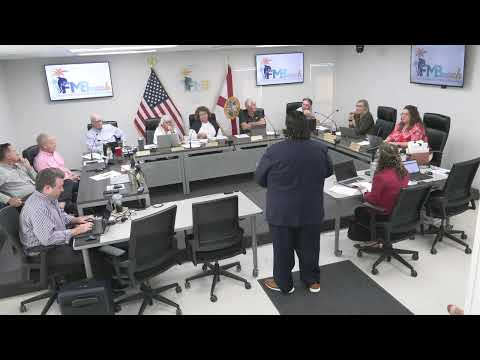
The Local Planning Agency on Feb. 11 conducted an extended, contested hearing on a proposed CPD amendment that would allow a mobile‑vendor (food‑truck) park with a permanent support structure and shared parking on properties at 2525 and 2518 Estero Boulevard and 2543 Cottage Avenue. The hearing included applicant presentations, intervener requests, expert qualifications, the admission of submitted documents, and testimony from interveners and neighbors; the hearing was recessed at noon and remains open.
Why it matters: The application requests a Commercial Planned Development (CPD) amendment and several deviations from the town’s land‑development code to enable a family‑oriented food‑truck park, a two‑story 2,500‑square‑foot permanent support building (including a proposed walk‑up ice‑cream/retail tenant), a separate comfort station for public use, and a shared parking lot. Experts and neighbors said the proposal could increase noise, smells and pedestrian/vehicle activity immediately adjacent to existing residences, raising questions about compatibility, traffic impacts on Estero Boulevard and nearby streets, and potential effects on nearby property values.
Staff overview and changes since January: Judith Frankel, principal planner, told the LPA the applicant revised its master concept plan and conditions since the prior hearing to relocate and enlarge the permanent support structure (from about 1,500 to 2,500 square feet), move a vending pad up toward Estero Boulevard, enlarge the buffer adjacent to Pelican Watch from 5 to 7.5 feet, and change the comfort‑station location. Frankel summarized staff’s recommendation material and noted staff’s list of extensive conditions intended to reduce nuisance impacts; she reminded the LPA that mobile‑vendor parks are not a defined use in the town code and that the applicant relied on nearby jurisdictions’ code language to estimate parking demand.
Intervener status, expert qualifications and evidentiary admissions: The LPA voted to grant intervener status to representatives of Pelican Watch Condominium Association and neighboring property owners and limited each intervener to five minutes of speaking time (per party). The LPA qualified several expert witnesses for the interveners and applicant, including a traffic consultant (Mohsen Salahi), an urban planner (Max Forgy), and a real‑estate valuation expert (Matt Simmons). The LPA also voted to accept documents that had been submitted with the agenda into the record and later agreed to admit an updated map and a set of additional opposition letters provided by the applicant that were not received by the original agenda deadline.
Key testimony in the hearing (selected): - Traffic: Mohsen Salahi, testifying for interveners, explained that Estero Boulevard is functionally constrained in the segment that includes the project area and recommended a traffic‑impact study. He said the corridor already experiences high delays and that additional demand from a concentrated destination could exacerbate queuing and spillover onto adjacent neighborhood streets. “Without a traffic impact study that shows full impact of this development…you don’t know what you’re dealing with,” he told the LPA. - Property values: Appraiser Matt Simmons testified the project was likely to have a negative influence on nearby residential property values, estimating an aggregate decline he characterized at about 8–10% for the Pelican Watch building and a larger influence on immediately adjacent single‑family parcels — potentially in excess of 10% and, in some scenarios, higher. Simmons cited an academic 2017 Portland study of food‑truck parks and said direct adjacency and live entertainment could increase negative effects. - Applicant presentation: The applicant team (represented by Noel Davies and planner Ken Galander) said the proposed CPD is less intense than the property’s by‑right entitlements, emphasized public benefits including a publicly available comfort station, and described multiple revisions to address neighbor concerns (fewer mobile pads, relocation of one pad, added buffering, a raised two‑story support building and limits on hours and outdoor entertainment). “What we’re proposing is less intense than those by‑right entitlements,” Davies told the LPA, and the applicant emphasized its willingness to work with neighbors on conditions. - Neighbors and interveners: Pelican Watch president Randy Bryce and nearby owners Thomas and Deborah Danford contested compatibility, noise, parking spillover and property‑value effects. Deb Danford said, “I have yet to hear one benefit to us and our families as neighbors…we live here,” and the interveners submitted expert reports and drafted mitigations.
Procedural rulings and minutes: The LPA took several procedural steps — admitting agenda materials into the record, qualifying multiple experts, granting intervener status (limited to five minutes per party) and accepting additional maps and letters. The applicant and interveners agreed on an order of presentation that would allow the LPA to hear expert testimony first and then short intervener remarks; the hearing was paused for lunch and reconvened later in the day (the transcript shows the hearing open and not concluded at the time of recess).
Next steps and outstanding items: Several LPA members and interveners requested a traffic‑impact study be prepared to quantify roadway and parking impacts; interveners urged the creation of townwide rules for food‑truck parks so future proposals had predictable standards. The LPA did not take a final vote on the CPD amendment at the February 11 session; the hearing remained open and will resume after the recess to hear remaining testimony and deliberation. Staff indicated it will return to discuss the CPD criteria and provide a written recommendation after the full hearing record is complete.
The hearing record includes expert reports, staff conditions and written opposition letters; the LPA admitted updated maps and letters into the record during the meeting. The meeting was recessed at 12:21 p.m. with the hearing left open for reconvening.