Get Full Government Meeting Transcripts, Videos, & Alerts Forever!
Get email alerts on the State Legislation topic
No spam. Unsubscribe anytime.
County council weighs state energy package, asserts local control and backs public-safety, tenant and nursing-home measures
Summary
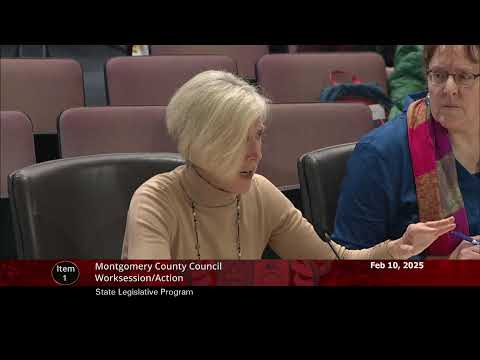
Montgomery County Council members met for a state legislative update and took positions on a broad package of bills, most unanimously, while voting to oppose a leadership‑backed clean‑energy siting and taxation provision that several council members said would preempt local land‑use authority.
Montgomery County Council members met for a state legislative update and took positions on a broad package of bills, most unanimously, while voting to oppose a leadership-backed clean-energy siting and taxation provision that several council members said would preempt local land‑use authority.
Nelani Wanger, director of government relations for Montgomery County, opened the session by calling the General Assembly session “a major work in progress,” and staff walked the council through local bills, companion state bills, and newly introduced energy and climate legislation.
Why it matters: Council members said the contested energy provision would constrain local zoning and remove a local revenue source the county currently collects from solar projects. Members also framed other votes as public‑safety measures (school‑bus stop and traffic camera bills), local economic relief (Purple Line construction parking grants), tenant protections (good-cause eviction), and stronger nursing‑home oversight.
The council debated and agreed positions on more than a dozen bills during the meeting. On the most contentious item, a leadership package solar bill (part of HB 1036 / SB 931 as described to the council), the body voted to oppose the bill because it would bar local governments from denying larger solar projects that meet statewide siting standards and would remove personal‑property and real‑property taxation authority for those projects. Garrett Fitzgerald, section chief for climate programs and state policy in the county’s Department of Environmental Protection, summarized the leadership package and called the governor’s original proposal “the governor’s big energy bill,” explaining components including a renamed renewable portfolio standard and new incentives for nuclear and for expedited natural‑gas generation.
Discussion and outcome highlights
- Solar/clean‑energy bills: Councilmembers raised concerns about preemption of local land‑use authority and the loss of local tax revenue. After debate, a motion to formally oppose the provision that would restrict local zoning authority and taxation passed (yes 8, no 2, abstain 2). Two councilmembers abstained. The body also discussed the broader energy package — including accelerated approvals for natural‑gas plants, small modular nuclear reactors and new statewide siting rules for solar and battery storage — and asked staff and MACo (Maryland Association of Counties) to continue engagement with delegates.
- School‑bus enforcement camera law amendments: The council supported amended state language that narrows where forced stop relocations or crossing guards would be required and delays the effective enforcement threshold, moving the compliance date and narrowing applicability to locations with more than 400 citations in the prior fiscal year. The county executive signaled support for the amendments, and the council voted to support the amended version unanimously.
- WSSC (Washington Suburban Sanitary Commission) requests: The council took no position on a bill that would repeal a statutory dollar threshold for design‑build authority and allow WSSC to adopt its own procurement rules. The council did vote to support a second WSSC bill that would allow WSSC to establish customer classes for fixed “ready‑to‑serve” charges, a change staff said was intended to address residential accounts with larger meters used for sprinkler systems.
- Purple Line construction‑zone parking grant: The council supported a state bill creating a Silver Spring Purple Line construction zone parking improvement grant program. Staff described the draft appropriation in the bill as $50,000 a year for two years as written, and also noted a technical drafting issue that could prevent immediate year‑one funding unless the legislature or governor takes additional action.
- Traffic and camera bills: The council supported local and companion state bills to lower speed limits without requiring an engineering study, authorize stop‑sign monitoring technology, and permit speed cameras on roads identified in the county’s high‑injury network. Staff said about 40 locations are currently restricted under existing law and the local bill would expand where cameras could be used.
- Tenant protections (good‑cause): Because the council had listed tenant good‑cause protections in its state priorities, members voted unanimously to support the good‑cause bills that preserve local authority to prohibit lease nonrenewals without good cause.
- Nursing‑home inspection authority: The council voted unanimously to support bills restoring or clarifying local inspection authority for nursing homes; staff and council members emphasized the need for local oversight and noted potential fiscal impacts if the state does not provide resources for the added work.
Votes at a glance
(HB/SB or local code — short description — council action / result)
- HB 1036 / SB 931 — statewide solar siting / taxation provisions (leadership package) — Oppose (motion passed; yes 8, no 2, abstain 2). - School bus enforcement camera bill (amended, companion) — Support (unanimous). - WSSC design‑build repeal (local) — No position taken. - WSSC customer‑class authority (local) — Support (unanimous; mover: Councilmember Friedson; second: Councilmember Sale). - Silver Spring / Purple Line construction zone parking improvement grant (state bill) — Support (unanimous). - MC 4‑25 / companion state bills (stop‑sign monitoring systems) — Support (unanimous). - MC 17‑25 / HB 1173 (speed cameras on high‑injury network) — Support (unanimous). - HB 744 / SB 590 and HB 883 / SB 710 (reckless/ negligent driving; motor‑vehicle criminal law changes) — Support (unanimous). - HB 348 / SB 520 (local/state highway items) — Approve (unanimous). - Good‑cause tenant protections (priority bill) — Support (unanimous). - HB 429 / SB 376 (nursing‑home inspection authority) — Support (unanimous).
Discussion vs. decisions: The article distinguishes items that were discussion only (for example, newly introduced BRFA/education blueprint changes and many energy package details that staff said had just dropped and require further analysis) from items on which the council gave formal direction or votes (the actions listed above). Staff repeatedly asked the council to continue engagement with MACo and legislative delegations on energy siting, taxation and fiscal impacts.
Background and next steps: Staff said the House Appropriations Committee will conclude operating‑budget hearings on March 3 and that federal earmark requests for FY‑26 are being queued for the county’s delegation (staff identified 11 draft departmental proposals and noted the delegation’s portal closes March 7). The council instructed staff to continue tracking the energy package, follow up on technical drafting issues (for the Purple Line grant), and coordinate with MACo on the solar/taxation provisions. Several council members asked staff to return with fiscal analyses where possible before the next state‑legislative meeting on February 24.
Ending note: While most votes were unanimous, the council’s formal opposition to the solar siting/taxation provision reflected a split among members about state preemption of local land use and fiscal authority. Councilmembers directed staff to pursue additional conversations with MACo and legislative sponsors before the bills' next hearings.