Get Full Government Meeting Transcripts, Videos, & Alerts Forever!
Get email alerts on the Rv Park Alcohol Fencing topic
No spam. Unsubscribe anytime.
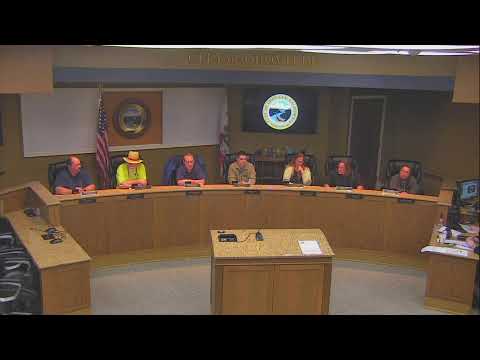
Oroville commissioners approve fencing plan, debate alcohol sales and stay limits for proposed RV resort
Summary
Commissioners added perimeter fencing requirements for the proposed 27-space Oroville RV Park and discussed alcohol sales provisions, security measures and whether visitor stays should be limited to 30 or 60 days. Public commenters and school officials raised safety concerns near adjacent schools.
Oroville — The Oroville City Commission voted to require taller perimeter fencing in portions of the proposed 27-space Oroville RV Park and spent extensive time weighing conditions for alcohol sales, security and guest-stay limits at the Jan. 23 meeting.
The commission approved a motion to require 6-foot fencing along the park’s public-facing frontage and 8-foot fencing along the freeway-facing and school-adjacent boundaries. Commissioners said the change was intended to address concerns raised by nearby schools and neighbors about visibility and access; the motion passed unanimously.
The RV park applicant, Dean Castelbaum, described the project as a private “luxury resort” for RV guests and said the development team plans on on-site managers, trained security staff and video surveillance. “Our intention is not to have a party house at our RV resort,” Castelbaum said, adding the park would use access cards tied to reservations and preloaded funds for purchases inside the park.
The staff report said the parking, security plan and conditioning are part of the resolution and that alcohol sales would require approval by the California Department of Alcoholic Beverage Control (ABC). Staff noted ABC requires a 500-foot notice radius for liquor-license applications (versus a standard 300-foot notice for other permits) and that the city’s municipal code and public-safety standards — including a security plan approved by the chief of police — would apply if alcohol sales are authorized.
Public commenters, including Cody Walker, who identified himself as assistant superintendent of business for the Thornbleedonian Elementary School District, and other residents urged stricter screening and an 8-foot fence next to the school, citing student safety and the adjacent Nelson Pool. Walker said additional sidewalks on Sixth Street would also improve student routes to nearby Nelson Avenue Middle School.
Commissioners discussed technical and operational limits on alcohol sales. Staff and the applicant said the proposal includes two license types: a Type 21-style license for off-premise, sealed-container sales at a welcome center-style supply store, and a second license (likely a Type 47) to allow on-site service in the clubhouse for guests when a bartender is present for events. The applicant said a bartender would be present only when needed, and that the facility would not be open to walk-in customers without reservations.
On the question of how long guests may stay, staff recommended amending a project condition to align with the city’s Uniform Transient Occupancy Tax (TO T) definition. The planning commission’s project-specific condition set a 30-day maximum consecutive stay; staff suggested changing that limit to 60 days to match the city code (OMC Title 3.2). The applicant said he was comfortable with either timeframe and favored the flexibility of 60 days in the event of emergencies or disaster response.
Commissioners discussed operational controls offered by the applicant — ID checks at point of purchase, limits on event-driven service and security patrols — and suggested additional electronic controls on purchases, such as limiting the frequency of alcohol purchases per wristband or card. Staff emphasized that failure to meet conditions (landscape maintenance, lighting, security plan approved by the chief of police and adherence to submitted plans) could ultimately lead to revocation of the use permit.
The commission directed staff to revise the resolution to incorporate the agreed fencing specification and to return updated documents to be signed; staff said those changes could be implemented administratively without returning the item to the commission. The transcript does not record a final roll-call vote on the guest-stay-condition amendment (30 vs. 60 days).