Get Full Government Meeting Transcripts, Videos, & Alerts Forever!
Get email alerts on the Budget And Tribal Relations topic
No spam. Unsubscribe anytime.
Committee lays out 2025 finance and tribal-relations work plan; scheduling, budget reform and tribal summit flagged
Summary
Chair Dan Strauss convened the Seattle City Council Finance, Native Communities and Tribal Governments Committee on Feb. 5, 2025, to review a proposed work plan for the coming year that covers finance measures, budget-process reforms and tribal-relations work including a planned Tribal Nations Summit.
Chair Dan Strauss convened the Seattle City Council Finance, Native Communities and Tribal Governments Committee on Feb. 5, 2025, to review a proposed work plan for the coming year that covers finance measures, budget-process reforms and tribal-relations work including a planned Tribal Nations Summit.
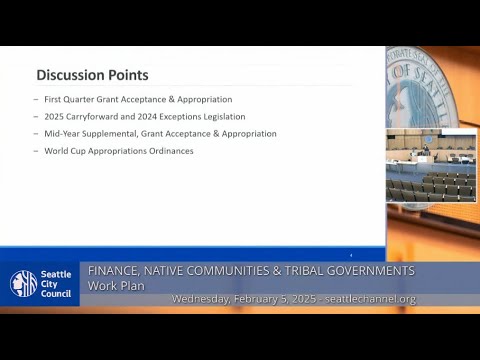
The briefing, presented by Edin Sysich of central staff and Deputy Director Yolanda Ho, outlined near-term items that include a March consideration of a transportation levy proviso lift (holding levy proceeds above $89,000,000 until SDOT presents a funding plan), a March FAS director appointment, midyear supplemental budget timing, updates to the Seattle Municipal Code and several department-led pieces of legislation such as animal-code changes, fund transfers and a proposed predatory home-buying ordinance.
Why it matters: the committee's allocation of items between the standing finance committee and a revived Select Budget Committee will shape how and when council members and the public see budget details, timing for appropriations and how the council coordinates with the executive on program outcomes and staffing changes.
Key points from the briefing
- Transportation levy proviso and near-term schedule: Central staff said the transportation levy proviso that held amounts above $89,000,000 in abeyance will come forward in March after SDOT presented its funding plan. Chair Dan Strauss and staff described using a mix of committee briefings so items can be vetted before a vote; Strauss said he aims "to have items briefed twice before a vote." Edin Sysich identified the levy proviso lift and the FAS director appointment as Q1 items.
- FAS director appointment and midyear budget timing: The presentation scheduled the FAS director appointment for March and noted the midyear supplemental budget is typically transmitted in June and discussed in July ahead of the fall budget/mid-biennial adjustments for the 2026 budget and the 2026'2030 CIP planning process.
- Budget reform and process changes: Committee members pressed for clearer, program-level outcome information from departments. Vice Chair Rivera and other council members urged a return of certain budget tools; central staff noted "form B" submissions (an individual councilmember budget proposal format) had not been used the prior two years and could be reconsidered. Strauss asked central staff to continue using a five-year look-back document started the prior year to track trends rather than incremental year-to-year changes.
- Division of labor between committees: Strauss opened a discussion about whether finance-related and budget items should be handled at the standing Finance, Native Communities and Tribal Governments Committee or go to the Select Budget Committee. Several councilmembers said either approach could work but flagged constraints: limited chamber and staff scheduling, the number of select committees already active this year, and the extra coordination required if items are moved into Select. Councilmember Saka and others said complex or citywide budget issues might benefit from Select-level attention, while others preferred keeping more items in regular committee to reduce scheduling bottlenecks.
- Tribal relations and Tribal Nations Summit: The briefing confirmed plans for a Tribal Nations Summit later in the summer as a follow-up to the inaugural summit. Chair Strauss said the tribal-relations director position (named in the briefing) has been filled by a hire to the governor's team and that the city is recruiting to refill the post. Strauss said the Office of Intergovernmental Relations (OIR) leads the tribal-relations work and that the committee is reserved as a place for OIR and Department of Neighborhoods staff to report government-to-government work, though the substantive negotiations remain government-to-government and may not be conducted at committee meetings.
- Public comment and requests: Jake Zanes, a District 2 resident, used the public comment period to ask the committee to "please include Duwamish tribal services in the upcoming Tribal Nations Summit," noting the Duwamish were not included in the inaugural summit. Chair Strauss acknowledged the request and indicated the committee and OIR would consider how to make the summit more inclusive.
What was not decided
No formal votes on legislation were taken at the meeting. The committee adopted the published agenda by unanimous voice announcement at the start of the meeting and adjourned after the briefing; no committee action was taken on the substantive items beyond scheduling and process discussion.
Next steps
Central staff and the committee will bring individual items forward according to the schedule discussed: the transportation levy proviso and the FAS director appointment in March; midyear and budget-reform briefings in Q2 and Q3; and follow-up work on Tribal Nations Summit planning later in the summer. Committee members asked for additional briefings and clearer program-outcome reporting from departments as items are developed.
Ending
Chair Dan Strauss closed the meeting after the briefing and discussion. Committee members did not take formal votes on policy items and directed central staff to proceed with the scheduled briefings and continued coordination with the Office of Intergovernmental Relations.