Get Full Government Meeting Transcripts, Videos, & Alerts Forever!
Get email alerts on the Local Rezoning Dispute topic
No spam. Unsubscribe anytime.
Residents contest proposed LR3 upzone on NE 40th Street, say segment conflicts with HB 1110 and neighborhood character
Summary
Several nearby homeowners and residents urged the council to remove a short segment of NE 40th Street from a proposed LR3 upzone, saying it is not near frequent transit, lacks a commercial core, sits in an environmentally critical area in parts, and would not produce affordable housing.
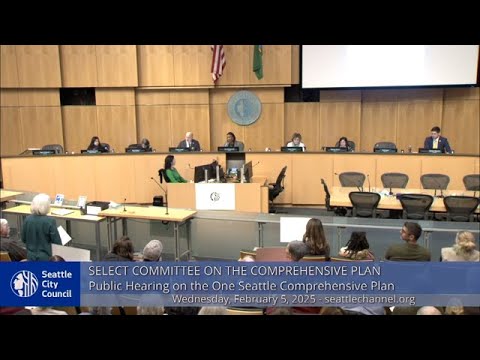
At the public hearing on the 1 Seattle draft comprehensive plan, multiple residents and small groups pressed the Select Committee to remove a specific proposed upzone: the short segment of Northeast 40th Street between 30th Avenue NE and 40th Avenue NE.
Opponentsargument: Testimony repeatedly said the segment does not meet the criteria in state law (House Bill 1110) and the plans stated standards for neighborhood centers and priority transit areas. Speakers said the block is a dead-end bus turnaround, has no existing commercial core, lacks high-frequency transit and contains long-term single-family houses and, in places, environmentally critical areas (steep slopes/slide-prone ground). William Scott, who said he led a petition, called the inclusion "a planning error" and asked the council to revert the segment to neighborhood-residential (NR) zoning.
Supporting evidence: Anne Scott Tyson and others said the short spur includes limited transit service, is outside any urban or regional center, and contains narrow streets and older homes. Leland Shields and Jim Gant described the high costs and geotechnical constraints that make expensive redevelopment likely, arguing that the upzone would produce higher-end housing rather than affordability.
What opponents requested: At minimum, residents asked councilmembers to delete the short segment from any LR3 designation (keeping NR zoning) or to narrow boundaries, conduct site-specific studies, and engage the local community before any rezoning there.
What supporters said: Other speakers at the hearing urged more citywide capacity and argued that upzoning across many neighborhoods is necessary to address affordability and to limit sprawl.
Outcome: Committee members did not vote at the hearing. Several asked staff for clarification on whether the segment meets HB 1110 criteria and requested more information on transit access, infrastructure capacity and soils/geotechnical constraints.
Why it matters: The dispute underlines a broader committee challenge: how to reconcile a citywide push for more housing with site-level constraints and neighborhood concerns about infrastructure, slope, trees, and displacement.