Get Full Government Meeting Transcripts, Videos, & Alerts Forever!
Get email alerts on the Elections Commission topic
No spam. Unsubscribe anytime.
Salem council committee advances home-rule petition to create Elections Commission amid staffing and budget questions
Summary
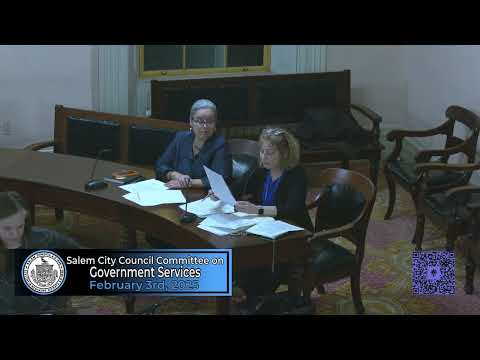
A council subcommittee in Salem City on Thursday discussed a home-rule petition to create a separate Elections Commission and referred the petition toward full council consideration while city election staff warned about staffing, confirmation and budget timing.
A council subcommittee in Salem City on Thursday discussed a home-rule petition to create a separate Elections Commission and referred the petition toward full council consideration while city election staff warned about staffing, confirmation and budget timing.
Supporters told the committee the change responds to a growing workload for election administration, including expansion of early and mail voting. Tom Fury, a longtime former city councilor and school committee member, told the meeting, "There's nothing more powerful than an idea whose time has come," and urged officials to approve the change to strengthen election integrity and outreach.
The committee and multiple councilors emphasized the proposed July 1, 2026, effective date is intended to align the new commission with the city's FY2027 budget cycle and allow time for state-level approval of a home-rule petition and for transitional hiring and training. Council members said the date was intended to permit preparatory work to begin before the budget year while ensuring new salaries and positions are funded in the FY2027 budget.
City election staff, including the City Clerk (unnamed in the transcript), raised several operational questions and concerns. Staff noted Massachusetts law provisions referenced in the discussion—participants referenced general-law provisions derived from "16A"—on board size and appointment procedures, and asked for clarification whether the mayoral appointments to the proposed commission would require city council confirmation. The clerk said she understood confirmation provisions are "baked in through '16A," but asked the committee to confirm details in the proposed language.
Staff told the committee a municipality may create a five-member elections commission even though the state typically contemplates a four-member board. The clerk and other staff members also asked about the role and appointment of "assistant commissioners," whether assistant commissioners are commissioners or staff, and whether assistant commissioners would require council confirmation. The transcript records staff concerns about continuity for current election-office employees and asked that the transition preserve employees' positions; committee members replied that guaranteeing staff jobs is outside the council's authority but that the council would work with the mayor on budget and implementation planning.
Staff estimated that at least one additional full-time person (and possibly two) would likely be needed in the clerk's office to support the new arrangement and noted overlap between current clerk responsibilities and election duties through the transition period. The transcript included a cited salary range for an election commissioner position of roughly $82,000 to $115,000 (presentation language: "82,000 to 115,000"); staff said the city clerk would continue performing election- and census-related duties up until the effective date and that budget planning should account for that overlap.
Committee members also discussed how the home-rule petition would proceed at the state level. One councilor described two types of home-rule petitions: those without a statutory rule that return to local deliberation and those with a rule attached that, if approved by the Legislature, would become local ordinance. Committee members said the commission model has precedent in other communities and expressed confidence it could pass at the Legislature if local legislators are supportive.
Motions and committee actions recorded in the transcript: Councilor Marcello (mover) made a motion "that we refer the order of petition to the full council with the positive mandate for approval," seconded by Councilor Salo (sponsor/second noted in the record). The transcript records committee discussion of votes and contains a remark that the record showed "4 4," but the final disposition (approval or denial) is not clearly recorded in the provided transcript segment. Separately, a motion was made to discharge a related order from committee "with no action"; that motion was seconded and brought to a vote during the same meeting, but the transcript does not record a clear final tally or certified outcome for that motion either.
Councilors repeatedly praised the existing election staff's competence and said the goal of the proposal was to support fair, effective elections rather than to remove experienced employees. Multiple councilors said the body should proceed mindfully and phase any transition so it minimizes disruption to employees and voters. Public comment supported the commission idea, with Tom Fury saying an elections commission would "enhance" the city clerk's office and the integrity of local elections.
The committee noted next steps would include forwarding the petition to the full city council and further clarifying statutory language, appointment and confirmation procedures, the role of assistant commissioners, and specific budgetary effects prior to final action.
Ending: The full council will receive the petition for further consideration; the transcript segment ends before a final full-committee vote outcome is clearly recorded in the provided excerpt.