Get Full Government Meeting Transcripts, Videos, & Alerts Forever!
Get email alerts on the Pedestrian Mall Security Bollards topic
No spam. Unsubscribe anytime.
Committee backs $80,000 design study for bollards on Essex Street pedestrian mall
Summary
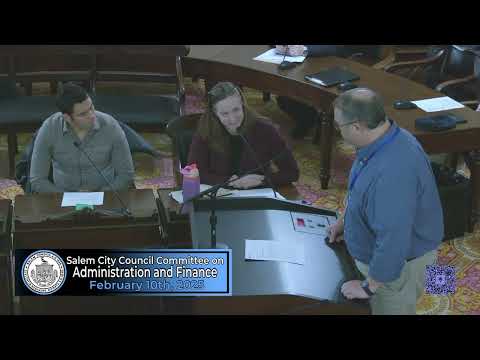
The City of Salem Committee on Administration and Finance voted unanimously on Feb. 10 to send an $80,000 design study for bollards and other vehicle barriers on the Essex Street pedestrian mall back to the full City Council with a positive recommendation.
The City of Salem Committee on Administration and Finance voted unanimously on Feb. 10 to send an $80,000 design study for bollards and other vehicle barriers on the Essex Street pedestrian mall back to the full City Council with a positive recommendation.
The funds would pay for design plans, bid documents, cost estimates for fixed and retractable bollard options at four primary access locations, and some construction oversight, Director of Transportation Dave Picharski told the committee. "These funds would go towards creating design plans for bollards and other barriers on the pedestrian mall for controlling traffic, protecting pedestrians, and enhancing security," Picharski said.
Why it matters: City and public-safety officials said physical barriers could make the pedestrian mall safer year-round and help enforce existing motor-vehicle restrictions. Salem Police Chief Miller, who framed the effort as a response to recent vehicle attacks elsewhere, said his priority is "to safeguard pedestrians on the mall" and recommended starting with the pedestrian mall before considering larger areas such as Derby Square or Salem Common.
Discussion and scope
Picharski said the study package submitted by Bowman focuses on four locations that currently provide access to the mall. The consultant would perform a kickoff site walkthrough with city staff and stakeholders, prepare design and bid documents, provide cost estimates for both fixed and retractable options, and help review bids and oversee construction. The study also posits a mix of fixed barriers and retractable bollards so the city can limit vehicle access while preserving emergency access when needed.
Committee members pressed for details on Bowman’s municipal experience, the degree of construction oversight included in the $80,000 figure, and how underground utilities could affect retractable installations. "We have to know what's in the ground especially for the retractable," Picharski said, adding the study could include subsurface investigation such as deep radar if needed.
Accessibility and enforcement concerns
Several councilors and Downtown stakeholders raised accessibility and delivery issues. One councilor said the pedestrian mall presents "trip hazard" concerns for people with mobility challenges and asked that designs not worsen accessibility. Picharski and police representatives said the design process will need to balance vehicle denial with pedestrian access.
Lieutenant Tucker described recent targeted enforcement and said parking enforcement and police have issued tickets and verbal warnings to delivery drivers. "We've written a couple of tickets and issued quite a few verbal warnings to UPS and FedEx," Tucker said, saying physical controls would "firm that up" because it is not practical to station officers at the mall every day.
Councilors also discussed the city’s existing vehicle-access rules for the mall and whether delivery hours should be revised. The transcript contains differing statements during the meeting about the ordinance’s hours; city representatives said signage was recently revised and enforcement varies. The study will examine how physical controls could work alongside or supplement ordinance enforcement.
Emergency access and implementation timeline
Picharski and police staff said designs would include control boxes or access mechanisms so fire, police and emergency medical services can raise or lower retractable bollards. Chief Miller said the fire department "seemed to be on board" with that approach. He cautioned that retractables are not instantaneous and that the city should plan for fixed backups and interim measures.
Officials said the goal is to have an interim plan in place this year and to pursue broader installation well before next October, though supply and manufacturing delays could affect timing. Police added they will also use mobile vehicle barriers and borrow equipment from other municipalities for large events if needed.
Vote and next steps
Councilor Watson Phyll moved to return the $80,000 request to the full council with a positive recommendation; Councilor Harvey seconded. The committee chair recorded the vote as "four hands plus my own," and the committee moved the item forward with a positive recommendation.
The consultant proposal and backup materials are available on the city meeting agenda (item A&F 35) and will be reviewed by the full City Council in a subsequent meeting.