Get Full Government Meeting Transcripts, Videos, & Alerts Forever!
Get email alerts on the Alternative Education topic
No spam. Unsubscribe anytime.
San Bernardino County student-services midyear report: alternative education sees short enrollments, mixed assessment gains
Summary
County staff presented a midyear Local Control and Accountability Plan (LCAP) update showing high student turnover in alternative education, mixed results on STAR Reading/Math growth for students with longer stays, and new literacy and math interventions.
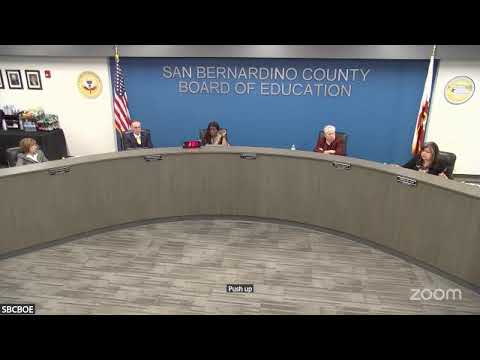
San Bernardino County Office of Education staff told the Board of Education on Feb. 10 that alternative education programs — including juvenile court schools and county community schools — continue to serve a high-turnover population but are showing measurable gains for students who remain long enough to receive sustained instruction.
“We had 5,052 students (snapshot Dec. 23, 2024) across student services, and we grew 244 students in one month,” Area Director Scott Wyatt said, noting more than 100 of the new enrollments were in alternative education programs. Wyatt described a countywide constellation of programs — county community schools, juvenile court schools, hospital/homebound instruction and residential programs — and said many students are transient placements tied to probation, expulsions or district referrals.
Program managers said average days of enrollment for students in county community schools was roughly 60 days; juvenile court schools averaged about 27 days. Program staff emphasized the short duration when interpreting assessment results: staff only report cohort progress for students who remained long enough to take diagnostic tests more than once.
“During the first semester of this school year, 56% of the students demonstrated growth in reading, and 63% demonstrated growth in math,” Program Manager Dr. Angela Brantley said, summarizing STAR Reading and Math diagnostic results for students who took at least two assessments in the reporting window.
Staff described a set of targeted interventions and partnerships: the Impact Truths Literature-to-Life program (student-authored children’s books), partnerships with Cal State San Bernardino for executive-function training (BFAST), an author/mentorship program tied to Freedom Writers at the High Desert site, and Khan Academy/Conmigo AI tutoring and Desmos for math. County staff said they are expanding Orton-Gillingham-aligned early literacy instruction, piloting math “homerooms” and adding AVID training and PBIS (Positive Behavioral Interventions & Supports) fidelity checks.
Family and community engagement efforts included “Back to School Jam” events at all alternative campuses and a new partnership with Inland Empire Health Plan (IEHP) to place health navigators at community schools to connect families with services. Superintendent Ted Alejandre and principals said the student-oriented events improved attendance and family engagement where they were held.
Why it matters: Alternative education programs are designed to serve students with urgent or temporary placement needs. Performance measures can be skewed by short enrollments; staff said their measures focus on students who stay at least a quarter and stressed data-driven cycles of continuous improvement.
What comes next: Staff said they will continue monitoring STAR diagnostics quarterly, expand teacher training (Orton-Gillingham and AVID), continue PBIS fidelity reviews and report updated outcomes in future board correspondence and the LCAP public process.
Ending: The board received the midyear LCAP update and discussed follow-up items including attendance interventions, data transparency and parent engagement.