
Colorado Energy Office outlines renewable siting study, seeks local capacity to balance clean energy and wildlife
Get AI-powered insights, summaries, and transcripts
Subscribe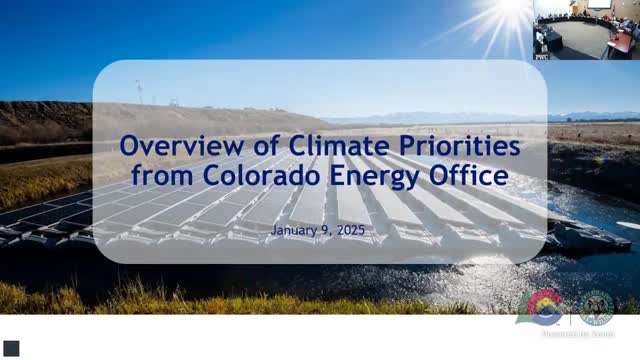
Summary
Colorado Energy Office executive director Will Toor told the Parks and Wildlife Commission the state will produce a siting study required by Senate Bill 212, expand local technical assistance, and coordinate with DNR and CPW to limit renewable energy and transmission impacts on wildlife.
Will Toor, executive director of the Colorado Energy Office, told the Colorado Parks and Wildlife Commission that the state is moving ahead with a required renewable siting study and additional local technical assistance while emphasizing the electricity sector’s central role in meeting the state’s greenhouse‑gas targets.
The energy office presentation and subsequent discussion centered on implementation of Senate Bill 212 and how to reduce siting conflicts between utility‑scale wind and solar and wildlife habitat. Toor said the legislature’s economy‑wide emissions targets have driven a rapid build‑out of wind and solar and that the Energy Office will submit the legislatively required siting report by the statutory September 30 deadline.
The report, Toor said, will evaluate existing local permitting processes and ordinances, impacts of renewables and transmission on wildlife, mitigation plans used by local governments, decommissioning policies, and community benefit practices. He described a multi‑step process of stakeholder surveys, webinars, public comment on a draft this spring, and a final report in late September. Toor added that the state has federal awards to provide technical assistance to local governments and will establish a clean energy resource hub for local planning and education.
Commission members pressed staff on how the siting study and technical assistance would work with the Department of Natural Resources and Colorado Parks and Wildlife (CPW). James (last name not stated), who manages the Energy Office’s siting work, said the office is partnering with DNR staff such as Aaron Ray and that DNR and CPW will be formal partners on habitat mapping and project review. Commissioner Marie Haskett, Commissioner Marie Robinson, and others urged the energy office to ensure continuous, early coordination with CPW on migration corridors, winter range, and other habitat mapping — “not just a study” but ongoing consultation at the permit stage, they said.
Commissioners also raised questions about transmission siting, the federal Department of Energy’s corridor mapping, and whether the federal corridor concept could override local control. James said DOE’s corridor process identifies high‑need areas but does not itself authorize construction without federal and state processes and agency coordination; FERC remains the permitting body for interstate transmission. Several commissioners asked staff to explore siting on disturbed lands and existing rights‑of‑way (highways, railroads, brownfields) to reduce pressure on intact habitats.
Toor and James also described legislative and market context: the state’s adopted utility targets and modeling showing deep reductions from low‑cost wind and solar plus storage; estimated land scale needs if the state follows the economic‑deployment pathway (roughly 11 GW of new utility‑scale solar and 5.5 GW of wind by 2040, which staff estimated as a high‑end scenario equal to tens of thousands of acres of utility‑scale panels); and related programs to support local governments, tribes and communities in siting decisions. Toor said the Energy Office is also working on programs that help local governments apply for federal implementation funding to update land‑use codes and pay for mitigation.
Why it matters: Colorado’s climate law and utility planning are driving rapid renewable and transmission deployment. Commissioners said early coordination, wildlife mapping and meaningful decommissioning/mitigation rules will determine whether the deployments lead to avoidable harm to migration corridors, sagebrush ecosystems and other sensitive habitats. Toor said the siting study will be the first step toward more explicit state‑level support for local siting that accounts for wildlife and community values, and that the work will continue through 2025 and beyond.
Ending: Commissioners thanked the Energy Office for the briefing and pressed for close collaboration with DNR and CPW when the siting study drafts are prepared and when federal transmission corridors are considered. Toor said the office will continue outreach and return with technical staff as the draft is developed.