
Senate health subcommittee advances nursing-home insurance and monitoring measures, reports food-allergy notice bill
Get AI-powered insights, summaries, and transcripts
Subscribe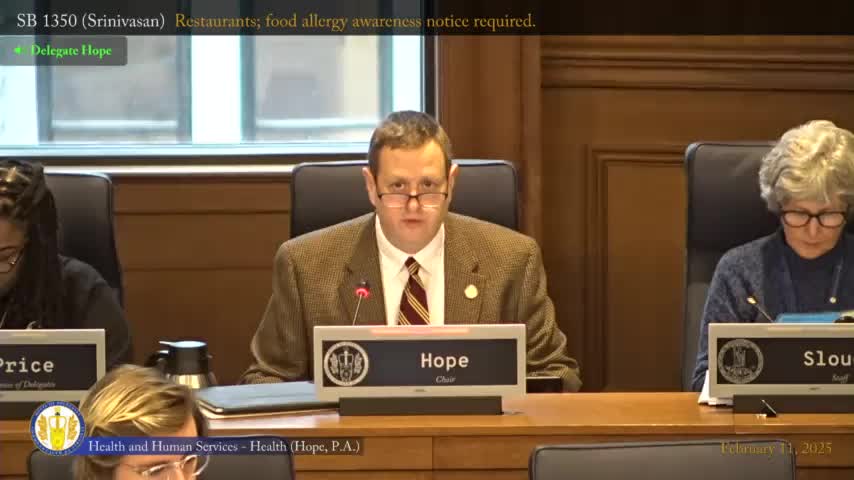
Summary
The Senate Health Subcommittee met to consider a package of public-health and consumer-protection measures and reported a set of bills to the full Senate, advancing changes to nursing-home insurance rules, electronic monitoring in long-term-care facilities, and standardized food-allergy notices for restaurants.
The Senate Health Subcommittee met to consider a package of public-health and consumer-protection measures and reported a set of bills to the full Senate, advancing changes to nursing-home insurance rules, electronic monitoring in long-term-care facilities, and standardized food-allergy notices for restaurants.
The panel unanimously reported Senate Bill 11‑52, which clarifies minimum insurance coverage requirements for nursing facilities and limits the use of policies that would reduce available coverage for residents (vote with substitute 8-0). Lawmakers also approved a substitute for Senate Bill 8‑21 to allow in-room electronic monitoring in private nursing-home rooms with a consent process for roommates if applicable (reported with substitute 7-1 after revision). Senate Bill 13‑50, requiring the Virginia Department of Health to post standardized food-allergy notices and asking restaurants to post and provide staff-accessible notices and menu indicators, was reported as amended (6-2).
Why it matters
Committee members and multiple stakeholders framed the measures as consumer-protection steps: the nursing-home insurance bill aims to ensure insurance limits protect residents rather than being consumed by defense costs or aggregated across unrelated facilities; the monitoring bill responds to family concerns about care and transparency while attempting to preserve privacy through consent and technical safeguards; the food-allergy bill standardizes guidance and signage to reduce the risk of restaurant-based allergic reactions.
Key items and discussion highlights
Nursing-home insurance (SB 11‑52): Sponsor Senator Obenshane told the subcommittee that the bill clarifies that required liability and professional-liability insurance is a per-facility obligation and that insurers and facilities should not let defense costs erode coverage intended to compensate harmed residents. "Current law requires the insurance to be purchased for each facility no matter how many facilities are owned by an owner," he said, explaining the measure is intended to match legislative intent. Scott Johnson, general counsel for the Virginia Healthcare Association, told the panel VHCA did not oppose the substituted language and thanked the sponsor for revisions. The substitute removed references to aggregate limits and clarified consequences for noncompliance; the committee reported the substitute 8-0.
Electronic monitoring in nursing facilities (SB 8‑21): Sponsor Senator Craig said the bill would let residents (or a legal representative) in private single rooms request fixed-position electronic monitoring devices, with recordings secured and controlled by the resident or their representative. Craig said the measure includes guardrails such as posted notice and on/off control for authorized family members: "This legislation has got appropriate guardrails to ensure privacy and to make sure notice is posted when there are recordings in place," he said. Stakeholders, including the Virginia Healthcare Association, LeadingAge Virginia and other providers expressed concerns that a narrow bill limited to private rooms could create unequal access and suggested alignment with existing Department of Health regulations. Scott Johnson explained that current regulations permit monitoring in shared rooms with roommate consent and that the bill as amended was intended to make the device the resident's choice in private rooms while preserving the facility's regulatory discretion for semi-private rooms. The subcommittee adopted a conceptual substitute incorporating roommate-consent language and reported the substituted bill 7-1.
Food-allergy notice (SB 13‑50): Sponsor Senator Svobratian presented the bill and a Department of Legislative Services technical amendment to limit the bill’s requirements to restaurants permitted under the Department of Health. Testimony in favor came from national advocacy representatives and Virginia residents. Jenna Reimann Schneider of the Asthma and Allergy Foundation of America (AAFA) told the panel food-allergy incidents in restaurants are common and cited national prevalence figures: "Adverse reactions in restaurants are common and account for a significant share of food-allergy related fatalities," she said. Parents who testified recounted personal allergic reactions and urged clearer staff training and menu notices. The subcommittee adopted the amendment and reported the bill as amended 6-2.
Other bills on the docket
- SB 12‑34: Directs VDH to collect data on replacement-well permits to study drying wells in some rural localities; reported 7-1. - SB 13‑79: Adds Inova Schar Cancer Institute to a proposed statewide cancer center consortium; reported with substitute 8-0. - SB 13‑84: Ensures doulas may remain with a birthing person during labor in line with existing hospital partner-spouse visitation practices; reported 8-0. - SB 9‑89: Technical clarification to pre-need funeral guarantee fee language (adds "pre-need" phrasing); reported 6-2. - SB 11‑33 (pork labeling): Brought at the request of the town of Herndon; the subcommittee debated how upstream supply-chain disclosures would be handled and the restaurant industry's compliance limits. The bill failed for lack of a motion to report. - SB 7‑45: A section‑1 (study) bill directing the Board of Pharmacy to convene stakeholders to evaluate therapeutic interchange practices and related reimbursement under health plans; reported 6-2.
Votes at a glance
- SB 8‑33 — Stricken from the docket (patron request): stricken 8-0. - SB 13‑50 (food-allergy notice) — Reported as amended to the full committee: 6 yes, 2 no. - SB 12‑34 (well permit data) — Reported: 7 yes, 1 no. - SB 13‑79 (cancer consortium, substitute) — Reported with substitute: 8 yes, 0 no. - SB 13‑84 (doula access) — Reported: 8 yes, 0 no. - SB 9‑89 (pre-need funeral guarantee clarifying language) — Reported: 6 yes, 2 no. - SB 8‑21 (nursing-home electronic monitoring, substitute) — Reported with substitute: 7 yes, 1 no. - SB 11‑33 (pork labeling) — Failed to be reported (no motion to report). - SB 7‑45 (therapeutic interchange study) — Reported (section 1): 6 yes, 2 no. - SB 11‑52 (nursing-home insurance clarification, substitute) — Reported with substitute: 8 yes, 0 no.
What’s next
Bills reported by the subcommittee will be scheduled for further consideration by the full Senate committee and, if advanced, for floor action. Several items (notably the electronic-monitoring bill and the nursing-home insurance substitute) were amended to address stakeholder concerns; sponsors and advocates said they expect more technical drafting before final votes.
Sources and evidence
This article summarizes spoken testimony, sponsor explanations, amendments and roll-call outcomes drawn from the subcommittee transcript and the record of motions and votes during the meeting. Direct quotes are attributed to the speakers who made them in the transcript.