Get Full Government Meeting Transcripts, Videos, & Alerts Forever!
Get email alerts on the Appellate Procedure topic
No spam. Unsubscribe anytime.
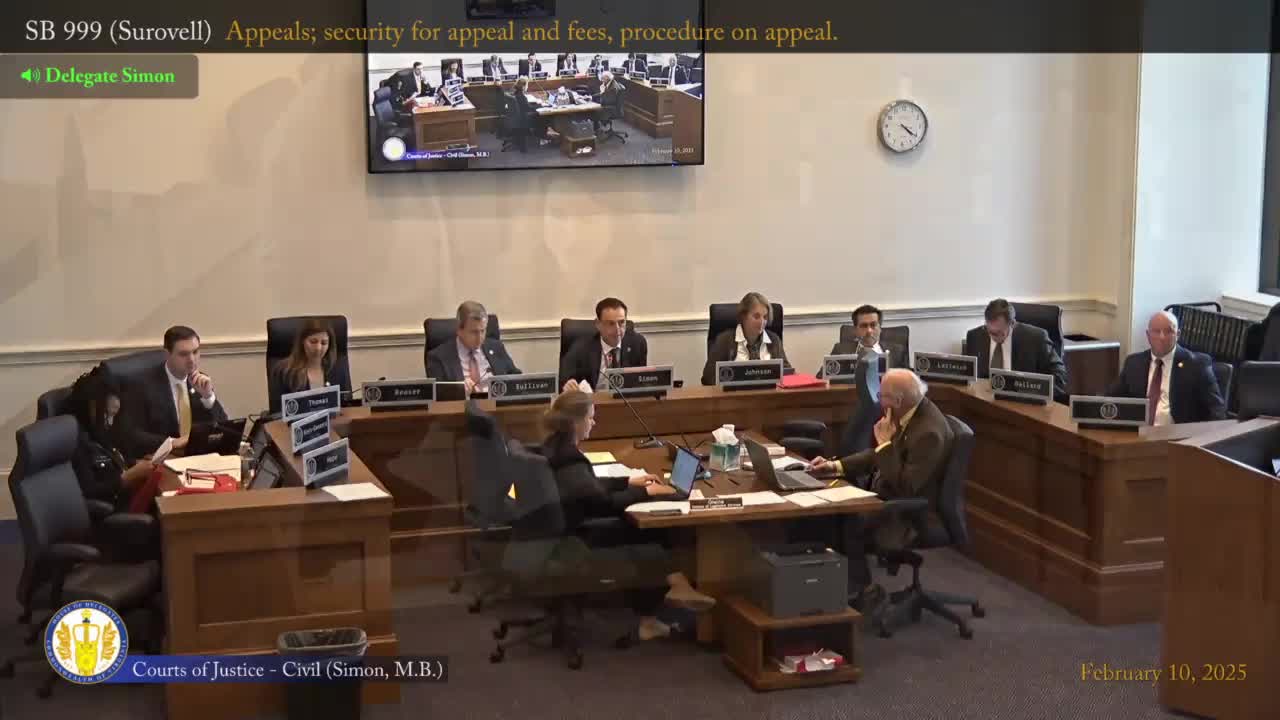
Subcommittee advances bill giving Court of Appeals discretion to skip oral argument in some cases
Summary
Senate Bill 999 would give the Virginia Court of Appeals discretion to decide cases without oral argument when argument would not aid the decision, and require an interest bond increase for delayed judgments; the subcommittee and appellate practitioners supported the measure and a two-year sunset on the waiver of argument to allow review.
Senate Bill 999, sponsored in the subcommittee, would make three principal changes affecting appeals: give judges discretion to dispose of cases without oral argument when the argument would not aid decision-making; require posting of 2.5 years’ interest as part of an appeal bond in appropriate judgments to address lengthy appellate delays; and include a two-year sunset on the oral-argument waiver to allow legislative review.
The sponsor said judges and appellate practitioners had flagged long delays in the Court of Appeals and requested tools to process dockets more efficiently. Appellate practitioners who testified, including Robert Lofton and Monica Monday, supported the bill as a targeted measure to relieve docket pressure while preserving appeal rights. Elisa Padden with the Office of the Executive Secretary said the court supports giving discretion to waive oral argument to help cases move through the docket. Phil Abraham, representing commercial real estate interests, said the change could reduce delays that hold up economic-development projects.
After testimony, the subcommittee voted to report the bill (committee vote recorded in the transcript as 8 to 0). The bill includes a two-year sunset for the oral-argument waiver to provide an opportunity to review whether the discretion is used appropriately.