Get Full Government Meeting Transcripts, Videos, & Alerts Forever!
Get email alerts on the School Construction Sales Tax Referendum topic
No spam. Unsubscribe anytime.
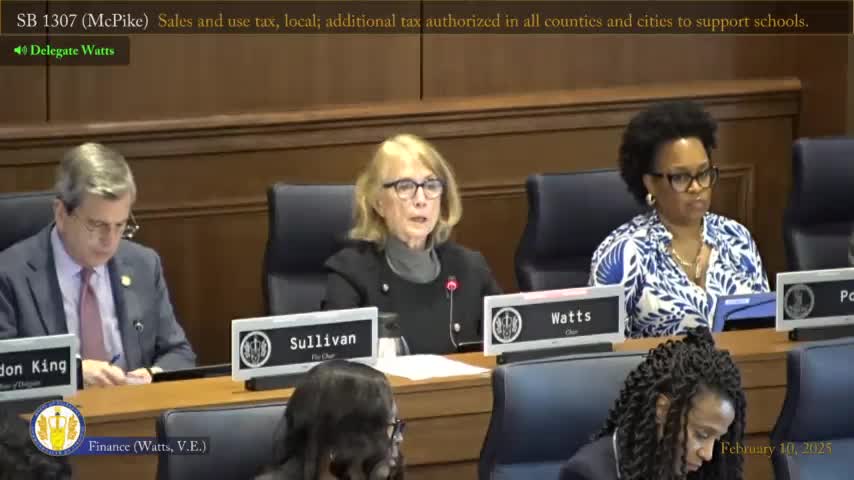
Committee approves substitute for bill allowing local 1¢ sales tax referendums for school construction; passes 13-7
Summary
A Virginia legislative committee reported a substitute to Senate Bill 13‑07 that would permit local referendums to impose an additional 1¢ sales tax for public school capital projects. The committee adopted an amendment clarifying the definition of "public school capital projects" and approved the measure, 13 to 7.
A committee of the Virginia General Assembly on Oct. 12 reported a substitute for Senate Bill 13‑07 that would allow localities to hold referendums to impose an additional 1¢ sales tax for public school capital projects; the measure passed the committee by a vote of 13 to 7.
The substitute defines “public school capital projects” as “construction and major renovation of public school buildings and facilities, including building new or enlarging existing buildings, restoring structural integrity, retrofitting or upgrading operational infrastructure, and site acquisition,” and the committee approved an amendment to repeat related language in the use tax code section so the sales and use tax provisions remain consistent.
The definition was read into the record by the chair during debate. The chair said the wording is intended to limit the measure to capital outlay — for example, structural repairs that would go to bonding — rather than routine maintenance.
Delegate Orrock, speaking in opposition, said he supports additional school funding but objected to bifurcating the tax process and said the measure shifts burdens to local governments and, he argued, disproportionately to less densely populated rural counties. “I’m not adverse to the general concept of additional funds for education, but I feel they need to be coming from the state level and not be forcing it back down to local governments,” Orrock said.
Delegate Simons spoke in favor of the measure, saying it implements a recommendation of the School Construction and Modernization Commission and gives local voters “skin in the game” to address billions of dollars in school construction needs.
Delegate London King, who said she has two school‑aged children, urged quick action, saying families and students cannot wait for a resolution and describing classroom conditions she characterized as lacking adequate heat, ventilation and cooling.
The committee first adopted the substitute and then approved an amendment to replicate language in the use tax section; the amendment was adopted without recorded opposition. The substitute as amended was reported to the next stage by a roll call vote of 13 in favor and 7 opposed.
The bill text and substitute reference earlier provisions that passed in the House in the prior session, and the chair said the substitute aligns the Senate bill with what previously passed the House. The committee record shows the substitute was modeled on last year’s House language and adjusted to clarify the scope of projects eligible for revenue from the tax.
No effective date, localities specified, or implementation timetable was included in the committee record reproduced in the transcript; those items were not specified during the session.
Votes at the committee level now move the measure forward for further consideration in the legislative process; additional committee action or floor consideration could add changes to scope, funding language or applicability.
Ending: The committee’s report sends the substitute for Senate Bill 13‑07 forward with the clarified definition of public school capital projects and an instruction that related sales and use tax code sections remain consistent. The bill passed the committee on a 13‑7 vote.