Get Full Government Meeting Transcripts, Videos, & Alerts Forever!
Get email alerts on the Police Oversight Appointments topic
No spam. Unsubscribe anytime.
Council committee forwards nine mayoral nominees for Cleveland Police Commission after interviews; Jackson interviewed at council request
Summary
A joint council appointments committee advanced nine mayoral nominees to full council for individual votes and interviewed a tenth candidate recommended by the Black Shield. Nominees and council members discussed the commission’s dysfunction, drone policy, police staffing and the ongoing executive-director search.
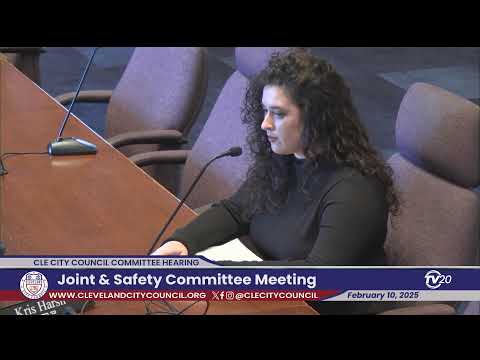
The council’s mayoral appointments committee voted to forward nine nominees for the Cleveland Police Commission to the full City Council for individual votes after interviews on Tuesday, and held a separate interview with Richard M. Jackson, a candidate put forward by the Black Shield organization at the council’s request.
The action moves the nine mayoral recommendations to the council floor for consideration tonight; Jackson’s interview was conducted so the council could hear from a Black Shield representative before any final decisions are made. The nominees the mayor submitted, as read at the hearing, are Chandra Benito, Maya Kinkade, Sheila Mason, Tara Coleman, Sherina Zayed, Michael Nelson, Antaya Miller, Moragarin and Imo Umosin.
The committee’s interviews focused on several recurring issues that will shape how the commission carries out oversight: the Cleveland Police Commission’s internal dysfunction and public image, the use of drones and other surveillance tools, police staffing targets, the commission’s discipline policy, and an outstanding search for a permanent executive director.
Shandra Morita Benito, a social worker and a current commissioner being considered for reappointment, told the committee she had served two years on the commission and sought a second term to finish work on crisis intervention and youth-focused policing. “I am interested in being reappointed because I believe that I still have work to do,” Benito said. She described the commission’s earlier turmoil as driven in part by “a few bad actors” but also by systemic growing pains while the commission established bylaws and procedures.
On surveillance and drones, Benito said she had voted for the commission’s current drone policy, which limits drone use at protests to circumstances where a crime is being committed or a warrant is obtained. She explained the vote as an attempt to balance public-safety needs against constitutional rights and expressed concern about how recorded footage might be used with facial-recognition tools such as Clearview AI. “What the drones are doing is recording. They’re recording all of that information and that information gets stored,” Benito said, adding she would remain open to policy changes if clearer rules on artificial intelligence and surveillance emerge.
Richard M. Jackson, whom council members identified as a Black Shield nominee and a retired Cleveland police sergeant, described his candidacy as representing Black Shield and emphasized his law-enforcement experience. “I am here as a representative for the Black Shield,” Jackson told the committee. Jackson said he supported using drones in some circumstances — particularly to limit high-speed vehicular pursuits — and argued drones are less costly than helicopters and can reduce risk to officers and bystanders.
On staffing, both candidates and council members discussed existing shortfalls. Benito noted the division is staffed below budgeted positions and said officers report high overtime; she supported outside staffing analyses. Jackson suggested a staffing target higher than the mayor’s proposed 1,350 officers, saying he would prefer roughly 1,450 officers to allow for district-based community policing and adequate staffing for investigative units.
Committee members also pressed nominees about the commission’s relationship with City Council and the commission’s executive director search. Benito said an outside firm has been conducting initial interviews for the executive director and that the commission expected to review candidates and possibly complete the process in February or March, but she cautioned she was not fully briefed because she is not currently serving as a commissioner. Delonte Thomas, the city’s chief ethics officer, confirmed the mayor submitted nine nominees and that the tenth interview (Jackson) was being held at council’s initiative.
Public commenters and several council members raised concerns about representation and the selection process. Some speakers urged the council to ensure the Black Shield — and other stakeholder groups — have an effective voice at the commission table; others said they feared backroom deals and urged transparency in selections.
The committee’s procedural decision to forward the nine mayoral nominees to the Council floor was presented as an effort to move forward with appointments while council works through outstanding disagreements about one or two specific nominees and a council-initiated candidate. The committee chair said the nine mayoral recommendations will appear as separate ordinances on the council floor for individual votes tonight.