Get Full Government Meeting Transcripts, Videos, & Alerts Forever!
Get email alerts on the Prison Education topic
No spam. Unsubscribe anytime.
Subcommittee advances bill to expand prison education, data tracking and Pell access
Summary
The Senate Education and Health Higher Education Subcommittee recommended House Bill 2,158 for reporting after hearing testimony that the bill would build a statewide prison-education pathway, include incarcerated learners in state education data, and create a five-year implementation task force.
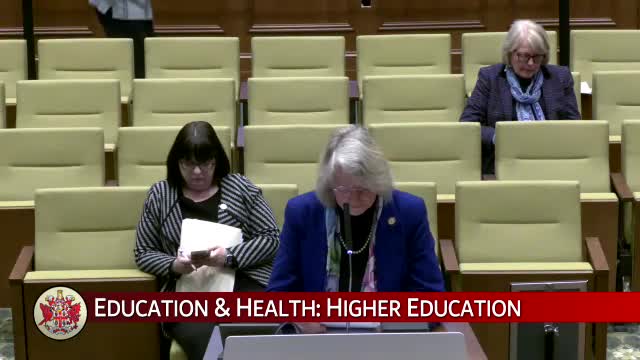
The Higher Education Subcommittee recommended House Bill 2,158 for reporting to the full committee after proponents described the bill as a framework to expand education in Virginia prisons, improve data integration and leverage federal funds such as Pell Grants.
The bill, presented by Delegate Carr, directs the Department of Corrections to strengthen basic literacy instruction, creates interagency partnerships to expand adult basic education and college-in-prison programs, requires inclusion of incarcerated individuals in the state's education and workforce data system, and establishes a five-year state task force to support implementation.
The measure’s supporters told the subcommittee that the need is large and the potential savings are substantial. "The need for this bill is clear," said Justin Haywood, a University of Virginia law student, citing committee testimony that Virginia has about 23,000 people in state prisons and that current education access is limited. Haywood told members that 4,000 incarcerated individuals read below an eighth-grade level, 32% are on a wait list for literacy instruction, 37% lack a high school diploma, about 50% are eligible for community college but only 2% are enrolled, and Virginia spends about $61,000 per person per year on incarceration. He added that education cuts recidivism nearly in half.
Kenneth Hunter of the Virginia Interfaith Center for Public Policy and David Dorey of the Virginia Community College System also spoke in support, saying the bill aligns college-in-prison expansion with workforce needs and the recent restoration of Pell Grant eligibility for incarcerated students.
The House amendments made at the subcommittee level clarify that code updates in the bill apply only to state correctional institutions operated by the Department of Corrections, set a five-year goal for reducing — rather than eliminating — the prison education wait list, and name the secretary of labor as a co-chair of the proposed task force alongside the secretary of education. The measure’s proponents said no physical funding impact occurs before 2027.
Moved and seconded that HB 2,158 be recommended for reporting. All those in favor said aye; the clerk recorded the tally as "Aye. Those opposed? That's 5, no 0." The motion was recommended for reporting to the full committee.
If approved by the full committee and both chambers, supporters said the bill would expand pathways from basic literacy through high school equivalency to college and career training and formalize interagency roles and data-sharing to support incarcerated learners.