Get Full Government Meeting Transcripts, Videos, & Alerts Forever!
Get email alerts on the Municipal Finance topic
No spam. Unsubscribe anytime.
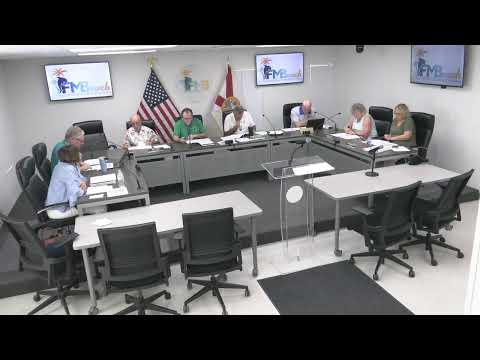
Fort Myers Beach audit committee hears finance director update on FEMA reimbursements, software rollouts and staffing
Summary
Finance Director Joe Onczyk told the Fort Myers Beach audit committee the town has nearly $7 million still expected from FEMA, is finalizing multiple software implementations, and has filled two finance roles; the committee approved the minutes and received the report by voice vote.
Fort Myers Beach Finance Director Joe Onczyk told the town—s Audit Committee on an update that centered on hurricane-recovery reimbursements, software conversions and staffing. He said the town has nearly $7 million in remaining FEMA receivables based on about $30 million of emergency expenditures to date.
The figures are part of a month-long reconciliation Onczyk said the finance team prepared to support the audit. "We had 29, almost $30,000,000 of expenditures so far," he said. After insurance proceeds and FEMA payments the town—s internal estimate left "still $7,000,000 remaining to be collected from FEMA," Onczyk said. He separately identified an outstanding $1,000,000 insurance receivable related to temporary town-hall housing.
The receivable estimate, Onczyk explained, is based only on money the town has already spent; it does not include projects not yet billed or additional future expenditures. He said the town has recorded about $15 million in insurance reimbursements and roughly $18 million in FEMA payments to date and described the receivable exercise as "manually intensive." Onczyk told the committee the reconciliation work is tied to preparation for the annual audit and that a small discrepancy in a deferred-inflow line item required an additional check.
On software modernization, Onczyk reported progress and some conversion challenges. He said the town is implementing a new utility-billing vendor (CUSI) and troubleshooting data conversion: "It's proven to be a little more difficult than we were expecting in the sense that it's a challenge to convert the data from the old system into the new system." He said the goal is to migrate up to five years of customer history into the new platform. The town is also implementing a short-term-rental tracking system to improve monitoring and follow-up, and is beginning a Tyler ERP Pro deployment; Onczyk called the ERP implementation "quite intense and aggressive" but said the thoroughness was reassuring.
Onczyk described work on a federal Community Development Block Grant disaster-recovery planning RFP (referred to in the packet as CDBG-DR planning grant) that requires HUD-specific terms. He said staff and the town—s consultant, Frankie Koprachek, are finalizing the RFP scope.
On staffing and routine operations, Onczyk said the finance department filled two positions: Paul Brown, hired as senior accountant, and Debbie Glavin, now handling contracts and procurement. He noted the department completed performance reviews and issued Form 1099s on time.
On capital and grant funding, Onczyk reviewed several requested state funding items the town is pursuing with its lobbyist: a request for $700,000 for South Water Tower repair (with a required 50% local match), a stormwater mitigation request he described as "almost $600,000" (with a corresponding local match), and a road-paving request. He said the town is limited by available cash for required matches and that proposed match amounts would come from 2024 savings and gas-tax reserves.
On stormwater financing, Onczyk said the town has about $3 million in accumulated savings in the stormwater fund from post-Hurricane Ian collections and noted that a two-year suspension of debt-service payments helped accumulation. He said the town is exploring increasing an existing State Revolving Fund (SRF) loan to cover a roughly $3 million shortfall on a Tier 1 stormwater project, but any loan increase would require demonstrating sustainable stormwater rates, tying the loan decision to the pending utility-rate study.
Onczyk also summarized other funding: the town has a $5 million 0% interest state loan allocated to FEMA-eligible projects (about $311,000 used so far), an $8 million state allocation for beach renourishment (around $4.2 million expended and roughly $3.8 million remaining), and roughly $40 million in cash and investments across funds. He said $1.2 million of American Rescue Plan Act (ARPA) funds remain to be spent and must be used by 2026.
On parking and local revenue, Onczyk described a first-pass calculation for lost parking revenue if on-street spots are used by developers; through calendar 2024, he said the town—s estimate was $4,865 in lost revenue per spot. He said the proposal under discussion would fold that value into a fee schedule and calculate an annual charge for developers who enter agreements to use those spots.
Committee members asked about timing, cash flow and seasonal revenue patterns. Members discussed lower parking revenue versus 2022 and the practical effects of vacant or hurricane-impacted properties; Onczyk and others noted some property owners are awaiting state-managed FEMA funding. The transcript records a mix of procedural and clarifying questions from committee members; Onczyk replied that some items remain in early stages and that additional details will follow as reconciliations and the rate study progress.
The committee approved the meeting minutes and then approved the finance director's report by voice votes.
The Audit Committee scheduled its next meeting for Monday, March 10.