Get Full Government Meeting Transcripts, Videos, & Alerts Forever!
Get email alerts on the Education Legislation topic
No spam. Unsubscribe anytime.
Blue Valley outlines five legislative priorities, opposes vouchers and tax-credit expansions
Summary
Superintendent and staff reviewed the district’s five legislative priorities — including funding special education, opposing private-school vouchers and tax-credit scholarships, and a push to rewrite the school finance formula — and summarized testimony the district submitted on several bills.
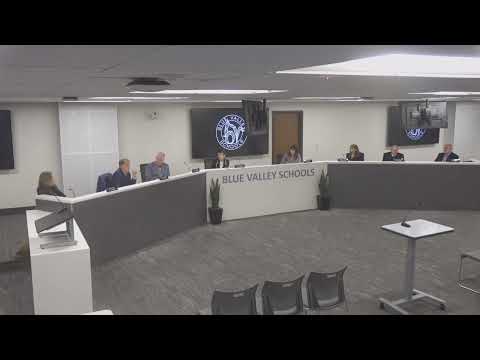
Superintendent Dr. Katie Collier and staff reviewed Blue Valley’s legislative agenda at the Feb. 10 Board of Education meeting and described testimony the district has filed this session in Topeka.
The district’s five stated priorities are funding special education, opposing tax‑credit scholarship programs and vouchers, establishing a fair and equitable school finance formula, enhancing student mental‑health resources in the community, and supporting teacher recruitment and retention programs. Staff said testimony and links to each bill and the district’s written testimony are posted at bluevalleyk12.org/legislative.
Staff reviewed specific bills on which Blue Valley submitted testimony: support for House Bill 2129 (reclassifying teachers between CAPERS tiers to aid recruitment), opposition to House Bill 2136 (expanding student eligibility under a tax-credit scholarship program), support for the Kansas State Department of Education budget and added special-education funding, and opposition to Senate Bill 48 (which would require districts to demonstrate improvement and compliance to maintain accreditation, a requirement staff described as potentially burdensome). The district also testified against Senate Bill 75, a bill establishing an Education Opportunity Tax credit and related expansions the board listed as a priority to oppose.
Staff flagged a separate tax proposal from the House Taxation Committee (House Bill 2011) that would reduce the 20-mill local levy that districts currently send to the state to 18.5 mills and increase the residential exemption. Staff said the committee indicated state general-fund dollars would backfill the reduction, but board members and staff warned that the long-term out-year treatment of that change could effectively freeze local funding and create a block-grant dynamic similar to prior budget standstills.
The superintendent said the district plans to meet with the Johnson County delegation in Topeka and continue to post testimony online. Board members asked clarifying questions about revenue-neutral proposals and how reductions in local mills could affect capital and other funds at the district level. A staff member noted the district is monitoring the session closely and urged constituents to consult the district’s legislative page for the full text of testimony and links to bills.