Get Full Government Meeting Transcripts, Videos, & Alerts Forever!
Get email alerts on the Hunting Regulation topic
No spam. Unsubscribe anytime.
Committee approves electronic deer-harvest reporting rule but falls short of two-thirds to introduce committee bill
Summary
The subcommittee approved regulations implementing Act 65 (2023) requiring electronic harvest reporting for deer, but a 6-3 vote failed to reach the two-thirds threshold needed to introduce a committee joint resolution; DNR said hunters reported roughly 175,000 deer using the system and estimates statewide population at about 700,000.
The House Regulations and Administrative Procedures subcommittee approved a regulation to implement electronic deer-harvest reporting required by Act 65 of 2023, but the committee's 6-3 approval did not meet the two-thirds threshold necessary to introduce a committee joint resolution, leaving the regulation without the expedited committee bill route.
Charles Ruth, wildlife biologist and supervisor of DNR's big-game program, and Emily Cope, deputy director for wildlife and freshwater fisheries at DNR, told the subcommittee the reporting system expands the department's existing electronic reporting (used previously for turkey and bear) to deer. Ruth said hunters reported about 175,000 deer during the most recent season after the rule was filed on an emergency basis to make the system available for the 2024 season. Ruth described the reporting data as a management tool that feeds a population reconstruction model; he said DNR's current estimate for the statewide deer population is about 700,000.
"This is a management tool that we've been been asking for for a number of years," Ruth said. "If you know how many deer are being killed at the county level, at the statewide level, again we can plug it in this population model." Cope said the regulation implements methods of telephonic and electronic reporting, content of the report and record-keeping, consistent with the statute's directive.
Representative David Martin, who represents Fort Mill, said he opposed the regulation on the grounds that it imposes government overreach and could burden older or non-technical hunters. "I don't think the government should be telling people whether they can or cannot hunt on their property and then once they do hunt on their property, what they're required to do to be able to track the animals that they shoot," Martin said. He and several other members asked whether certain fields in the reporting form are mandatory. Ruth and other DNR staff identified the mandatory fields as date (auto-filled), county of kill, sex of the deer, time of day (AM/PM) and antler point count on males; other items such as weight are optional.
Concerns raised during the discussion included privacy and enforcement questions (members asked whether game wardens can inspect private freezers and about probable cause), the administrative burden on older hunters, and whether suburban nuisance situations (for example in York County and Tega Cay) require different responses. Cope told the committee that if the regulation does not receive the committee bill route, DNR may need to rely on emergency regulations to remain in compliance with the law while the department works with legislators to address concerns.
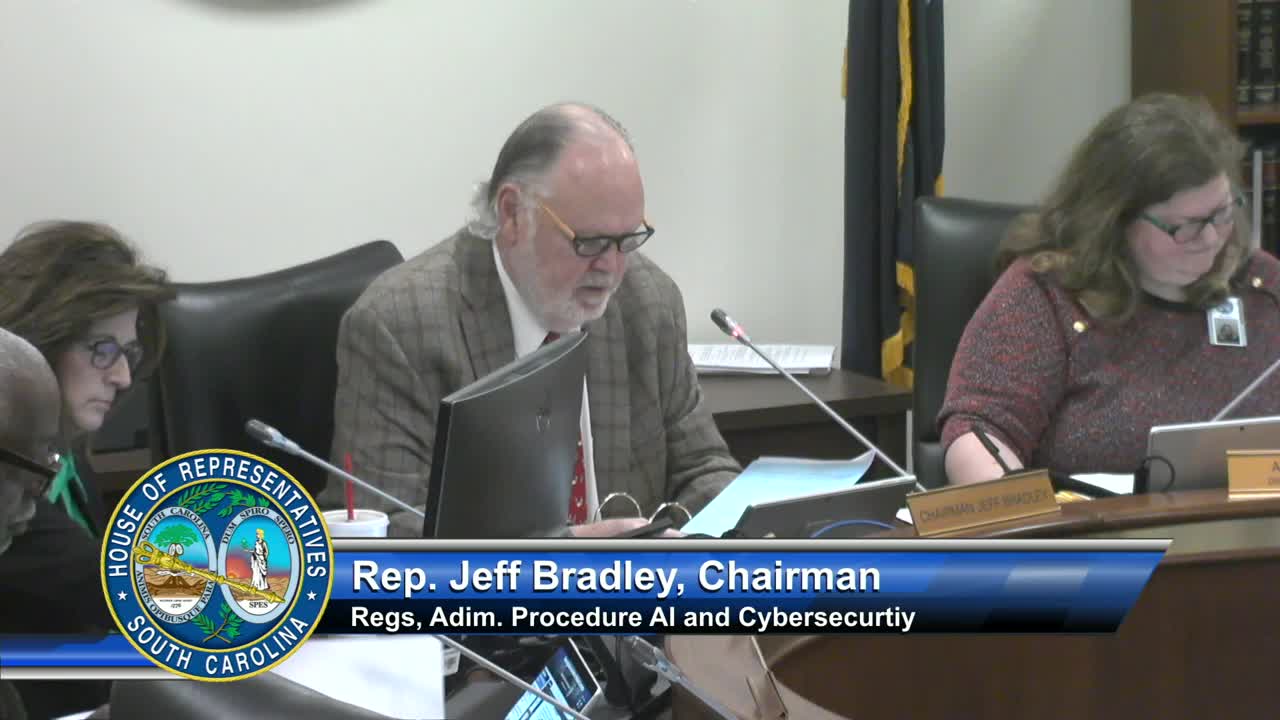
On the recorded roll call for the committee decision, votes were: Mr. Alexander (yes), Mr. Guffey (no), Mr. Hart (yes), Mr. Long (yes), Mr. Martin (no), Mr. Neese (no), Mr. Taylor (yes), Mr. Teeple (yes), and Chairman Bradley (yes). The subcommittee announced the tally as 6-3 in favor of the regulation; staff noted that a two-thirds committee vote is required to introduce a committee joint resolution, which this vote did not reach.
Subcommittee members asked DNR staff to meet with several members who voted no and see whether adjusted regulatory language or clarifications (including clearer marking of optional fields on the app/website and potential exemptions to address localized nuisance or agricultural issues) could win additional support before a full committee or future meeting. DNR staff agreed to follow up with those members and to consider emergency-rule options if required to implement the statute in a timely way.