Get Full Government Meeting Transcripts, Videos, & Alerts Forever!
Get email alerts on the Public Safety topic
No spam. Unsubscribe anytime.
Committee holds hearing on school-zone speed cameras; debate centers on hours, signage and revenue
Summary
Senate Bill 75, a hearing-only proposal that would set statewide standards for automated school-zone speed-detection devices, drew split testimony on whether cameras should run only at arrival/dismissal or throughout the school day, and whether revenue should be directed to safety improvements rather than vendor shares.
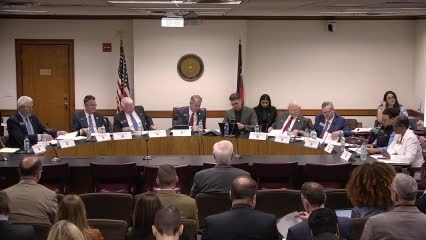
The Senate Public Safety Committee took testimony on Senate Bill 75, a hearing-only measure proposing statewide guardrails for automated speed-detection devices in school zones, and heard divergent views on operational hours, signage and the use of revenue.
Senator Burns, who presented the bill, said the substitute (LC 394505) would limit automated enforcement to defined two-hour blocks at the start and end of the school day and standardize warning signage so motorists have notice. "This bill puts, limited guardrails around the use of speed zone detection devices in a school zone," Burns said, describing requirements for warning signs at a half-mile and a speed indicator at a quarter-mile so drivers can adjust speed before entering the zone.
Testimony was split. Dr. Ashley Rose Toomer, executive director of Give School Kids a Break and a former principal, urged broader coverage and said cameras should run "before, during, and after the school day" because children and staff are exposed to danger throughout daily activities such as field trips and staggered school schedules. "Students and teachers and students deserve to be safe before, during, and after the school day," Toomer said.
Bob Dallas, former director of the Governor's Office of Highway Safety and a representative of a camera company, urged consistent signage and said automated enforcement yields high compliance rates where deployed, with the result that ticket revenue typically declines over time because speeds fall. By contrast, Ray of the Georgia Budget and Policy Institute testified in opposition, arguing that automated enforcement is reactive and can be regressive; he recommended using generated revenue for road redesign and traffic-calming measures rather than as a continuing revenue stream.
Committee members pressed for details about costs, local control and vendor revenue shares. Sponsors and members noted these devices are typically a local responsibility and that automated citations are triggered only when a motorist exceeds the posted limit by 10 mph; certified officers retain discretion to cite lower speeds when present. Witnesses agreed additional, standardized signage and speed-feedback signs can improve compliance, but they differed on whether cameras should be active all day, whether revenue-sharing with private vendors should be permitted, and whether generated funds should be earmarked for safety improvements.
Senator Burns said the committee would work offline to address concerns, noting the panel will not meet Wednesday because of appropriations subcommittee scheduling and will reconvene Monday at 1 p.m.