Get Full Government Meeting Transcripts, Videos, & Alerts Forever!
Get email alerts on the Integrated Community Supports topic
No spam. Unsubscribe anytime.
Committee lays over bill to codify Integrated Community Supports, require DHS reporting and impose 2‑year moratorium on new setting applications
Summary
Senate File 813, as amended, would direct the Minnesota Department of Human Services to codify the Integrated Community Supports program in statute, require quarterly reporting on setting utilization and review timelines, ask DHS to propose provisional approvals and impose a two‑year moratorium on new setting applications while DHS works through its backlog.
Senate File 813, as amended, would direct the Minnesota Department of Human Services to draft statutory language codifying the Integrated Community Supports (ICS) program, require quarterly public reporting on setting utilization and licensing review timelines, ask DHS to propose a temporary or provisional approval process, and impose a two‑year moratorium on new ICS setting applications to allow the department to work through a backlog.
Supporters said the bill is intended to add transparency and predictability to a program that was created through federal waiver amendments rather than state statute. Zania Harout, board president of the Residential Providers Association of Minnesota (RPMN), told the committee that RPMN represents roughly 200 small residential providers, many BIPOC‑owned, who serve people with disabilities accessing Medicaid services through the CADI and brain injury (BI) waivers. She and other testifiers said providers have waited months to more than a year for setting approvals and are often required to pay for housing they cannot yet bill for while waiting for DHS review.
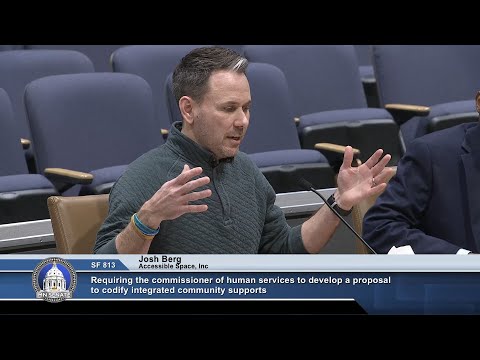
Josh Berg, who identified himself as representing ASI, said ICS was approved in waiver amendments effective Jan. 1, 2021, and that the program’s rules currently are spread across a 500‑page waiver amendment, DHS policy, memos and the CMS guidance manual. Berg told senators that DHS paused some application processing in early 2024 for regions it determined had high service capacity; he said providers interpret that pause as applying to Anoka, Dakota, Hennepin, Ramsey and Washington counties and that the department’s last published update for some metro region processing dates to Oct. 18, 2023.
The amendment before the committee would require DHS to publish, on a quarterly basis, (a) the number of approved ICS beds, (b) average utilization for those beds in the prior quarter, (c) the number of setting applications in review and (d) the average review wait time for the prior quarter. It would place a two‑year moratorium on submitting new setting applications, with exceptions similar to other statutory moratoriums, to allow DHS to process the existing backlog. The amendment also directs DHS to prepare a legislative proposal for how a temporary or provisional license process could operate so providers could obtain preliminary approval before incurring major facility costs.
Sponsors and testifiers gave multiple provider examples of how the backlog affects clients. Berg described one case in August 2024 where a person ready to leave an acute care setting could not move into an affordable accessible apartment because the provider’s ICS setting was at capacity and DHS would not prioritize a one‑unit capacity increase. Berg and Harout said the backlog and capacity limits force some people to remain in institutional care longer than they or their providers want.
Committee members expressed support for greater transparency but repeatedly said they did not want DHS to unilaterally draft final statutory language without stakeholder and legislative input. Several senators asked that legislators, advocates and providers participate in drafting any statute; one senator said the bill should be a starting point for a broader conversation rather than the final language.
Disposition: the chair laid Senate File 813, as amended, over for possible inclusion in the omnibus bill. The committee did not record a roll‑call vote in the hearing transcript but the motion to lay the bill over was announced and accepted on the record.