Get Full Government Meeting Transcripts, Videos, & Alerts Forever!
Get email alerts on the Utility Finance topic
No spam. Unsubscribe anytime.
Advisory working group reviews alternatives to put distribution upgrades off the electric bill; group authorized to study wider funding options
Summary
A state advisory working group reviewing how to fund distribution-grid upgrades heard progress on technical sessions, discussed alternatives that would move costs off utility bills, and voted to allow its scope to include funding mechanisms beyond traditional electric-sector charges.
The advisory board’s Focus Area Working Group on distribution infrastructure said it has held multiple deep-dive sessions to examine how distribution investments are put into rates and to evaluate financing options that could reduce upward pressure on electric bills.
The work group, which has run a webinar plus two in-depth meetings and plans further sessions led by Eversource, has been assessing rate-making basics, cost-recovery mechanisms used in Massachusetts and other jurisdictions, and non-traditional financing tools such as securitization, public–private partnerships, and state or federal revolving funds. Paul, a working-group presenter, said the group plans focused sessions later this month and next to finish phase 1 and begin developing phase 2 work products.
Why this matters: distribution-system investment is currently a minority share of a customer’s bill but is likely to grow faster than generation and transmission costs as electrification increases demand and two-way grid flows. The group framed its work around minimizing disproportionate impacts on electric ratepayers while preserving reliability and regulatory prudency overseen by the Department of Public Utilities (DPU).
The group catalogued two broad categories of options: mechanisms that still flow primarily through utility bills but change the financing structure (for example DPU-authorized securitization, special-purpose entities, or clean-energy tariff constructs) and approaches that raise revenues outside of bills (state revolving funds, federal greenhouse-gas‑reduction funding, bonds, or other public programs). Presenters said the choice among alternatives will require legal, regulatory and, in some cases, legislative changes and close coordination with the interagency rates work the Department of Energy Resources is leading.
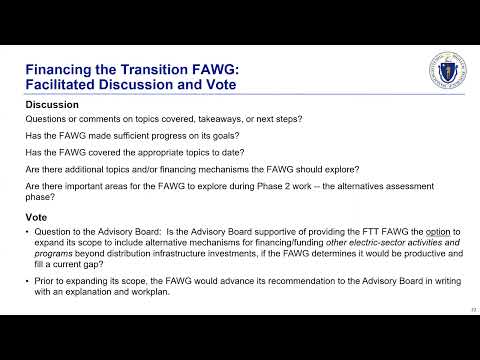
Discussion focused on scope and sequencing. Some members urged the working group to stay narrowly focused on distribution-level financing so its recommendations remain actionable; others argued that affordability concerns require considering a wider set of cost drivers and cross-cutting solutions. Shelby Sierra, speaking as a staff member, urged the group to preserve focus but to allow later application of solutions beyond the present scope.
Formal action: the advisory body held a voice vote to give the working group an explicit option to expand its scope to consider funding mechanisms beyond traditional electric-sector charges and programs limited to infrastructure investments. The motion carried on a voice vote; two members recorded opposition during the roll call (identified in the transcript as Dan and Vince). No abstentions were recorded in person.
The working group’s next steps include the Eversource-led session on revenue requirements, followed by February work to map the applicability and legal/regulatory needs for candidate financing structures, and a March advisory-board meeting to present recommendations and observations.
Ending: Members stressed the need to coordinate with related proceedings (DPU dockets on affordability and rate design, DOER’s interagency work on rates) and to focus on producing concrete, short-term deliverables that can guide policy or legislative action.